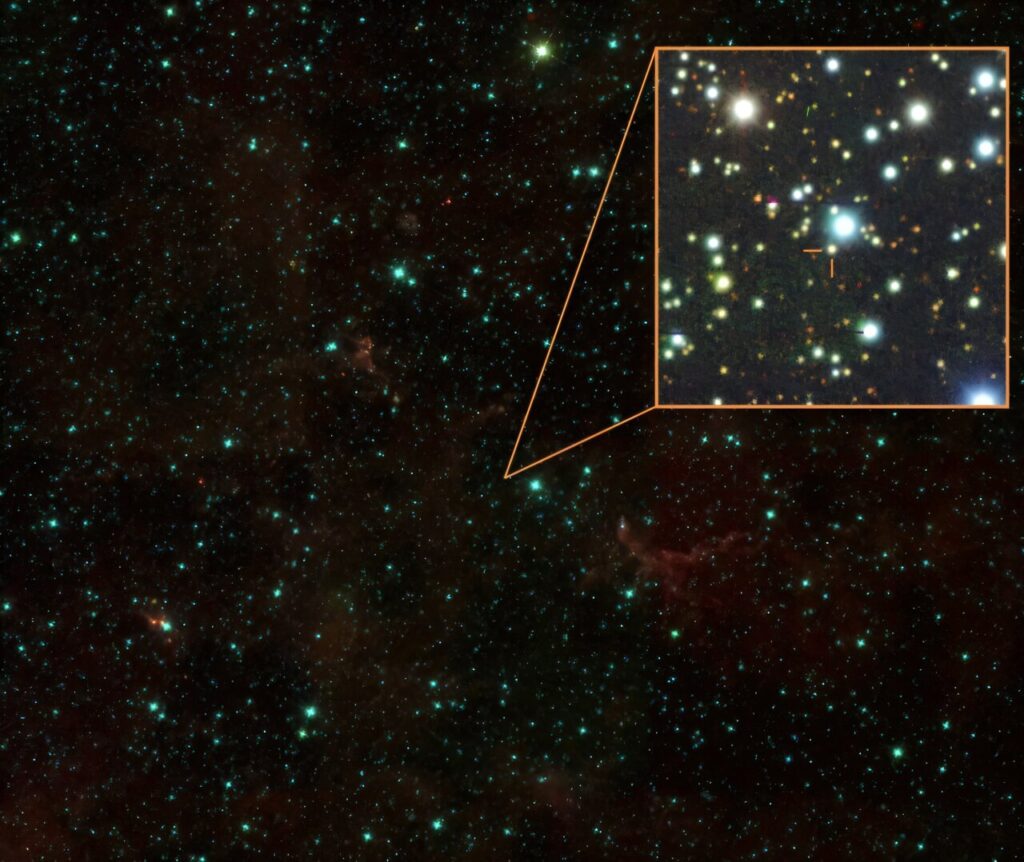
For years, the star known as Gaia20ehk was, by all accounts, unremarkable. Located roughly 11,000 light-years away near the constellation Puppis, it sat quietly in the cosmic distance as a stable main sequence star. Like our own sun, it was expected to emit a steady, predictable glow, a constant anchor in the vast dark of the University of Washington’s archival data.
But when doctoral candidate Anastasios “Andy” Tzanidakis began combing through telescope records from 2020, he realized the star’s “boring” reputation was a mask for something violent. Starting in 2016, the star’s light output, which should have been a flat line of consistency, began to stutter. It suffered three distinct dips in brightness, like a candle flickering in a draft. Then, in 2021, the signal went “completely bonkers.” The steady hum of the star vanished, replaced by a chaotic, wild fluctuation that defied the typical behavior of solar-type stars.
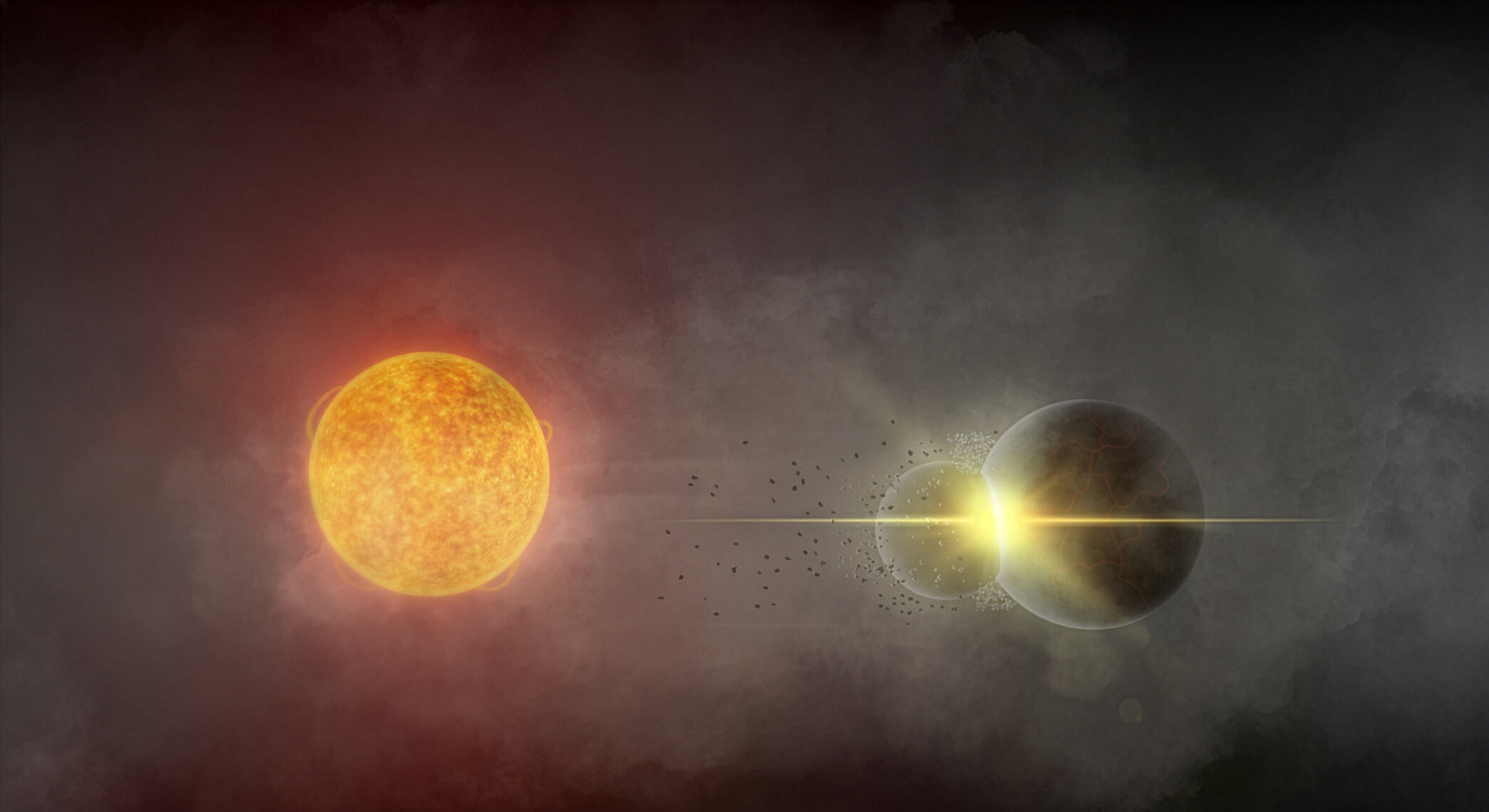
The mystery wasn’t found within the nuclear furnace of the star itself, but in the space surrounding it. Something massive and fragmented was passing between the star and Earth, patchily obscuring its light. As the researchers dug deeper, they realized they weren’t just looking at a flickering star; they were witnessing the immediate, messy aftermath of a catastrophic collision between two worlds.
A Ghostly Glow in the Dark
To solve the riddle of the flickering light, the team had to look beyond what the human eye could see. While the visible light from the star was dimming and jumping erratically, senior author James Davenport suggested a shift in perspective. They turned to infrared data, and the results were a revelation.
The infrared light curve was the perfect mirror image of the visible light. Just as the star appeared to fade to the naked eye, it began to scream in the infrared. This “spike” in heat-based energy provided the smoking gun: the material blocking the star wasn’t just cold space dust—it was hot, glowing debris.
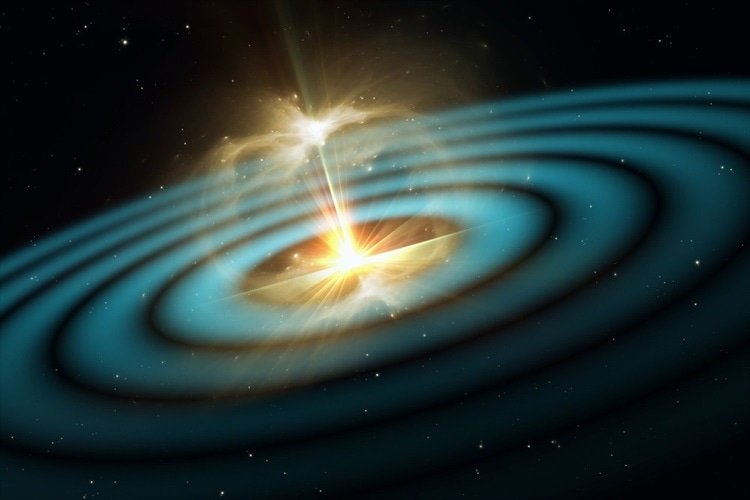
This heat was the thermal fingerprint of a cataclysmic impact. When two planets smash into one another, the kinetic energy is so immense that the resulting wreckage glows with intense heat. The initial, smaller dips in light identified by Tzanidakis likely represented the “death spiral” of the two worlds. Before the final, crushing blow, the planets may have experienced a series of grazing impacts, clipping one another and throwing off smaller clouds of debris that caused the early fluctuations. Then came the “big one,” a head-on strike that shattered the bodies and sent a massive, molten cloud of rocks and dust billowing into orbit.
The Echo of Our Own Creation
The wreckage orbiting Gaia20ehk isn’t just a celestial car crash; it is a mirror held up to our own history. The debris cloud is currently orbiting its host star at a distance of approximately one astronomical unit—the exact distance between the Earth and the Sun.
This specific placement is hauntingly familiar to astronomers. Roughly 4.5 billion years ago, our own solar system was a chaotic theater of war where planets routinely collided, exploded, or were ejected into the void. It was during this 100-million-year period of instability that a similar impact is believed to have occurred in our neighborhood, leading to the formation of the Earth-Moon system.
The hot, glowing material currently circling Gaia20ehk will eventually cool. Over the next few years—or perhaps several million—that dust may settle and solidify into a new planetary arrangement. Because this collision mirrors the one that birthed our world, observing it in real-time offers a rare laboratory to study how habitable environments are forged from chaos.
Hunting for the Ingredients of Life
While catching such an event requires immense luck and patience, the discovery at the University of Washington has turned a rare find into a call to action. New technology, specifically the Simonyi Survey Telescope at the Vera C. Rubin Observatory, is preparing to launch the Legacy Survey of Space and Time. Astronomers estimate this new tool could find as many as 100 new impacts over the next decade.
The urgency to find these collisions stems from a fundamental question in astrobiology: how rare is a world like ours? The Moon is often considered a “magical ingredient” for life. It creates the ocean tides and weather patterns that mix biological and chemical components globally; it acts as a shield against asteroids; and it may even help drive the tectonic plate activity that keeps a planet geologically alive.
By finding more of these planetary smash-ups, scientists can begin to calculate how often these “Goldilocks” collisions happen. Understanding the frequency of these violent births will ultimately help narrow the search for other habitable worlds in the galaxy, proving that sometimes, to understand the origin of life, you have to watch a world break apart.
Study Details
Anastasios Tzanidakis et al, Gaia-GIC-1: An Evolving Catastrophic Planetesimal Collision Candidate, The Astrophysical Journal Letters (2026). DOI: 10.3847/2041-8213/ae3ddc