For almost 100 million years, the heart of a distant galaxy lay quiet. At its center, a supermassive black hole sat in silence, no longer hurling matter outward, no longer carving glowing scars into space. Then, without warning, it woke up.
Astronomers have now captured one of the most vivid scenes ever recorded of this kind of cosmic rebirth. At the center of the radio galaxy J1007+3540, a black hole has reignited its powerful jets, sending streams of energized material tearing through its surroundings. The result looks less like a neat structure and more like a violent eruption, a phenomenon researchers have likened to a “cosmic volcano” spreading almost 1 million light-years across the universe.
What makes this moment extraordinary is not just the scale, but the timing. This black hole did not blaze continuously. It stopped, waited through vast stretches of cosmic time, and then began again. The newly released images reveal this story frozen in space, a layered record of activity, silence, and renewal.
A Galaxy Caught in the Act of Waking Up
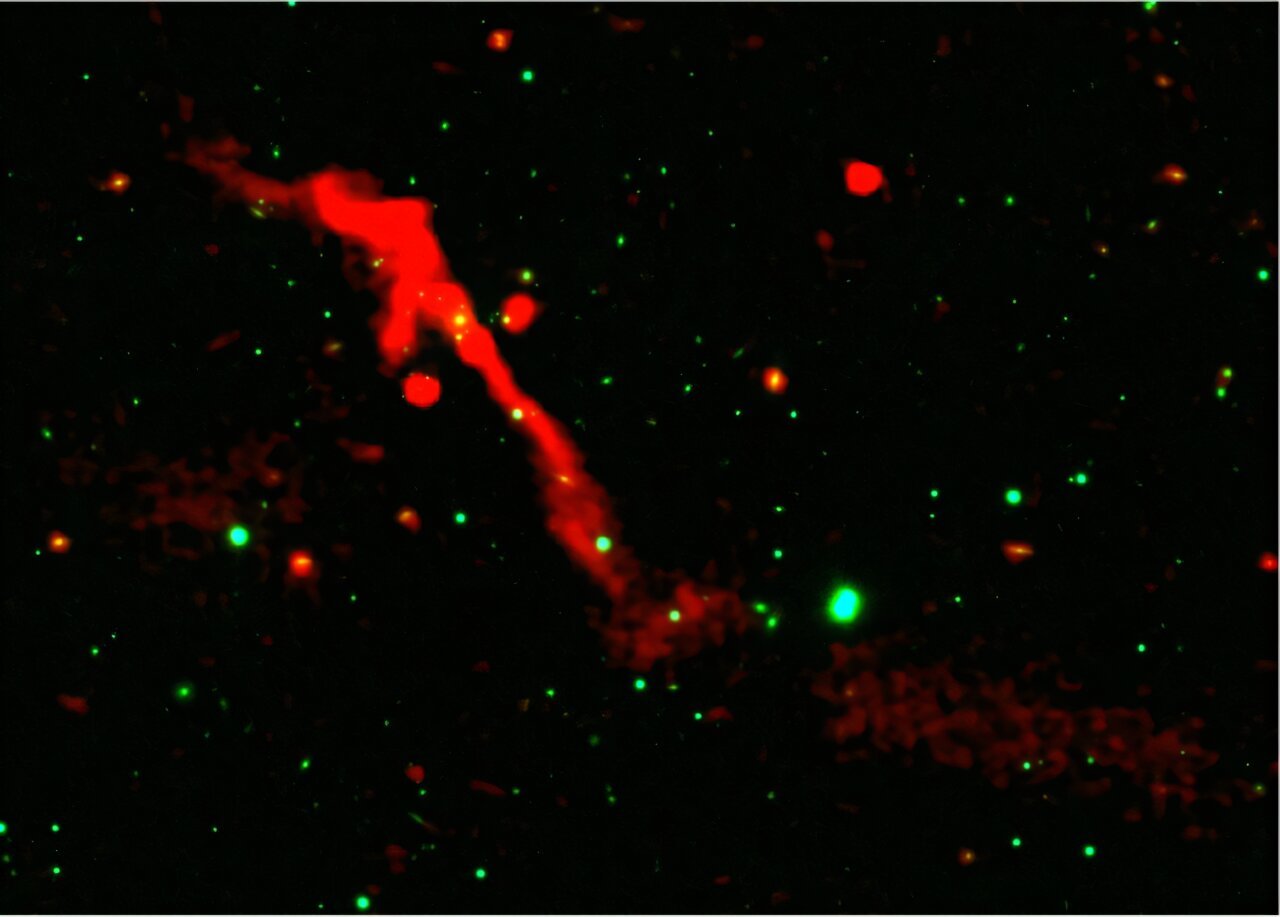
The discovery began with radio observations that revealed something strange at the center of J1007+3540. Nestled inside faint, ghostly structures was a compact, bright inner jet. To lead researcher Shobha Kumari of Midnapore City College in India, this was unmistakable.
The bright inner jet was the clear sign of a recent awakening. Surrounding it was something very different: a cocoon of older, faded plasma, the leftover debris from eruptions that happened long ago. These older structures were no longer energetic. They had been stretched, squeezed, and distorted over time, battered by the environment in which the galaxy lives.
“It’s like watching a cosmic volcano erupt again after ages of calm—except this one is big enough to carve out structures stretching nearly a million light-years across space,” Kumari said.
What astronomers were seeing was not a single event, but a sequence. The galaxy’s central engine had turned on, shut down, and turned on again. The new jets were now pushing their way through the remains of their own ancient outbursts, creating a dramatic layering that revealed the galaxy’s hidden history.
The Signature of an Engine That Refuses to Stay Quiet
Most galaxies are believed to host supermassive black holes, but only a small fraction produce enormous jets of radio-emitting magnetized plasma. Fewer still show clear evidence that these jets come and go in cycles. J1007+3540 does exactly that.
The radio images show young, energetic jets nested inside exhausted lobes from earlier eruptions. This configuration is the defining mark of what astronomers call an episodic AGN, a galaxy whose black hole repeatedly switches between active and quiet phases over cosmic timescales.
“This dramatic layering of young jets inside older, exhausted lobes is the signature of an episodic AGN—a galaxy whose central engine keeps turning on and off over cosmic timescales,” Kumari explained.
The galaxy does not erase its past when it wakes up again. Instead, each new eruption builds on what came before, pushing through old plasma and reshaping it. The result is a complex, chaotic structure that preserves a record of multiple lives lived by the same black hole.
Trapped Inside a Hostile Cosmic Environment
The story of J1007+3540 is not just about the black hole itself. It is also about where the galaxy lives.
This radio galaxy sits inside a massive galaxy cluster filled with extremely hot gas. Compared to the relatively open space around many radio galaxies, this environment is crushing. The pressure here is enormous, and it plays a powerful role in shaping everything the black hole tries to create.
“J1007+3540 is one of the clearest and most spectacular examples of episodic AGN with jet-cluster interaction, where the surrounding hot gas bends, compresses, and distorts the jets,” said Dr. Sabyasachi Pal, a co-author of the study.
As the revived jets push outward, they do not travel freely. Instead, they collide with dense, hot material that bends them, squeezes them, and forces them into distorted paths. The black hole is powerful, but it is not alone, and the environment pushes back.
Jets Bent, Squeezed, and Broken
The details of this struggle were revealed through observations made with two highly sensitive radio interferometers: the Low Frequency Array (LOFAR) in the Netherlands and India’s upgraded Giant Metrewave Radio Telescope (uGMRT). The images were later published in Monthly Notices of the Royal Astronomical Society.
LOFAR’s view shows that the galaxy’s northern lobe has been compressed and dramatically distorted. Instead of expanding symmetrically, it curves and twists, forming what researchers describe as a curved backflow signature. This suggests the plasma is being shoved sideways by the pressure of the surrounding cluster gas.
The uGMRT image adds another layer to the story. In the same compressed region, astronomers found an ultra-steep radio spectrum. This means the particles there are extremely old and have lost much of their energy, a clear sign that the cluster environment has been harsh and unforgiving.
Together, these clues show that the black hole’s past eruptions did not fade away quietly. They were reshaped, aged, and scarred by the environment, turning the galaxy into a living laboratory for studying how jets evolve under pressure.
A Faint Trail That Tells a Long Story
Beyond the distorted lobes lies something even more haunting. Stretching far to the southwest is a long, faint tail of diffuse radio emission. It is wispy and delicate, yet it spans an enormous distance, telling a story that unfolded over millions of years.
This tail suggests that magnetized plasma is being dragged through the cluster environment, leaving behind a trail of ancient material. It implies motion, interaction, and time. The galaxy is not only producing jets, but also moving through a powerful medium that sculpts and stretches everything it touches.
The researchers say this feature shows that J1007+3540 is being shaped as much by its surroundings as by its own central engine. The black hole may ignite the jets, but the cluster decides how they survive.
A Violent Dance Between Power and Pressure
Taken together, the images reveal a galaxy locked in a chaotic struggle. The black hole erupts, sending jets outward with immense force. The cluster responds, bending and compressing those jets, aging them prematurely, and dragging their remains into long, ghostly trails.
This is not a calm or orderly process. It is a battle, played out over tens and hundreds of millions of years, between explosive energy and overwhelming pressure. Each eruption leaves behind scars that shape the next one, creating a layered, turbulent history written across nearly a million light-years of space.
Why This Research Matters
Galaxies like J1007+3540 are rare, and that rarity makes them invaluable. They allow astronomers to see, in a single system, how black holes switch between active and quiet phases, how radio jets evolve over millions of years, and how dense cluster environments reshape entire galaxies.
This research shows that galaxy growth is not smooth or gentle. It is episodic and violent, driven by cycles of awakening and dormancy. The images of J1007+3540 reveal that black holes can restart after immense periods of silence, and that when they do, they must fight their way through environments that can bend, distort, and even suffocate their jets.
By studying this galaxy, scientists gain rare insight into how repeated eruptions transform a galaxy’s surroundings over cosmic time. The system demonstrates that a galaxy’s fate is shaped not only by the power of its central black hole, but also by the immense pressure of the cosmic neighborhoods it inhabits.
The research team now plans to probe even deeper into the core of J1007+3540, tracking how the restarted jets propagate through this hostile environment. Each new observation brings astronomers closer to understanding how galaxies grow, shut down, and awaken again, and how the universe itself leaves its fingerprints on everything that tries to break free from a black hole’s grasp.
Study Details
Shobha Kumari, et al. Probing AGN duty cycle and cluster-driven morphology in a giant episodic radio galaxy, Monthly Notices of the Royal Astronomical Society (2026). DOI: 10.1093/mnras/staf2038