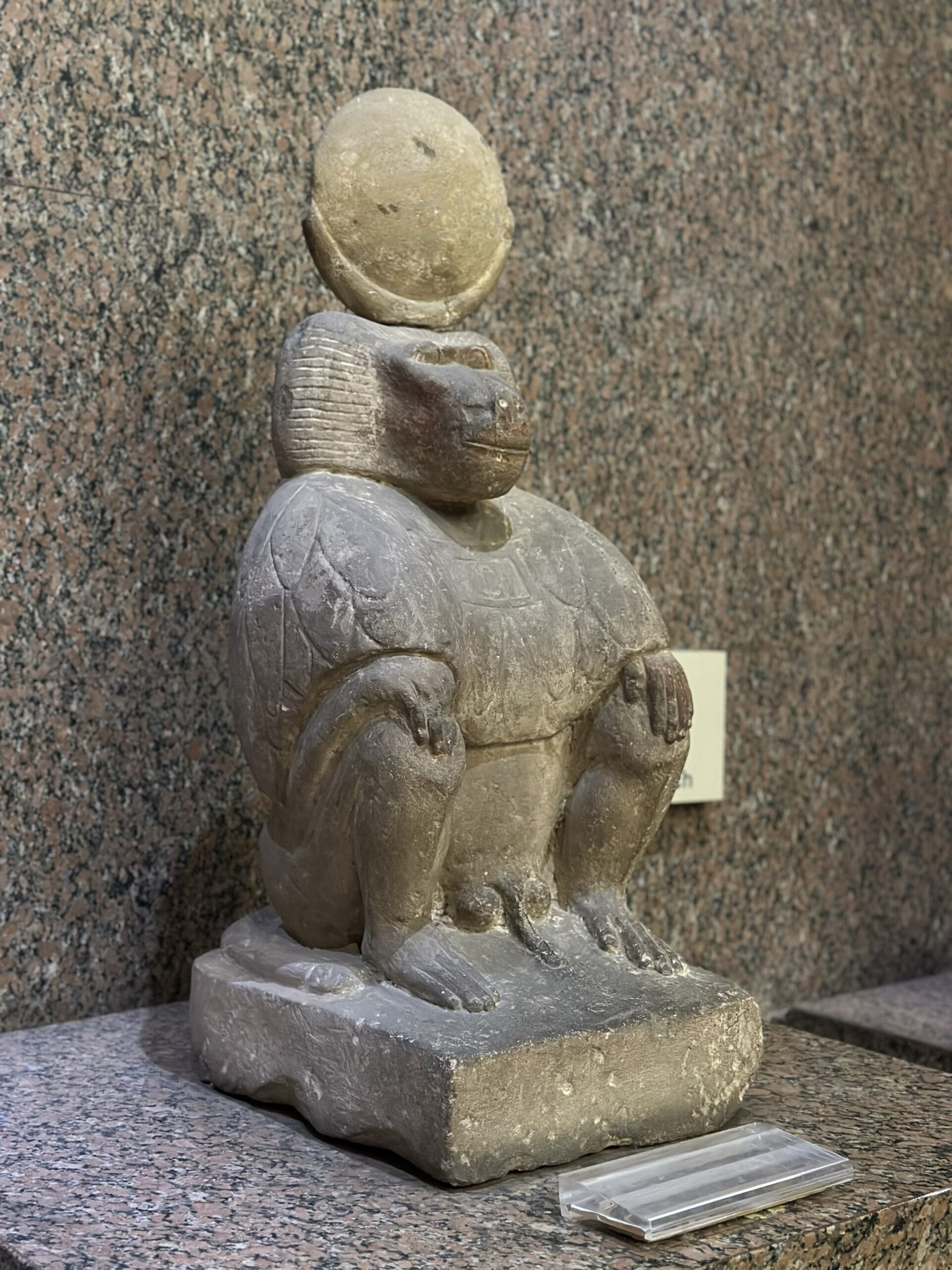
A new study argues that one of ancient Egypt’s most enduring religious mysteries may have a surprisingly measurable explanation. By comparing the spectral properties of moonlight with the fur of baboons and the plumage of sacred ibises, researchers found that the sacred baboon’s silvery-gray coat—and the ibis’s brilliant white feathers—closely match the color profile of moonlight, supporting the idea that these animals became embodiments of the moon god Thoth because they visually resembled lunar light.
For thousands of years, the ancient Egyptian god Thoth embodied wisdom, writing, magic, cosmic order, and the Moon. Yet one question has long puzzled archaeologists and historians alike: why was Thoth represented by two very different animals—a sacred ibis and a sacred baboon?
The ibis has often seemed the easier of the two to explain. Its long, curved bill resembles a crescent moon, while its striking black-and-white plumage has been interpreted as echoing phases of the lunar cycle. The baboon, however, has remained an enigma. Unlike many sacred animals in the Egyptian pantheon, baboons were not native to Egypt during the Holocene. Although imported baboons were kept, mummified, and buried in large numbers, only one species—the sacred baboon (Papio hamadryas)—became an official manifestation of Thoth, despite another imported species, the olive baboon (Papio anubis), also being available.
A new study suggests the answer may have been visible all along—in the color of the animals themselves.
Testing an ancient idea with modern spectroscopy
The research, led by Nathaniel J. Dominy of Dartmouth College and Catherine Hobaiter of the University of St Andrews, builds upon recent scholarship proposing that Thoth’s ancient Egyptian name is linguistically connected to concepts meaning “white,” “bright,” or lunar luminosity. If Thoth’s very name was associated with brightness and moonlight, the researchers wondered whether his animal forms were chosen because they physically resembled the Moon.
Rather than relying on visual impressions alone, they turned to spectroscopy—a technique that measures how light is reflected across different wavelengths.
The researchers compared published measurements of moonlight with new reflectance measurements taken from museum specimens of the two baboon species known to ancient Egyptians and from sacred ibises. Hair and feather samples came from specimens housed in the American Museum of Natural History in New York.
The team analyzed visible-light reflectance using a spectrometer at standardized locations on each specimen. For the baboons, they examined hair from multiple parts of the body, while ibis measurements focused on chest plumage. The moonlight spectrum used for comparison had previously been recorded under well-documented lunar conditions and closely matches other independent measurements of lunar irradiance.
A striking match between moonlight and sacred baboons
Moonlight is not generated by the Moon itself. Instead, the Moon reflects sunlight, producing a spectrum that is broadly similar to sunlight but vastly dimmer. Within visible wavelengths, moonlight exhibits a relatively smooth spectrum that peaks between approximately 600 and 700 nanometers.
The researchers discovered that the sacred baboon’s fur displays a remarkably similar reflectance profile.
Hair from Papio hamadryas reflected about 65 percent more light than hair from the olive baboon. More importantly, its spectral shape closely mirrored the spectrum of moonlight, with both peaking within the same visible wavelength range.
By contrast, the olive baboon showed a distinctly different reflectance curve. Its spectrum featured a broad peak at shorter wavelengths before declining, corresponding to the olive-green coloration reflected in its common name.
To human observers, the sacred baboon’s spectral profile corresponds to gray or silvery hues, while the olive baboon appears noticeably greener.
The researchers argue that this difference may explain why ancient Egyptians selected only one of these imported species as Thoth’s living embodiment.
The brightest features belonged to mature males
The study also highlights an especially distinctive feature of male sacred baboons.
Adult males develop dramatic secondary sexual characteristics, including long silver-gray shoulder mantles, white cheek ruffs, and dense facial hair. Females and juveniles lack these striking ornaments and instead possess shorter, darker olive-brown coats.
When the researchers measured these bright male features, they found extraordinarily high reflectivity.
Although reflectance varied between individual hairs—partly because each hair naturally contains alternating gray bands and partly because measurements sampled extremely small areas—the overall pattern remained consistent. Mature males possessed exceptionally bright silver-white fur across their shoulders and cheeks.
According to the study, the average reflectivity of these regions exceeded that reported for other monkey species familiar to ancient Egyptians by roughly a factor of two. At their brightest, some measurements even surpassed those recorded for golden lion tamarins, monkeys previously recognized for unusually luminous fur.
The researchers suggest that this combination of silver coloration and exceptional brightness may have made mature male sacred baboons especially suitable as visual symbols of the Moon and, by extension, Thoth himself.
The ibis tells the same story
The findings did not stop with baboons.
Measurements of sacred ibis plumage revealed another close correspondence with moonlight.
Earlier interpretations emphasized the bird’s crescent-shaped bill or the contrast between its black and white feathers. More recent linguistic research proposed that the bird’s brilliant white plumage may have been equally important.
The new spectroscopic measurements support that possibility.
According to the researchers, the reflectance spectrum of sacred ibis plumage is likewise indistinguishable from the spectral profile of moonlight, strengthening the case that both of Thoth’s sacred animals shared a common visual characteristic rather than representing unrelated symbolic traditions.
If correct, this would mean that color—not merely shape or mythology—linked the ibis and the baboon within ancient Egyptian religious thought.
Ancient Egyptians distinguished between similar species
The study argues that these similarities were unlikely to have been accidental.
Ancient Egyptian artists demonstrated remarkable attention to zoological detail. They routinely distinguished between closely related animal species in their artwork, including two species of baboons and multiple species of ibises.
This suggests that Egyptians deliberately selected Papio hamadryas rather than simply depicting any baboon available to them.
The archaeological record reinforces that choice. Although remains of both olive and sacred baboons have been recovered from temples, tombs, and animal necropolises, only the sacred baboon acquired the religious role of manifesting Thoth.
The researchers argue that the species’ moonlike coloration offers a plausible explanation for this otherwise puzzling preference.
Ancient texts hint at another lunar connection
Color may not have been the only factor linking sacred baboons with the Moon.
The authors revisit historical accounts describing unusual baboon behavior during lunar conjunctions.
One of the best-known descriptions appears in the fifth-century work Hieroglyphica, attributed to Horapollo. It recounts that male sacred baboons supposedly refused food, lowered their heads, and appeared distressed when the Moon disappeared during conjunction with the Sun.
Whether literally accurate or not, the account reflects a long-standing association between baboons and celestial events.
The researchers note that archaeological evidence indicates sacred baboons were maintained in captivity for decades within Egyptian temple complexes. Written records document named animals that lived under human care before eventually being mummified.
Temple keepers therefore had ample opportunity to observe baboon behavior closely.
Modern observations provide an intriguing point of comparison. Studies of captive sacred baboons during solar eclipses have documented abrupt behavioral changes, including increased vigilance, huddling, reductions in normal activities, and occasional vocalizations. Contemporary observers interpreted these responses as signs of anxiety, echoing aspects of the ancient descriptions.
The new paper does not present these behaviors as proof of religious beliefs. Instead, it suggests they may have reinforced an already powerful visual association between baboons and lunar phenomena.
A possible explanation for another Egyptian mystery
The authors also discuss another curious aspect of Egyptian symbolism.
Canopic jars associated with Hapi, the divine protector of the lungs, frequently carried baboon-headed stoppers.
Ancient Egyptians understood the importance of the lungs and trachea in producing speech. Because baboons occupied a special place in Egyptian thought as creatures possessing mysterious, sacred vocalizations associated with divine knowledge, the researchers suggest they may also have become appropriate guardians of the organs required for speech in the afterlife.
This proposal remains interpretive, but the authors argue it fits broader Egyptian ideas linking baboons, language, and Thoth, the deity credited with giving writing and speech to humanity.
Interpreting symbolism through measurable evidence
The study does not claim that spectroscopy alone can reveal why ancient Egyptians worshipped particular animals.
Religious symbolism is inherently complex, and the researchers acknowledge that many zoomorphic associations in Egyptian religion remain difficult to explain. While some deities have obvious animal counterparts—such as Anubis’ association with canids or Hathor’s with cattle—others have resisted convincing explanation for generations.
Instead, the authors argue that their measurements provide objective physical evidence supporting a linguistic and archaeological hypothesis already proposed by earlier scholarship.
By demonstrating that both sacred ibises and sacred baboons possess coloration closely matching the spectral properties of moonlight, the research strengthens the idea that visual resemblance played an important role in the religious elevation of both species.
Rather than viewing Thoth’s two animal forms as unrelated symbols, the findings suggest they may have shared a single underlying characteristic: bodies that reflected light in ways ancient observers could have associated with the Moon itself.
Although questions about Egyptian religion can never be answered with complete certainty, the researchers conclude that the moonlike brightness of these animals offers a compelling explanation for one of the oldest symbolic mysteries in the ancient world.
More information
Nathaniel J. Dominy et al, Moonlight and the apotheosis of sacred baboons, Time and Mind (2026). DOI: 10.1080/1751696x.2026.2696260