Scientists have identified what appears to be a miniature version of Earth’s Dungey cycle operating above Mars’ localized crustal magnetic fields, revealing a previously unrecognized system of magnetic reconnection, plasma circulation, and electron acceleration that powers some of the Red Planet’s brightest discrete auroras. The findings suggest that despite lacking a global magnetic field, Mars can generate an Earth-like magnetic cycle on much smaller scales, expanding scientists’ understanding of how planets interact with the solar wind.
For decades, Earth’s shimmering polar auroras have been understood as visible signatures of a vast magnetic engine driven by interactions between the solar wind and the planet’s global magnetic field. That engine, known as the Dungey cycle, continuously opens and reconnects magnetic field lines, circulating plasma throughout Earth’s magnetosphere while accelerating electrons that crash into the upper atmosphere and produce the familiar northern and southern lights.
Mars, however, has always posed a puzzle.
Unlike Earth, the Red Planet no longer possesses a strong global magnetic field. Instead, only scattered patches of ancient magnetized crust remain, concentrated primarily in the southern hemisphere. These isolated magnetic regions create an intricate magnetic environment where auroras appear in unexpected places and under changing solar wind conditions.
Now, researchers analyzing observations from NASA’s Mars Atmosphere and Volatile EvolutioN (MAVEN) mission report evidence that these localized magnetic patches can generate their own scaled-down version of Earth’s magnetic circulation system. Rather than requiring a planet-wide magnetic shield, the newly identified process operates within miniature magnetic structures only a fraction of Earth’s size.
The discovery introduces what the researchers describe as a “miniature Dungey-like cycle” at Mars—a mechanism that links magnetic reconnection, plasma motion, electric currents, electron acceleration, and auroral emissions into one coherent physical framework.
A familiar process in an unfamiliar world
Auroras form when energetic charged particles collide with atmospheric atoms and molecules.
At Earth, these particles are accelerated during magnetic disturbances triggered when the interplanetary magnetic field carried by the solar wind reconnects with Earth’s own magnetic field. This reconnection repeatedly changes magnetic field lines from closed loops attached to Earth into open lines connected to the solar wind before reconnecting them again farther downstream. The continuous circulation of magnetic flux and plasma is known as the Dungey cycle.
Mars presents a far more complicated environment.
Instead of a global dipole magnetic field, the planet retains only localized crustal magnetic fields left over from an ancient magnetic dynamo. These patches rotate with the planet while interacting with the solar wind, producing an induced magnetosphere that is considerably more complex than scientists once believed.
Previous observations had already shown that Martian discrete auroras tend to occur over the strongest crustal magnetic regions, particularly when the orientation of the interplanetary magnetic field favors magnetic reconnection. Those studies suggested reconnection was important but could not fully explain how electrons gained enough energy to produce the observed auroras.
The new work sought to connect all of the major ingredients into one physical picture.
A rare set of observations
The researchers focused on detailed MAVEN measurements collected on February 25, 2017, during a pass over one of Mars’ strongest crustal magnetic regions near the dusk terminator.
The spacecraft simultaneously measured energetic electrons, magnetic fields, and ion flows while flying through the region.
The electron observations revealed two intervals containing substantially enhanced high-energy electrons. Their energy distributions indicated that the particles had experienced field-aligned acceleration similar to the processes responsible for Earth’s discrete auroras.
Using an empirical relationship between electron energy flux and ultraviolet auroral brightness, the team estimated that these electrons could generate carbon monoxide Cameron-band auroral emissions reaching roughly 10 kiloRayleighs—comparable to some of the brightest auroras previously observed by MAVEN’s Imaging UltraViolet Spectrograph.
The spacecraft’s ultraviolet instrument had observed auroral emissions during nearly the same period, although not directly above the electron measurements because the observations sampled different locations. The researchers concluded that the measured electron populations nevertheless carried sufficient energy to generate observable auroras.
Following the magnetic currents
The electron measurements alone did not reveal the full story.
By examining subtle deviations in the measured magnetic field relative to Mars’ crustal magnetic field model, the researchers inferred the presence of field-aligned currents—electric currents flowing along magnetic field lines between the magnetosphere and the ionosphere.
These currents displayed a distinctive arrangement.
Regions of upward current, where electrons travel downward toward the atmosphere, were consistently bracketed by regions of downward current. Importantly, the accelerated electrons appeared primarily where upward currents were present.
Independent calculations showed that the electron currents closely matched the magnetic field-derived current estimates during the upward-current intervals. According to the researchers, this agreement supports the idea that accelerated electrons themselves carry much of the required current toward the atmosphere.
The measurements also revealed something that had proven particularly difficult to observe previously: horizontal ionospheric plasma flows.
Both molecular oxygen ions and atomic oxygen ions exhibited prominent east-west motion, including a reversal in flow direction during one interval. These plasma movements provided the missing observational component needed to connect previous studies into a complete circulation system.
Building a miniature magnetic cycle
Combining all of the observations allowed the researchers to reconstruct the sequence of events.
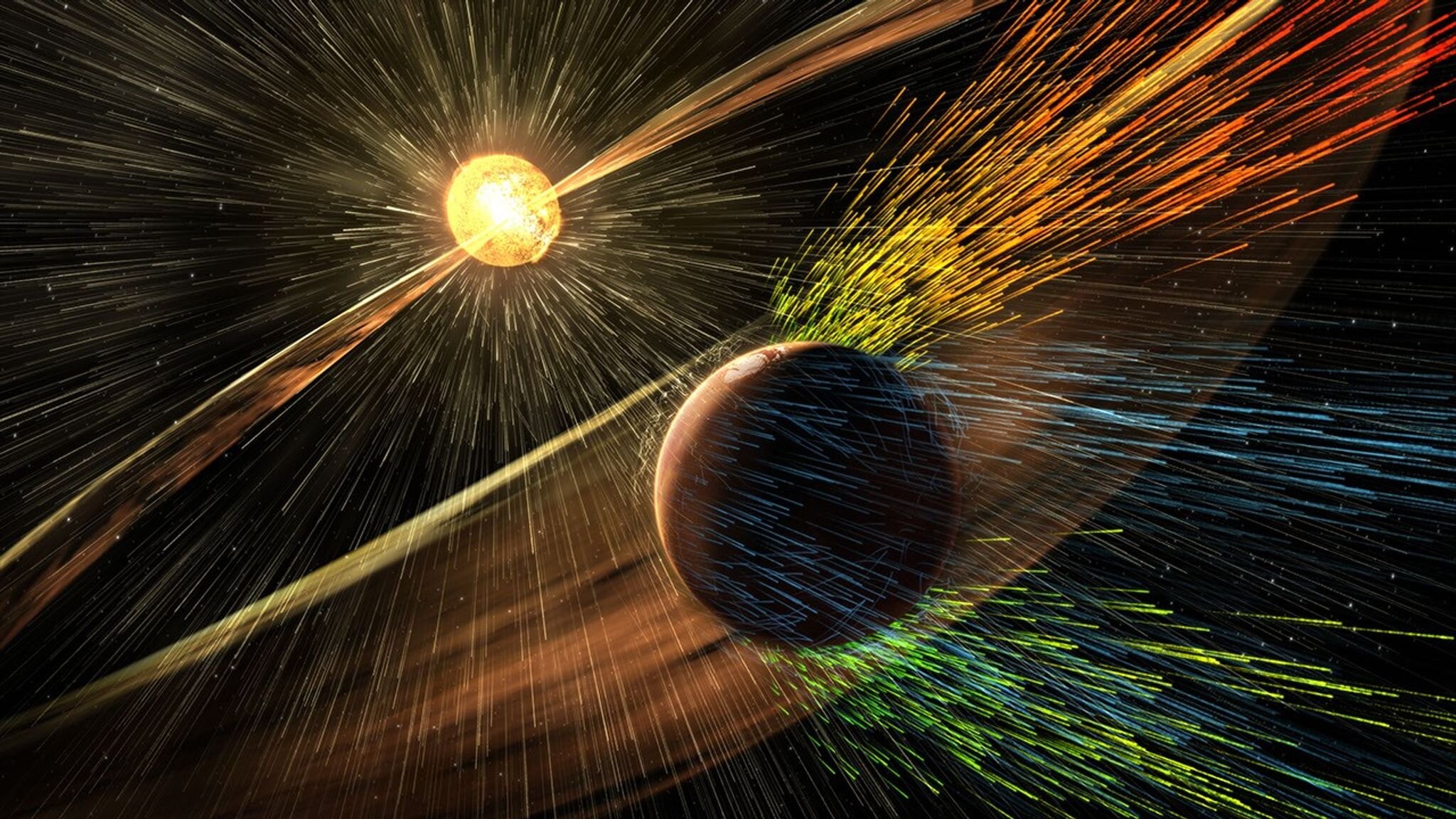
The proposed cycle begins when the solar wind’s magnetic field reconnects with one of Mars’ crustal magnetic loops under favorable magnetic orientations.
That first reconnection converts previously closed crustal magnetic field lines into open field lines connected to interplanetary space.
As the solar wind carries these open field lines farther downstream, they reconnect again with oppositely directed magnetic field lines. This second reconnection creates newly closed magnetic loops that relax back toward Mars, completing the circulation.
The movement of these magnetic field lines also drives plasma circulation in the ionosphere.
According to the proposed model, plasma rotates clockwise around one crustal magnetic patch and counterclockwise around a neighboring patch. The resulting electric fields establish cross-field currents that close through field-aligned currents extending between the ionosphere and the magnetosphere.
When the available electron population cannot naturally carry enough current, strong electric fields develop along magnetic field lines. These electric fields accelerate electrons downward into the atmosphere, producing the nearly monoenergetic electron populations observed by MAVEN and ultimately generating discrete auroras.
The researchers found that every major observational signature from the spacecraft—the arrangement of field-aligned currents, the accelerated electrons, and the measured plasma flows—fit consistently within this proposed circulation pattern.
More than a single event
To determine whether the phenomenon represented an isolated occurrence, the team searched for additional examples.
They identified six more events displaying similar combinations of magnetic currents, plasma flows, and accelerated electrons.
These cases occurred at different geographic locations and times, while two events were observed at nearly identical locations despite being separated by 11 days.
Most appeared over strong southern crustal magnetic fields during post-dusk conditions, although one event occurred before dawn over crustal fields with opposite polarity.
Taken together, the observations suggest that the miniature Dungey-like cycle operates repeatedly across Mars as the planet rotates and as solar wind conditions evolve.
Earth-like physics on a much smaller scale
Although the Martian process resembles Earth’s Dungey cycle, its dimensions are dramatically reduced.
Based on the observations, the researchers estimate that the second magnetic reconnection occurs only a few Martian radii downstream rather than roughly 15 Earth radii as on Earth.
Assuming downstream plasma speeds near 100 kilometers per second, the complete Martian cycle likely takes on the order of one minute, compared with approximately one hour for Earth’s large-scale cycle.
The ionospheric plasma itself moves at around 2 kilometers per second, producing electric fields of roughly 0.5 millivolts per meter.
The entire current system spans only about 200 kilometers across, with an estimated electrical potential of approximately 50 volts between current regions. By comparison, Earth’s quiet-time polar cap potentials reach tens of thousands of volts.
Using measured plasma properties, the researchers estimated that the resulting current densities matched those inferred from the magnetic observations. They further calculated that the local energy dissipation associated with the cycle reaches approximately one million watts.
Connecting decades of Martian aurora research
One of the study’s most significant contributions is not simply identifying a new process but providing a unified explanation for several previously disconnected observations.
Earlier investigations had separately documented magnetic reconnection, field-aligned currents, electron acceleration, and discrete auroral emissions at Mars. Direct evidence for ionospheric plasma circulation, however, had remained elusive because measuring those slow ion flows pushed the capabilities of the spacecraft’s instruments.
By observing plasma motion alongside the other phenomena, the new study links all five elements into a single physical framework.
The authors argue that this framework can explain earlier observations of Martian discrete auroras and should apply broadly wherever strong crustal magnetic fields interact with the solar wind under favorable magnetic conditions.
Not all Martian auroras are the same
The researchers also distinguish their proposed mechanism from other types of auroral activity observed at Mars.
The Emirates Mars Mission’s ultraviolet spectrometer has detected a wider variety of auroras, including emissions above regions with weak magnetic fields. Because that instrument is more sensitive than MAVEN’s ultraviolet spectrograph, it can detect much fainter emissions produced by ordinary solar wind electrons or ionospheric photoelectrons.
By contrast, the brighter auroras typically observed by MAVEN are concentrated over stronger crustal magnetic fields and appear to require much more energetic electron populations.
The authors suggest that these more intense auroras are the ones most likely generated by field-aligned electron acceleration associated with the miniature Dungey-like cycle.
A new category of planetary magnetic behavior
The researchers place the newly identified Martian process alongside two previously recognized large-scale magnetic circulation systems in the Solar System.
Earth and Mercury are dominated by the classic Dungey cycle, while Jupiter and Saturn primarily exhibit the Vasyliunas cycle, driven by internally supplied plasma and rapid planetary rotation.
Mars now appears to represent a third category.
Its localized crustal magnetic fields create miniature magnetic engines that resemble Earth’s circulation mechanism despite lacking a global magnetic field. Only half of each crustal magnetic “dipole” is exposed above the surface, yet that appears sufficient to establish repeated cycles of magnetic reconnection, plasma circulation, current closure, electron acceleration, and auroral production.
The researchers conclude that this miniature Dungey-like cycle broadens understanding of the diversity of planetary plasma environments throughout the Solar System and may improve the interpretation of auroral observations as remote probes of planetary magnetic fields. They also note that the process should continue operating regularly over Mars’ numerous crustal magnetic regions as the planet rotates beneath changing interplanetary magnetic field conditions.
Publication details
Shaosui Xu et al, Miniature Dungey-like cycle at Mars, Nature Communications (2026). DOI: 10.1038/s41467-026-75019-3