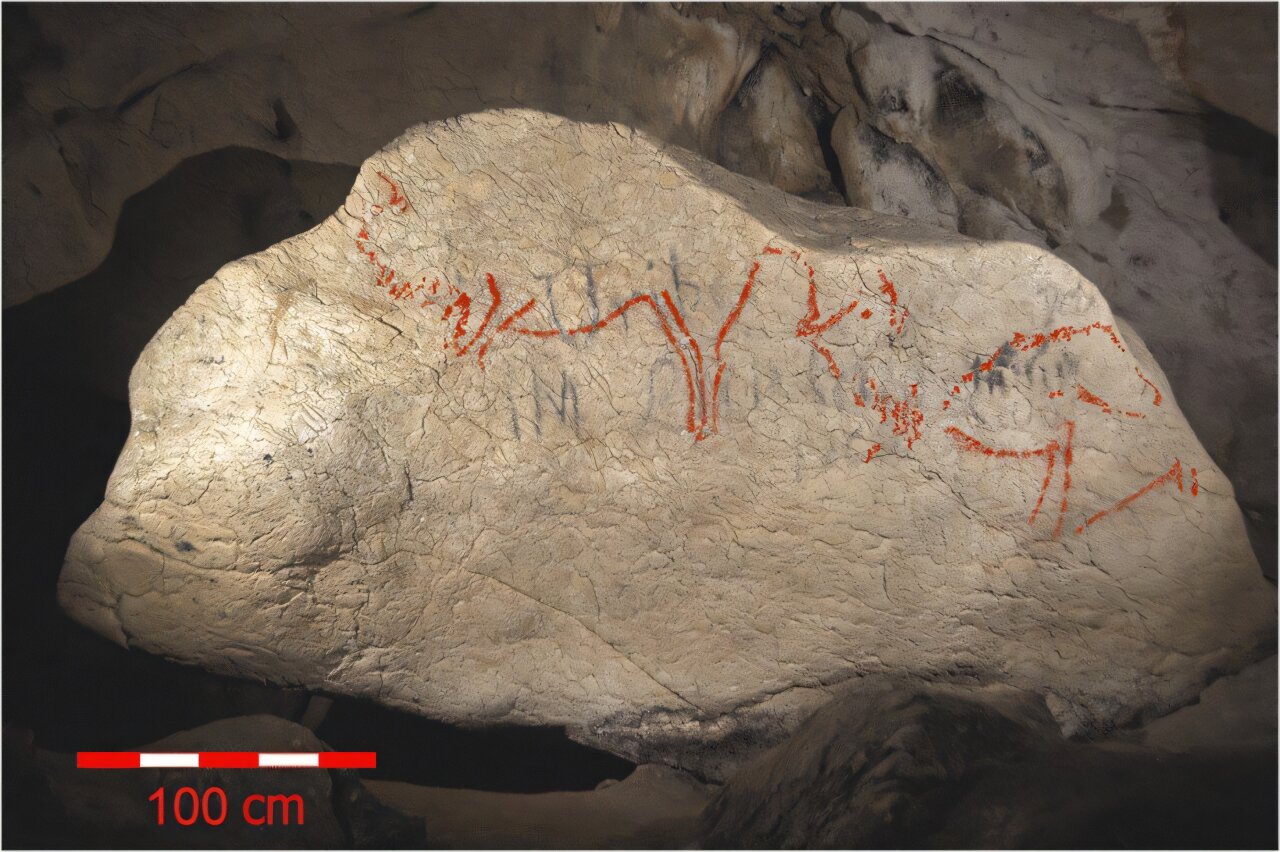
Ancient cave paintings across southwestern Europe may have been created according to a surprisingly consistent visual framework rather than as isolated works of art. By analyzing hundreds of Ice Age images with network science, researchers found recurring relationships between animals, symbols, and their placement, revealing evidence of an organized graphic system that persisted across multiple caves during the Magdalenian period.
For more than a century, archaeologists have debated whether Europe’s famous Paleolithic cave paintings represent carefully organized symbolic systems or simply the gradual accumulation of images added over generations.
A new analysis of Magdalenian cave art from the Bay of Biscay region suggests the paintings were far from random. Instead, the study found recurring patterns in which particular animals repeatedly appeared together, occupied similar positions within compositions, and even tended to face particular directions.
Rather than attempting to decode the meaning of the images, the research focused on something more measurable: the way motifs were organized. The findings point to a consistent internal structure that may have guided how prehistoric artists created cave art roughly 18,500 to 14,000 years ago.
Looking for patterns instead of meanings
Interpreting the symbolic meaning of Paleolithic art has always been difficult because the societies that produced the images disappeared thousands of years ago. Without written records or direct cultural continuity, proposed explanations often remain speculative.
Instead of asking what the paintings meant, the researcher asked whether they followed recurring organizational rules.
The study treated cave art as a visual communication system whose structure could be examined independently of any symbolic interpretation. Similar approaches are commonly used in linguistics, where relationships between words reveal underlying grammatical patterns without requiring knowledge of meaning.
Hundreds of cave images became a giant network
The research analyzed more than 500 graphic motifs documented in nine decorated caves located across the Basque region of northern Spain and southwestern France.
The dataset included depictions of animals, humans, abstract signs, and other motifs preserved within Magdalenian cave art. Together, these images represent nearly 68% of the known animal and human figures from the region.
Each cave had previously undergone extensive documentation using laser scanning, photogrammetry, geographic mapping, and three-dimensional modeling. Researchers also evaluated how erosion, sediment movement, and other geological processes might have altered the original artwork over thousands of years before including the images in the analysis.
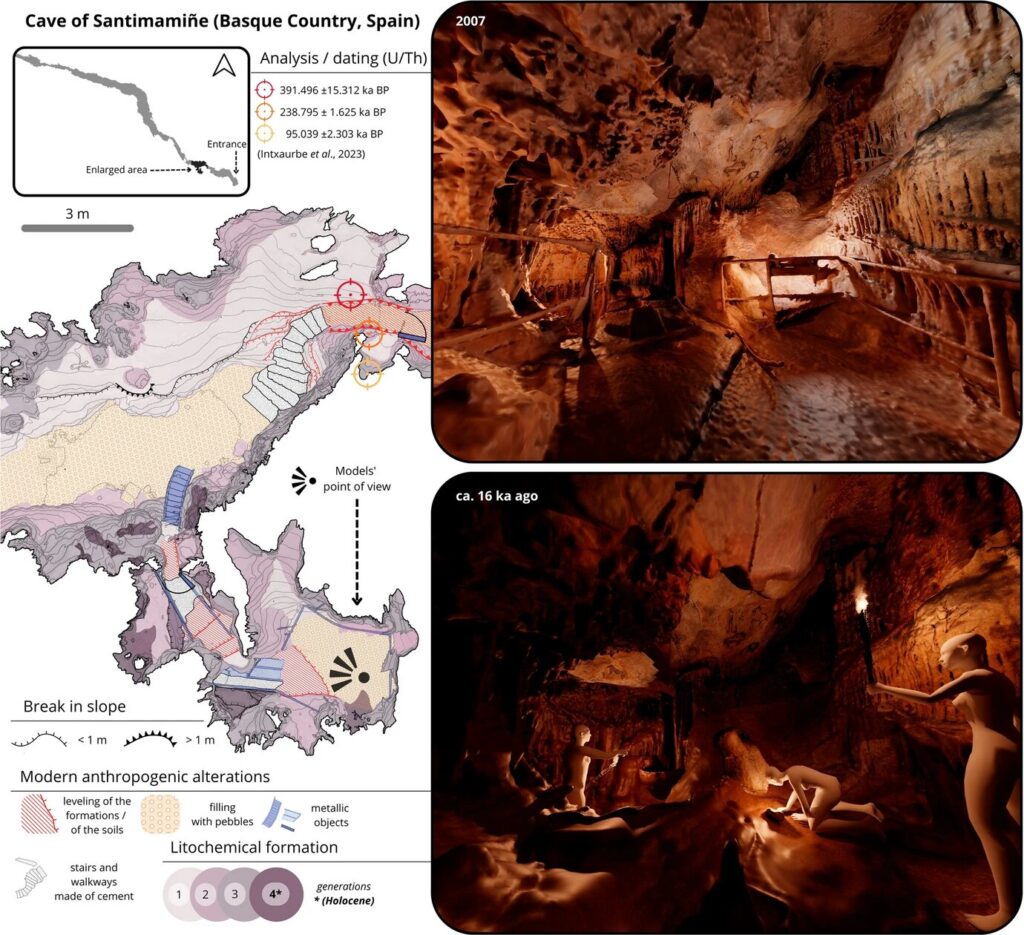
Instead of studying individual drawings in isolation, the researcher examined each decorated panel as a complete composition. Whenever two themes appeared together on the same panel, they formed a connection within a network. Repeating this process across hundreds of panels produced an extensive map of relationships among different motifs.
The analysis also used multiple statistical techniques—including co-occurrence networks, minimum spanning trees, and bipartite network models—to test whether the observed patterns remained stable under different analytical approaches.
Three large animals consistently formed the heart of the system
Across nearly every analytical method, one result remained remarkably consistent.
Bison, horses, and ibex repeatedly occupied the most central positions within the networks. These large herbivores appeared together far more often than would be expected if images had been arranged randomly.
When redundant relationships were removed to reveal the strongest structural backbone, bison emerged as the principal organizing motif. Horses and ibex remained closely connected, forming what the researcher describes as a stable triad that dominated the visual organization of the cave art.
Although the exact ranking of these three animals shifted slightly depending on how the data were analyzed, they consistently remained the central structural elements throughout the entire corpus.
Other animals—including deer, reindeer, birds, fish, and abstract signs—generally occupied more peripheral positions. Rather than serving as primary organizing motifs, these images appeared to connect or complement the dominant animal themes.
Ancient artists also followed visual conventions
The study found evidence that organization extended beyond which animals appeared together.
Some species showed recurring directional preferences.
Bison and ibex were more often depicted facing left, while horses more frequently faced right. Individual species-level statistical tests became less convincing after correcting for multiple comparisons, meaning these directional tendencies should be interpreted cautiously. However, when the entire dataset was analyzed together, motif type and orientation showed a statistically meaningful relationship.
The positioning of figures also displayed consistent patterns.
Horses were strongly associated with horizontal placement, whereas bison appeared in a wider variety of orientations, including vertical and diagonal positions. Human figures and stylized female forms were disproportionately represented in vertical orientations.
These recurring preferences suggest artists may have followed shared graphic conventions governing not only which subjects appeared together but also how they were arranged on cave walls.
Some motifs remained surprisingly isolated
Not every image played an equally important role.
Sexual motifs, particularly vulva representations, appeared only rarely within the network. In fact, the examples in the analyzed dataset occurred together on a single dedicated panel and were otherwise isolated from the broader system.
Anthropomorphic figures were also relatively uncommon.
The researcher notes that this scarcity could reflect genuine cultural preferences, but it may also result partly from classification challenges. Some simplified or damaged figures might represent humans or hybrid beings that are difficult to identify confidently today.
Regional traditions may have shared common design principles
The Basque region occupies a geographic crossroads between the Iberian Peninsula and continental Europe, making it an important place for investigating broader cultural connections.
The recurring prominence of the bison-horse-ibex combination closely matches patterns reported previously from both Cantabrian and Pyrenean cave art.
Rather than representing isolated local traditions, these similarities suggest that at least some organizational principles were shared across interconnected Magdalenian communities living around the Bay of Biscay.
The findings also highlight regional differences. Animals such as mammoths and rhinoceroses, which are more prominent in some other parts of Europe, are largely absent from this corpus, indicating that different regions may have followed distinct thematic traditions while still sharing broader structural rules.
The study cannot reveal what the paintings meant
Despite the strong statistical evidence for structured organization, the researcher emphasizes that the results should not be interpreted as revealing the symbolic meaning of Paleolithic art.
Finding repeated patterns does not explain why prehistoric artists chose particular animals or arrangements.
Several methodological limitations also remain. The definition of what constitutes a single decorated panel inevitably involves some researcher judgment, meaning alternative ways of grouping images could influence the results. The category of “unknown” figures also introduces uncertainty because damaged or ambiguous motifs cannot always be identified reliably.
To address these concerns, additional analyses excluded uncertain categories and modified disputed classifications. The overall structure remained largely unchanged, suggesting the main findings are robust despite these uncertainties.
A new tool for studying ancient symbolic systems
Beyond its conclusions about cave art, the study introduces a fully reproducible analytical framework that other researchers can apply to additional archaeological datasets.
Because the workflow and underlying code are openly available, future studies can test whether similar structural patterns appear in other Paleolithic regions or even in entirely different forms of ancient symbolic communication.
Rather than claiming to decode Ice Age beliefs, the research demonstrates that Europe’s cave paintings possess an internal organization that can be measured objectively. The recurring relationships among animals, symbols, and visual conventions suggest that Magdalenian artists were not simply filling cave walls with isolated images—they were working within a structured graphic tradition whose underlying rules are only now beginning to emerge.
More information
Iñaki Intxaurbe, Mapping the Symbolic Structure of Palaeolithic Rock Art Using Co-occurrence Network Analysis, Journal of Archaeological Method and Theory (2026). DOI: 10.1007/s10816-026-09796-y