Ancient gold diadems and funerary mouth-pieces unearthed from elite tombs at Hala Sultan Tekke on Cyprus show that local craftspeople blended artistic traditions from across the eastern Mediterranean into a unique regional style. The finds also suggest that some of these ornaments were worn during life before accompanying people into the grave, offering an unusually detailed glimpse into identity, status, craftsmanship, and long-distance cultural connections nearly 3,500 years ago.
A series of gold ornaments recovered from the Late Bronze Age cemetery of Hala Sultan Tekke is providing fresh insight into how people on Cyprus expressed wealth and identity during one of the Mediterranean’s most interconnected eras.
The study examines gold diadems—decorative bands worn across the forehead—and smaller gold mouth-pieces placed over the mouths of the dead during burial rituals. The objects were excavated from seven chamber tombs and one shaft tomb dating between the fifteenth and thirteenth centuries BC.
Rather than representing imported luxury goods copied from neighboring civilizations, the ornaments appear to reflect local Cypriot production that combined artistic ideas from multiple cultures while preserving a distinctive local identity. According to the study, the collection illustrates how cultural exchange did not simply replace regional traditions but inspired new forms of craftsmanship unique to Cyprus.
A port city at the crossroads of the ancient world
The discoveries come from Hala Sultan Tekke, a prosperous coastal city on southeastern Cyprus that occupied an ideal position for maritime trade.
During the Late Bronze Age, the settlement overlooked what was then a sheltered natural harbor connected to the Mediterranean. Archaeological evidence shows the city participated in extensive international trade while producing copper, textiles dyed with valuable purple pigments, and pottery.
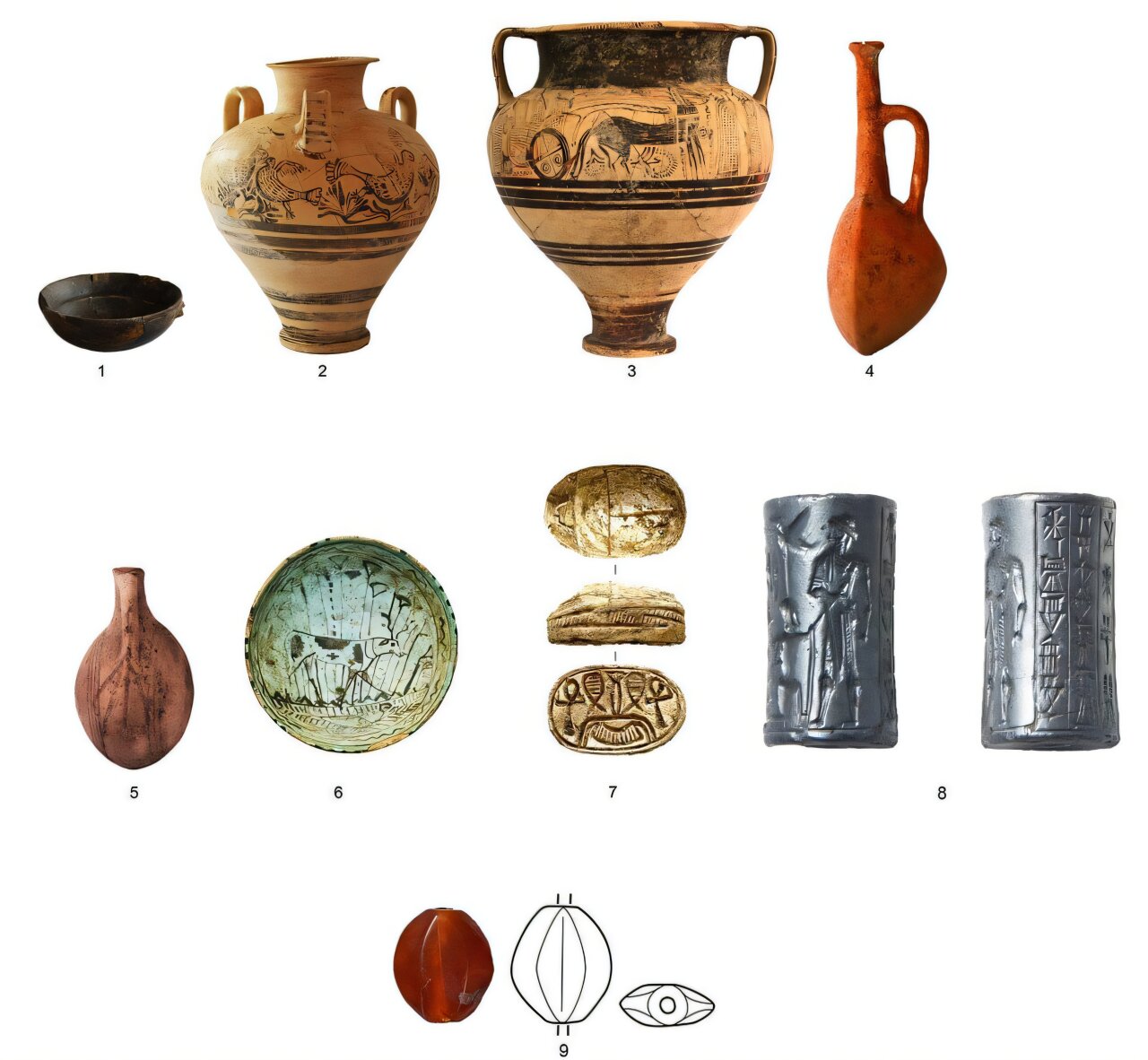
Imported goods found throughout the site reveal contacts stretching across an enormous geographic area. Archaeologists have identified objects from mainland Greece, Crete, Egypt, Anatolia, the Levant, Mesopotamia, Sardinia, Afghanistan, India, and even the Baltic region. Against this backdrop of intense commercial and cultural interaction, the newly studied gold ornaments offer a particularly revealing record of how outside influences became woven into local artistic traditions.
Nine diadems and two funerary mouth-pieces
The research focuses on nine gold diadems and two gold mouth-pieces recovered during excavations conducted between 2016 and 2024.
The researchers distinguish the two object types by both size and purpose. Diadems were long enough to encircle the forehead and were apparently worn by living people before sometimes accompanying them in death. The shorter mouth-pieces, by contrast, appear to have been created specifically for funerary use and placed over the mouths of the deceased as part of burial ceremonies.
Many of the tombs contained generations of burials. Families repeatedly reopened the chambers over periods lasting as long as roughly 150 years, carefully placing new burials alongside older ones. This long sequence allowed archaeologists to study the ornaments within well-dated archaeological layers and compare them with associated pottery, imported objects, and human remains.
Decorations that blend cultures instead of copying them
One of the study’s strongest conclusions comes from the imagery embossed onto the delicate gold sheets.
A striking bull diadem combines several traditions within a single object. The frontal bull, complete with a solar disk between its horns and an Egyptian-style wig, closely resembles imagery associated with Apis, the sacred bull of ancient Egypt. Yet surrounding floral decorations resemble motifs widely seen on Mycenaean pottery, while rosette designs have parallels in Mycenaean funerary art. Rather than copying any single artistic tradition, the ornament merges elements from several cultural worlds into a unified composition.
Another elaborate diadem features running ibexes framed by feline heads. The dynamic pose of the animals recalls artistic conventions known from Aegean art, while the lion imagery reflects cultures beyond Cyprus, where lions themselves did not naturally occur. Palm motifs, floral patterns, spirals, rosettes, and geometric designs similarly echo artistic traditions from Mycenaean Greece, Minoan Crete, Egypt, and the Near East.
Even when motifs appear familiar, subtle differences suggest local craftspeople were not simply reproducing foreign designs. Similar floral decorations on different diadems were likely produced using different embossing tools, indicating independent local manufacture rather than mass copying.
Signs that some ornaments were treasured in life
Evidence from the artifacts themselves suggests not all were made solely for burial.
The heaviest diadems, weighing between roughly 11.7 and 23.14 grams, display visible wear, particularly one rosette diadem whose surface appears especially worn. Combined with their substantial construction, the researchers argue this pattern makes it likely these ornaments had been worn during life before being placed in graves.
Smaller, lighter diadems weighing just 1 to 3 grams, however, show little or no comparable wear. These may have been produced specifically for funerary ceremonies.
Although certainty is impossible, the contrast hints that elite individuals may have owned ceremonial ornaments used only on special occasions before those same objects became part of their burial.
Gold crowns for women, men, and even children
The burials also reveal who received these prestigious ornaments.
Diadems were associated with adult women, adult men, teenagers, and young children. One especially notable burial belonged to a 4- to 5-year-old child whose diadem remained in place across the forehead. The child was buried alongside a necklace containing 68 gold beads, four gold earrings, silver objects, and other luxury goods.
According to the researchers, this exceptionally rich burial demonstrates that elite social status could extend even to young children.
The study also challenges simple assumptions about gender symbolism. A large diadem decorated with a powerful bull motif—imagery often regarded as masculine—was associated with a woman approximately 35 to 40 years old. The researchers suggest this may indicate overlapping symbolic roles or greater gender flexibility than modern expectations might predict.
Skilled craftsmanship behind remarkably thin sheets of gold
Despite their ornate appearance, the ornaments were manufactured using surprisingly thin gold sheets.
Decorations were created by pressing designs into the metal with carved matrices or stamps. Different embossing tools appear to have been used for similar motifs, indicating multiple production episodes or workshops.
After embossing, craftspeople trimmed the sheets into their final shapes, punched attachment holes, and polished the visible surfaces. The precision varies between objects. Some edges cut neatly around decorative motifs, while others slice through designs more roughly, suggesting differences in finishing techniques or craftsmanship.
The researchers note that fragments of sheet gold have been found at Hala Sultan Tekke, although no embossing tools have yet been discovered. Even so, the unusually large number of gold ornaments recovered from the site makes the city itself a plausible production center.
Where did the gold come from?
The study cannot determine the precise origin of the raw gold, but it discusses several possibilities.
Some of the metal may have come from Egypt’s Nubian gold mines, particularly given the large number of Egyptian imports recovered at Hala Sultan Tekke. The researchers also consider the possibility that gold reached Cyprus from the Balkans, including the famous prehistoric mining region around Ada Tepe in present-day Bulgaria.
At present, however, these ideas remain hypotheses. The authors note that detailed chemical analyses capable of tracing the gold’s geological origin have not yet been carried out.
A snapshot of a connected Mediterranean
Perhaps the study’s biggest contribution is its picture of cultural interaction.
Rather than portraying Cyprus as a passive recipient of foreign influences, the evidence suggests local artisans actively selected, adapted, and combined ideas arriving from across the Mediterranean. Egyptian religious imagery, Aegean decorative traditions, Near Eastern motifs, and Cypriot artistic preferences all became part of new objects that belonged unmistakably to their own cultural setting.
The surrounding grave goods reinforce this picture. Individual tombs contain varying mixtures of imported ceramics and luxury items from different regions, leading the researchers to suggest that some elite families may even have specialized in trade networks focused on particular parts of the Mediterranean.
What archaeologists still do not know
The authors emphasize that several important questions remain unresolved.
Poor preservation of many skeletons—caused largely by the site’s salty groundwater and coastal environment—limited the certainty of some age and sex identifications. Repeated reopening of family tombs over generations also displaced some burials, making it impossible to link every ornament confidently to a specific individual.
The origin of the gold itself also remains uncertain, and no workshop or manufacturing tools directly associated with producing the ornaments have yet been identified.
Future chemical analyses of the metal, along with continued excavation at Hala Sultan Tekke, may eventually reveal where the gold originated, whether multiple workshops operated at the site, and how one of the eastern Mediterranean’s most cosmopolitan Bronze Age cities transformed international influences into a distinctive artistic tradition.
Publication details
Peter M. Fischer, Cultural fusion in late Bronze Age goldwork: Diadems and mouth‐pieces from Hala Sultan Tekke, Cyprus, Oxford Journal of Archaeology (2026). DOI: 10.1111/ojoa.70012