Deep within the sun-dappled valley of Les Eyzies in southwestern France, the limestone cliffs of the Dordogne region hold secrets that have remained silent for millennia. Among these, the cave of Font-de-Gaume stands as a sanctuary of prehistoric imagination, its walls adorned with the silhouettes of ancient beasts. For decades, these masterpieces existed in a chronological vacuum; while their beauty was undeniable, their exact place in the timeline of human history remained a sophisticated guess. The shadows of the past were long, and the tools we had to measure them were simply not sharp enough to pierce the darkness.
The Mystery of the Indelible Ink
For a long time, the scientific community operated under a frustrating assumption. It was believed that the artists who frequented Font-de-Gaume—much like those who painted the world-famous Lascaux—relied almost exclusively on inorganic minerals to create their pigments. Specifically, researchers thought the black figures were rendered using iron oxides and manganese oxides. These minerals, while durable and striking, possess a major drawback for modern archaeology: they contain no organic carbon. Without carbon, the gold standard of archaeological timing, radiocarbon dating, is impossible.
This perceived absence of organic material created a barrier that seemed insurmountable. Archaeologists could analyze the style of the drawings or the tools found on the cave floor, but the paintings themselves refused to speak their age. The figures of bison, mammoths, and mysterious symbols remained timeless, trapped in an era that could only be estimated through indirect clues. However, a team led by a CNRS researcher began to wonder if we had simply been looking at the surface without truly seeing the chemistry beneath. No study had ever definitively proven that carbon was absent; it was a void in our knowledge waiting to be tested.
Piercing the Darkness with Light
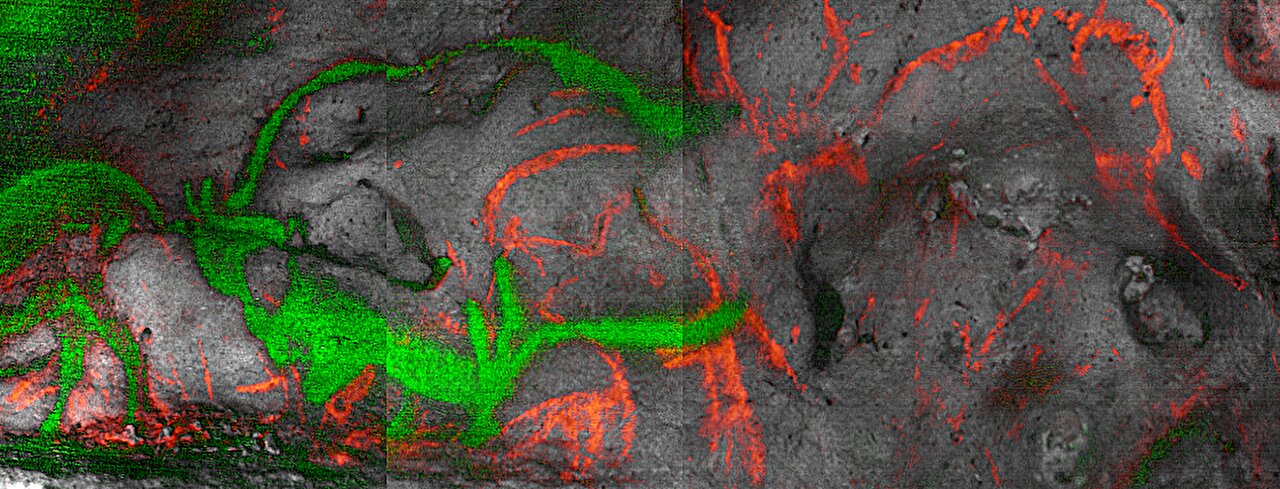
To solve this prehistoric puzzle, the research team turned to the frontiers of modern physics. They didn’t start by scraping the walls; instead, they used light to interrogate the ancient pigments. Using Raman microspectrometry and hyperspectral imaging, the scientists were able to look at the molecular fingerprint of the black drawings without ever touching them. These noninvasive methods acted like a chemical microscope, scanning the dark strokes of a painted bison and a hauntingly abstract mask.
The results were a revelation. Hidden within the mineral oxides, the scans detected the unmistakable signatures of charcoal. This wasn’t a surface layer or a stray smudge; the charcoal was a fundamental component of the black lines themselves. To ensure they weren’t looking at modern interference—such as soot from 19th-century explorers or the breath of modern tourists—the team mapped the charcoal across the entirety of the figures. Its uniform presence throughout the lines confirmed that this carbon was not a contaminant. It was the original “ink” used by the Paleolithic artists thousands of years ago.
A Rare Glimpse into the Deep Past
With the presence of carbon confirmed, the stakes were raised. The French authorities granted an exceptional authorization: the scientists were allowed to collect micro-samples of the pigment for carbon 14 dating. This was a delicate operation. Because the amount of material was so infinitesimal, the analysis pushed the limits of dating technology. Every microscopic grain of charcoal was a precious piece of evidence that could finally anchor these drawings in time.
The findings, published on March 9, 2026, in the Proceedings of the National Academy of Sciences, did more than just provide dates; they rewrote the history of the cave. The data suggested that Font-de-Gaume was not a gallery finished in a single generation, but a living canvas used over vast stretches of time. The bison was found to have been painted between 13,461 and 13,162 calBP (calibrated years before present). This placed the artwork in the Upper Paleolithic, yet it was slightly more recent than previous stylistic estimates had suggested. The cave was not a static relic; it was a destination for artists across several millennia.
The Layers of an Ancient Masterpiece
The most startling discovery came from the analysis of the mask. Unlike the bison, which appeared to be a single event in time, the mask was a composite of history. Different sections of the figure yielded wildly different ages. One part of the drawing was dated to between 15,981 and 15,121 calBP, while another section was added between 15,297 and 14,246 calBP. Most surprisingly, a final layer of the mask was dated to a much later period, between 8,993 and 8,590 calBP.
This chronologically layered “story” suggests that the inhabitants of the Dordogne returned to the same images century after century, perhaps touching them up, adding new meanings, or honoring the work of ancestors who had lived thousands of years before them. It reveals a cultural continuity that is difficult for the modern mind to grasp—a single piece of art being “in progress” for over seven thousand years.
Why This Chronological Breakthrough Matters
This research is a landmark because it shatters the limitations that once hindered our understanding of European cave art. By proving that charcoal exists in sites previously thought to be purely mineral-based, the team has provided a new analytical methodology for the entire field of archaeology. We now have the “key” to unlock the ages of countless other Paleolithic figures across France and beyond.
Understanding the exact timing of these paintings allows us to synchronize the art with the environment and the people of the time. It helps us see these early humans not as primitive shadows, but as sophisticated populations with enduring traditions. By accurately dating these images, we are no longer just looking at pretty pictures on a wall; we are reconstructing the cultural heartbeat of our ancestors and gaining a clearer view of the very dawn of human expression.
Study Details
Ina Reiche et al, Radiocarbon dating and chemical imaging of carbon black–based Paleolithic cave art in the Dordogne region (France), Proceedings of the National Academy of Sciences (2026). DOI: 10.1073/pnas.2524751123