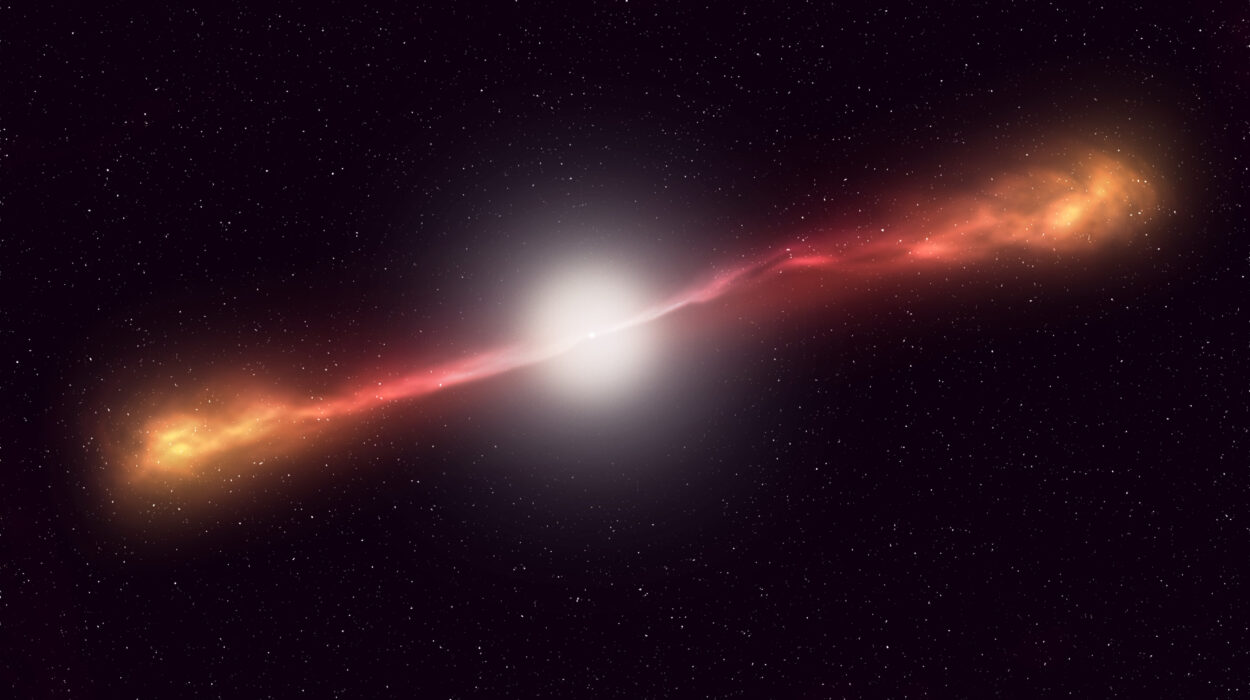
High above our atmosphere, the Fermi satellite maintains a silent watch over the cosmos, waiting for the briefest whispers of light from the deep past. In September 2023, it captured something extraordinary: a sudden, violent flicker of energy that pierced through the darkness of space. This flash, cataloged as GRB 230906A, was no ordinary flicker. It belonged to a rare class of short gamma-ray bursts, explosions so immensely powerful that for a few fleeting moments, they can outshine every star in an entire galaxy combined. To the team of international astronomers led by researchers at Penn State, this was the first page of a cosmic detective story that began hundreds of millions of years ago.
The Ghostly Dance of Dead Suns
The origin of such a monumental blast lies in a process of extreme celestial violence. Long before the light reached our sensors, two neutron stars—the crushed, ultra-dense husks left behind by the deaths of massive suns—were locked in a terminal gravitational embrace. These dead remnants did not simply drift; they spiraled toward one another, moving faster and faster as the distance closed. When they finally collided, the resulting impact was a compact binary star merger. This event did more than just release light; it acted as a celestial forge, ripping the fabric of space-time and unleashing a flood of energy that would travel for eons before being detected by human instruments.
A Trail of Crumbs Across the Void
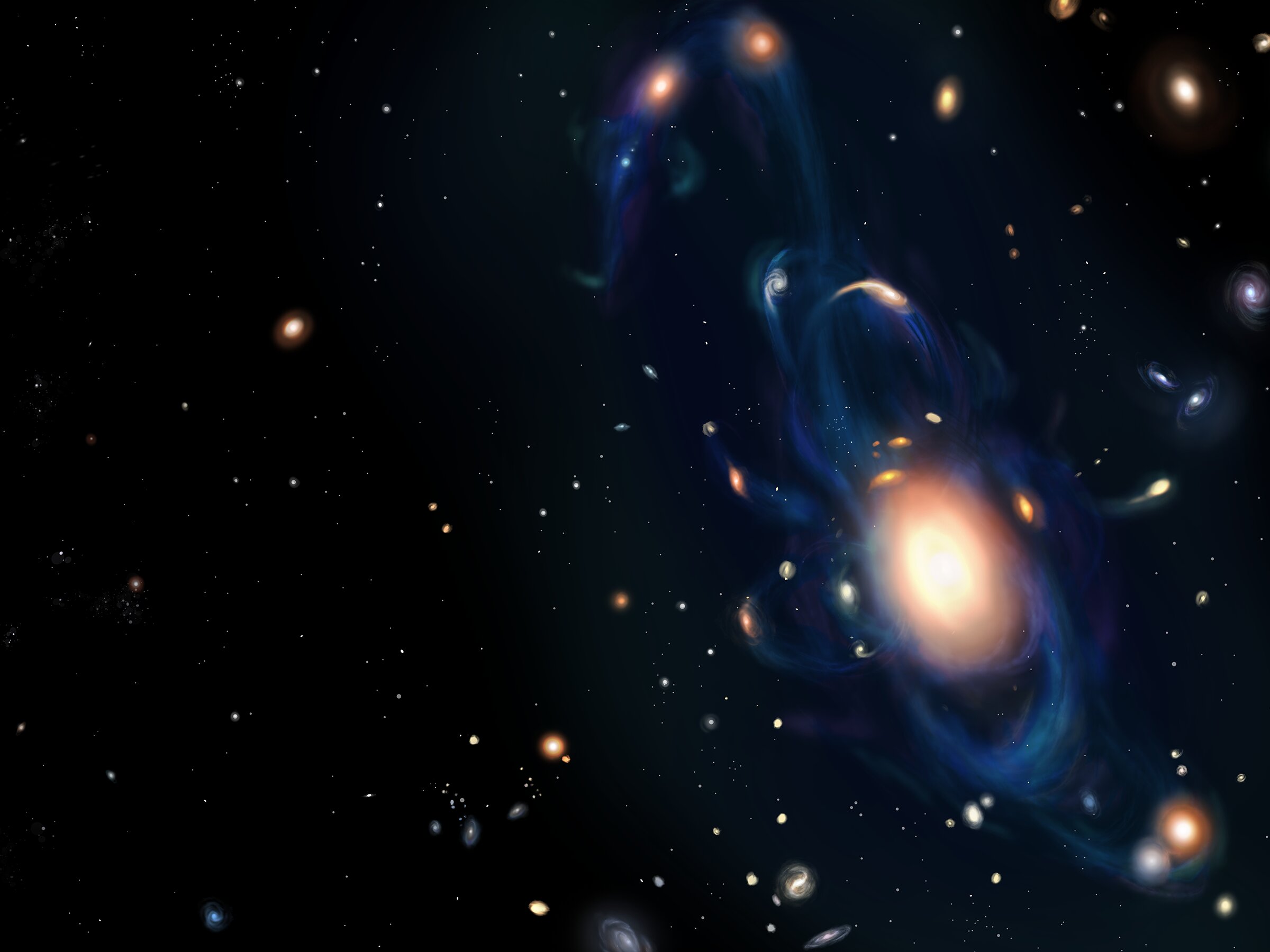
To understand where this explosion came from, scientists needed more than just the initial flash. They turned the eyes of the Chandra X-ray Observatory and the Hubble Space Telescope toward the patch of sky where the burst appeared. What they found was a faint, distant galaxy tucked within a larger group approximately 8.5 billion light-years away. This wasn’t a peaceful neighborhood. The entire group of galaxies is currently undergoing a cosmic merger, a slow-motion collision where massive gravitational forces tug and pull at the constituent stars and gas.
In the midst of this chaos, the researchers noticed a “tidal tail”—a long, thin stream of stars and dust stretched out into the void like a bridge of light. This tail was formed by the sheer gravitational strength of the interacting galaxies. It was within this debris field, this wreckage of a galactic collision, that the gamma-ray burst occurred. The presence of the burst in such a specific location suggested to the team that the galactic merger itself was the catalyst for the explosion. When galaxies collide, they stir up clouds of gas and dust, triggering a frantic surge of star formation.
Forging Gold in the Heart of Disaster
The story of GRB 230906A is not just one of destruction, but of profound creation. When those two neutron stars collided, they produced a kilonova, a bright halo of light that serves as one of the universe’s primary factories for the heaviest materials. These explosions are the birthplaces of heavy elements like gold and platinum. The researchers suspect that the specific stars involved in this blast were born during a spike in star formation triggered by the galactic merger roughly 700 million years before they finally met their end.
As these stars merged and exploded, they didn’t just create light; they scattered these newly forged elements into the surrounding space. This discovery provides a natural explanation for why astronomers often see an enhanced rate of heavy element production in the halos of interacting galaxies. The “tidal tails” and debris fields become enriched with the building blocks of planets and, eventually, life. The violence of the collision is what allows the universe to evolve chemically, shifting from simple gases to the complex variety of elements we see today.
The Ancient Heritage Within Our Veins
There is a deeply personal connection between this distant explosion and our own existence. Every piece of gold found on Earth, from the jewelry we wear to the components in our electronics, was likely produced in an ancient, explosive event exactly like the one detected in September 2023. The history of our solar system is written in the debris of dead stars. Even the iron in our blood can be traced back to the deaths of roughly 10,000 stars that once lived in our own galaxy.
Those stars died billions of years ago, but the material they left behind persisted. As the Earth formed and life began to evolve, our bodies incorporated that stardust, using the iron to carry oxygen through our veins. The research highlights how the most violent interactions in the universe—the collisions of entire galaxies and the merging of dead suns—are the very events that set the stage for our own biological history. Without these catalysts of creation, the universe would be a much emptier, simpler place.
Why This Ancient Flash Matters Today
The study of GRB 230906A is a reminder that we are living in a dynamic and interconnected universe. By using precision instruments like the Chandra X-ray Observatory, astronomers can find the faint “host” galaxies that would otherwise be invisible, allowing them to map out the history of the cosmos. This specific burst may even be one of the most distant short gamma-ray bursts ever recorded, though its exact distance is still being refined by the scientific community.
Understanding these events also gives us a glimpse into our own future. While it is common for galaxies to have neighbors, it is rare to see them in the act of colliding—yet this is exactly what awaits the Milky Way. In approximately four or five billion years, our galaxy will merge with the Andromeda galaxy. When that happens, the same processes observed in this distant burst will likely occur here. Tidal tails will form, new stars will be born, and eventually, new generations of neutron stars will collide, seeding the future universe with heavy elements. This research helps us understand the cycle of cosmic life and death, proving that even in the farthest reaches of space, destruction is often the first step toward something new.
Study Details
A Merger within a Merger: Chandra Pinpoints the Short GRB 230906A in a Peculiar Environment, The Astrophysical Journal Letters (2026). DOI: 10.3847/2041-8213/ae2a2f