The universe is not merely vast. It is staggering beyond instinct, beyond intuition, beyond the comfortable limits of human imagination. Every time science sharpens its gaze—through telescopes, particle accelerators, or mathematical equations—the cosmos reveals something even more astonishing than before.
We live on a small rocky planet orbiting an ordinary star in an ordinary galaxy. And yet, through physics and astronomy, we have learned truths about black holes, cosmic expansion, quantum fields, and the birth of spacetime itself. The deeper we look, the stranger reality becomes.
Here are seventeen scientifically accurate, profoundly mind-bending facts about the universe—each one a reminder that existence is far more extraordinary than it appears.
1. The Universe Is About 13.8 Billion Years Old
Modern cosmology tells us that the universe began approximately 13.8 billion years ago in a hot, dense state. This conclusion comes from multiple lines of evidence: the expansion of galaxies, the cosmic microwave background radiation, and the abundance of light elements such as hydrogen and helium.
When astronomers observe distant galaxies, they see that their light is redshifted—stretched to longer wavelengths. This redshift indicates that space itself is expanding. By tracing that expansion backward using Einstein’s equations of general relativity, scientists arrive at a beginning point.
The faint glow of the cosmic microwave background—discovered in 1965—is the afterglow of the early universe, emitted when it cooled enough for atoms to form roughly 380,000 years after the Big Bang. Its temperature and structure provide a precise cosmic clock.
Everything you know—every atom in your body, every star in the sky—emerged from that primordial beginning.
2. Most of the Universe Is Invisible
Everything you can see—stars, planets, galaxies, gas clouds—makes up only about 5% of the universe’s total energy content.
Approximately 27% is dark matter, an invisible form of matter that does not emit or absorb light but exerts gravitational influence. The remaining 68% is dark energy, a mysterious form of energy causing the universe’s expansion to accelerate.
Dark matter reveals itself through gravitational effects. Galaxies rotate too quickly to be held together by visible matter alone. Gravitational lensing—where massive objects bend light—also shows more mass than we can see.
Dark energy was discovered in 1998 when astronomers studying distant supernovae realized that cosmic expansion is speeding up.
The majority of reality is unknown to our senses. The cosmos is dominated by substances we cannot directly perceive.
3. The Observable Universe Is 93 Billion Light-Years Across
Although the universe is 13.8 billion years old, the observable universe is about 93 billion light-years in diameter.
This seems paradoxical until we consider that space itself has been expanding. Light emitted from distant galaxies billions of years ago has been traveling toward us while space stretches in between. As a result, those galaxies are now much farther away than the simple age of the universe might suggest.
The observable universe is limited by the cosmic horizon—the maximum distance light has had time to travel since the Big Bang.
Beyond that horizon may lie infinitely more space, possibly even regions with different physical properties. We cannot see them, but mathematics does not forbid their existence.
4. A Teaspoon of Neutron Star Material Would Weigh Billions of Tons
When massive stars explode in supernovae, their cores can collapse into neutron stars—objects so dense that protons and electrons combine to form neutrons.
A typical neutron star is about 20 kilometers in diameter but contains more mass than the Sun.
The density is extreme. A teaspoon of neutron star material would weigh around a billion tons on Earth.
In these stars, matter is compressed beyond atomic structure. The physics governing their interiors involves nuclear forces and quantum mechanics under extraordinary pressure.
They are cosmic laboratories of density, stretching matter to limits barely conceivable.
5. Black Holes Warp Space and Time
Predicted by Einstein’s theory of general relativity, black holes form when massive stars collapse under their own gravity.
A black hole’s gravity is so strong that beyond a boundary called the event horizon, nothing—not even light—can escape.
But black holes are not cosmic vacuum cleaners indiscriminately sucking in everything. From a distance, they behave like any other mass. Only objects that venture too close are captured.
Time behaves strangely near a black hole. To a distant observer, clocks near the event horizon appear to tick more slowly due to gravitational time dilation. If you fell into one, time for you would proceed normally—but outside observers would see your descent slow dramatically.
At the center lies a singularity, where current physical theories break down.
Black holes are not holes in space. They are regions where spacetime itself curves into an extreme abyss.
6. The Universe Is Expanding Faster Over Time
In 1998, two independent research teams discovered that distant Type Ia supernovae were dimmer than expected. The conclusion was shocking: the universe’s expansion is accelerating.
This acceleration implies the presence of dark energy—a form of energy intrinsic to space itself.
In Einstein’s equations, this can be represented by a cosmological constant. But its physical nature remains unknown.
If acceleration continues indefinitely, distant galaxies will eventually recede beyond our observable horizon. In the far future, observers in our galaxy may see only local stars, unaware that countless galaxies once filled the cosmos.
The universe is not just expanding. It is racing apart.
7. You Are Made of Star Stuff
Nearly all elements heavier than hydrogen and helium were forged in stars.
Inside stellar cores, nuclear fusion combines lighter elements into heavier ones. When massive stars explode in supernovae, they scatter these elements into space. Later generations of stars and planets form from this enriched material.
The carbon in your cells, the oxygen you breathe, the iron in your blood—all were created in ancient stars.
When you look at the night sky, you are witnessing the origin of your own atoms.
We are not separate from the universe. We are an expression of its evolution.
8. The Cosmic Microwave Background Is a Baby Picture of the Universe
The cosmic microwave background (CMB) is radiation left over from when the universe became transparent about 380,000 years after the Big Bang.
Before that time, the universe was a hot plasma of charged particles and photons. Light could not travel freely. When atoms formed, photons decoupled and began streaming across space.
Today, we detect that radiation as microwaves with a temperature of about 2.7 Kelvin.
Tiny temperature fluctuations in the CMB reveal the seeds of galaxies—slight density variations that grew under gravity into cosmic structures.
The CMB is a snapshot of the infant universe, imprinted across the sky.
9. There May Be Trillions of Galaxies
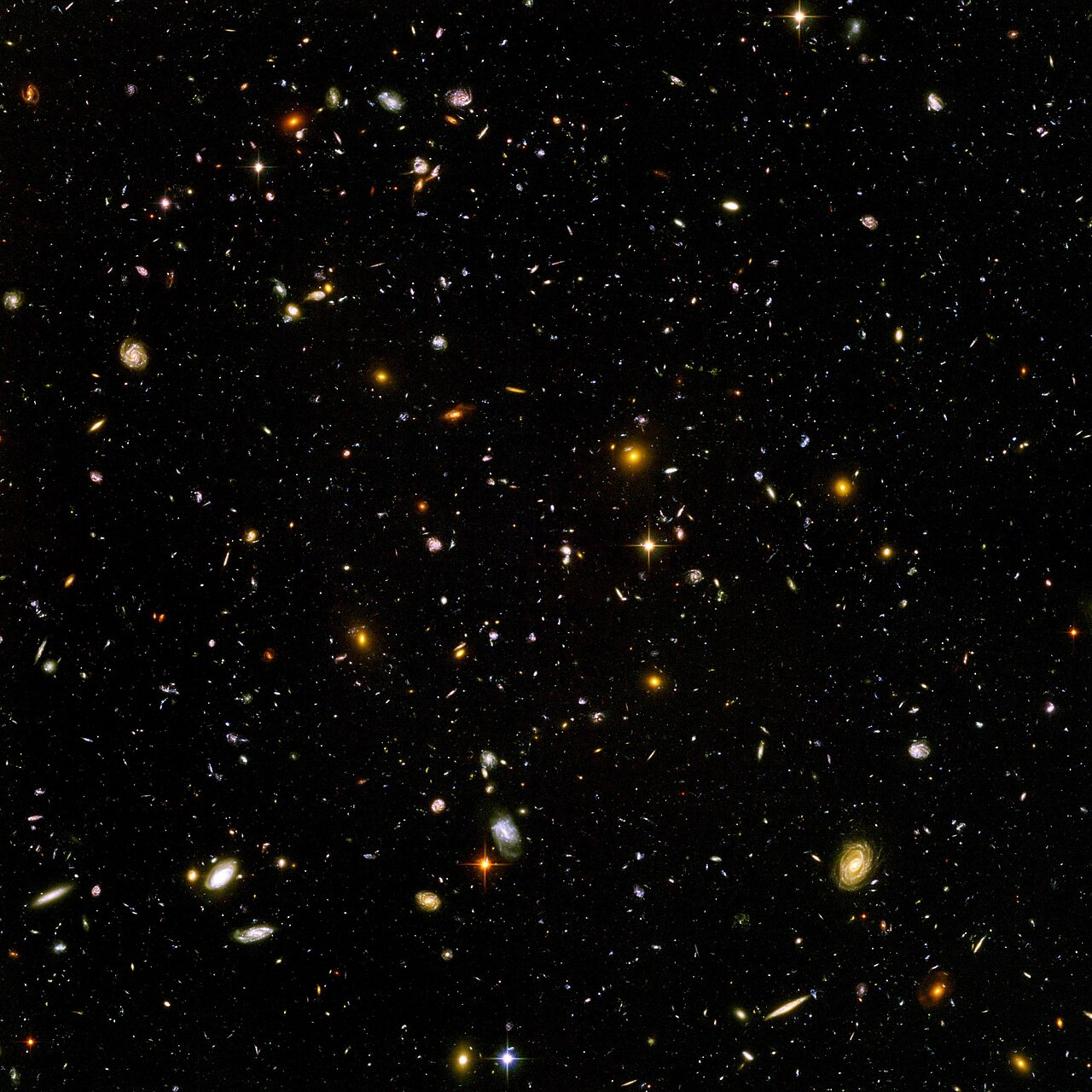
Earlier estimates suggested about 100 billion galaxies in the observable universe. More recent deep-field surveys indicate the number could be closer to two trillion.
Each galaxy contains millions to trillions of stars. Our own galaxy, the Milky Way, holds hundreds of billions of stars.
The scale is almost incomprehensible.
Even if intelligent life were extraordinarily rare, the sheer number of stars and planets suggests that we may not be alone.
10. Time Slows Down at High Speeds
According to special relativity, time is not absolute.
If you travel near the speed of light, time passes more slowly for you relative to someone at rest. This effect, called time dilation, has been experimentally confirmed with atomic clocks flown on airplanes and satellites.
Astronauts aboard the International Space Station age slightly more slowly than people on Earth due to both their speed and weaker gravity.
In principle, near-light-speed travel could allow a traveler to journey far into the future of Earth.
Time is not a universal constant. It stretches and bends with motion.
11. The Universe Is Almost Perfectly Flat
Measurements of the cosmic microwave background show that the large-scale geometry of the universe is remarkably close to flat.
In curved space, parallel lines either converge or diverge. In flat space, they remain parallel. Observations suggest the universe obeys Euclidean geometry on cosmic scales.
This flatness implies that the total energy density of the universe is extremely close to a critical value.
Such precise balance raises profound questions about initial conditions and cosmic inflation—a rapid expansion thought to have occurred in the early universe.
The universe balances on a razor’s edge between open and closed.
12. There Are Rogue Planets Drifting Alone
Not all planets orbit stars.
Gravitational interactions in young planetary systems can eject planets into interstellar space. These rogue planets wander the galaxy alone, unlit by any sun.
Some may retain internal heat from formation or radioactive decay. In theory, subsurface oceans could exist beneath thick ice layers.
The galaxy may be filled with billions of these dark wanderers.
Not every world has a sunrise.
13. Gravitational Waves Ripple Through Spacetime
In 2015, scientists directly detected gravitational waves—ripples in spacetime predicted a century earlier by Einstein.
These waves were produced by two merging black holes over a billion light-years away.
Gravitational waves stretch and compress space itself as they pass. Detecting them required measuring changes in distance smaller than a proton’s width.
This discovery opened a new way of observing the universe—not through light, but through vibrations of spacetime.
We can now listen to cosmic collisions.
14. The Coldest Known Natural Place Is a Nebula
The Boomerang Nebula, located about 5,000 light-years away, is the coldest naturally occurring place known in the universe.
Its temperature is about 1 Kelvin—colder than the cosmic microwave background.
The nebula is cooling as gas rapidly expands outward from a dying star, a process that lowers temperature dramatically.
Even in a universe filled with blazing stars, there are regions colder than deep space.
15. Quantum Fluctuations Seeded Galaxies
The large-scale structure of the universe—galaxies, clusters, cosmic filaments—originated from tiny quantum fluctuations in the early universe.
During cosmic inflation, these microscopic fluctuations were stretched to cosmic scales.
Gravity amplified them over billions of years, forming the structures we observe today.
The galaxies we see are the magnified imprint of quantum uncertainty.
16. The Sun Contains 99.8% of the Solar System’s Mass
Our Sun dominates the solar system.
It contains about 99.8% of the total mass. Its gravitational pull governs planetary orbits, comet paths, and asteroid belts.
Through nuclear fusion, it converts hydrogen into helium, releasing energy that sustains life on Earth.
Every sunrise is powered by reactions at 15 million degrees Celsius deep within its core.
The star that feels ordinary to us is a nuclear furnace beyond imagination.
17. The Universe May Have No Center
It is natural to imagine the Big Bang as an explosion from a central point into empty space.
But the Big Bang was not an explosion in space. It was an expansion of space itself.
Every region of space was once compressed into a hot, dense state. As space expanded, distances increased everywhere.
There is no center in the universe—at least not within our observable region. From any galaxy, the expansion appears the same.
The universe does not expand into anything. Space itself grows.
We are not at the center. Nowhere is.
A Cosmos Beyond Intuition
The universe defies common sense.
It is mostly invisible. It expands faster over time. It bends time and space. It forges atoms in stellar cores. It began in a hot, dense state and evolved into galaxies and consciousness.
Each fact stretches the imagination. Yet each is grounded in observation, experiment, and theory.
The more we learn, the more astonishing reality becomes.
We are small. But we are capable of understanding.
And perhaps the most mind-blowing fact of all is this: the universe, vast and ancient beyond comprehension, has produced within itself beings who can contemplate its origins, measure its age, detect its ripples, and trace their own atoms to ancient stars.
In knowing the cosmos, the cosmos knows itself.