There is a star so dominant, so overwhelming in its presence, that every second of your life unfolds under its influence.
It rises without asking permission. It powers oceans and forests. It sculpts climates and drives winds. It feeds the food chain, fuels weather, and governs the rhythm of sleep and waking. Without it, Earth would be a frozen rock drifting silently through space.
That star is our Sun.
Astronomically ordinary yet existentially extraordinary, the Sun is a middle-aged, medium-sized star located in the outer regions of the Milky Way galaxy. And yet, the deeper we look, the more astonishing it becomes.
Here are fifteen scientifically accurate facts about the Sun—each one a doorway into cosmic wonder.
1. The Sun Contains 99.86% of the Solar System’s Mass
The Sun is not merely the largest object in our solar system—it is the solar system.
With a mass of approximately 1.989 × 10³⁰ kilograms, the Sun accounts for 99.86% of all the mass in the solar system. Everything else—planets, moons, asteroids, comets, dust—makes up just 0.14%.
Jupiter, the largest planet, contains most of that remaining fraction. Earth’s mass is about one three-hundred-thousandth of the Sun’s.
This immense mass is why the Sun dominates gravitationally. It holds planets in orbit, governs comet trajectories, and shapes the heliosphere—the vast bubble carved into interstellar space by the solar wind.
Without the Sun’s gravity, the solar system would not cohere. It would disperse into the galaxy like scattered sand.
The Sun is not just at the center of our planetary system—it is the reason that system exists at all.
2. The Sun Is Powered by Nuclear Fusion
At its core, the Sun is a nuclear furnace.
Deep inside, at temperatures around 15 million degrees Celsius and pressures exceeding 250 billion atmospheres, hydrogen nuclei fuse into helium through a process called nuclear fusion. Specifically, the dominant chain reaction is known as the proton-proton chain.
In each fusion reaction, four hydrogen nuclei ultimately combine to form one helium nucleus. But the mass of the helium nucleus is slightly less than the mass of the four original protons.
That missing mass is converted into energy according to Einstein’s famous equation, E = mc², formulated by Albert Einstein.
Every second, the Sun converts about 600 million tons of hydrogen into helium. Roughly 4 million tons of mass are transformed into pure energy each second.
That energy radiates outward, eventually reaching Earth as sunlight.
The sunlight warming your skin began its journey in the Sun’s core hundreds of thousands of years ago, diffusing outward through layers of plasma before streaming across space in just eight minutes.
Fusion is the alchemy that powers life.
3. The Sun Is About 4.6 Billion Years Old
The Sun formed approximately 4.6 billion years ago from the gravitational collapse of a region within a giant molecular cloud.
As gravity pulled gas and dust inward, the collapsing cloud spun faster and flattened into a rotating disk. Most of the mass gathered at the center, where pressure and temperature eventually ignited nuclear fusion.
The remaining material formed planets, moons, and other bodies.
The Sun is currently about halfway through its stable hydrogen-burning phase, known as the main sequence. It will continue fusing hydrogen for another 5 billion years.
Stars are born, mature, and die. The Sun is in its long, steady adulthood.
It has shone over Earth since before the first oceans formed, before the first cells divided, before life breathed.
4. The Sun’s Surface Is Not Solid
The “surface” of the Sun, called the photosphere, is not a solid boundary. It is a layer of hot plasma about 500 kilometers thick where the Sun becomes opaque to visible light.
The photosphere has an average temperature of about 5,500°C.
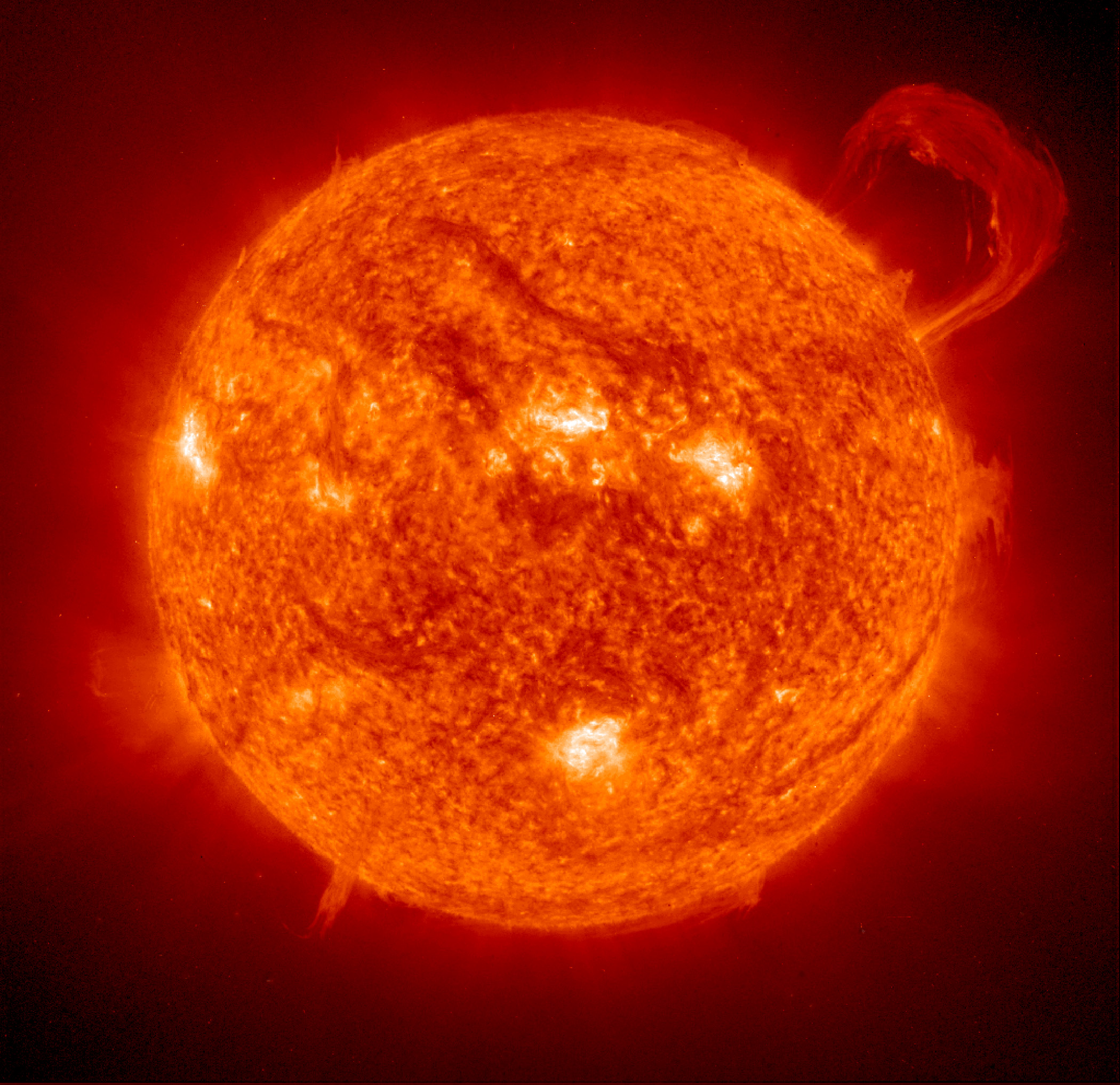
Above it lie the chromosphere and the corona. The corona—the Sun’s outer atmosphere—extends millions of kilometers into space and reaches temperatures of several million degrees Celsius.
Curiously, the corona is far hotter than the surface below it. This “coronal heating problem” remains an active area of research. Magnetic reconnection and wave heating are leading explanations, but the full mechanism is still being studied.
The Sun has no solid crust, no defined edge. It is a sphere of ionized gas governed by gravity and magnetic fields.
It is fluid fire.
5. The Sun’s Light Takes Time to Escape
When fusion produces energy in the Sun’s core, that energy begins as high-energy gamma-ray photons.
But those photons do not travel directly outward.
Instead, they scatter countless times off charged particles in the Sun’s dense interior. Each scattering changes direction. The process is called radiative diffusion.
It can take photons anywhere from tens of thousands to hundreds of thousands of years to reach the surface.
Once they escape the photosphere, however, they travel to Earth in just about 8 minutes and 20 seconds.
Sunlight is ancient by the time it touches your face.
6. The Sun Generates a Powerful Magnetic Field
The Sun is not only hot—it is magnetically dynamic.
Because it is made of plasma, its material conducts electricity. As the Sun rotates (once about every 25 days at the equator and slower near the poles), differential rotation twists and tangles magnetic field lines.
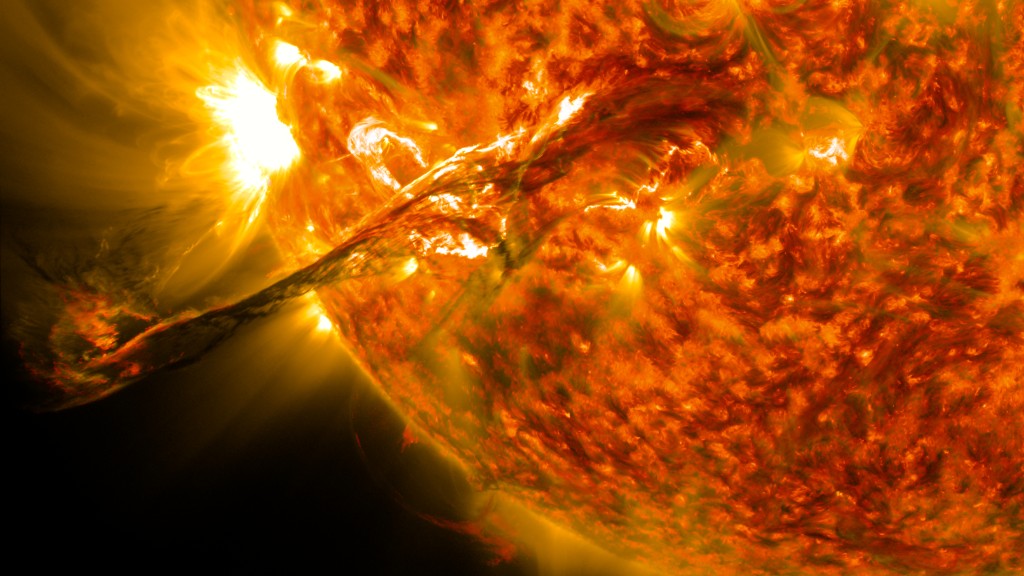
This creates sunspots—cooler, darker regions where magnetic fields are especially strong. It also drives solar flares and coronal mass ejections.
The Sun’s magnetic activity follows an approximately 11-year cycle, known as the solar cycle. During solar maximum, sunspots and solar storms are more frequent.
These magnetic storms can affect Earth, disrupting satellites, communication systems, and power grids.
Our technological civilization is more connected to solar magnetism than ever before.
7. The Sun Loses Mass Constantly
Every second, the Sun loses mass in two ways: through nuclear fusion and through the solar wind.
The energy radiated into space carries away mass equivalent to about 4 million tons per second. Additionally, the solar wind—a stream of charged particles—blows outward at speeds of hundreds of kilometers per second.
Over billions of years, this mass loss is measurable but small compared to the Sun’s total mass.
Yet even small changes matter gravitationally. As the Sun slowly loses mass, Earth’s orbit gradually expands.
Cosmic change is subtle, patient, relentless.
8. The Sun Will Become a Red Giant
In about 5 billion years, the Sun will exhaust the hydrogen in its core.
When that happens, fusion will shift to a shell around the core, and the Sun will expand dramatically into a red giant.
Its outer layers will swell, possibly engulfing Mercury and Venus. Earth’s fate is uncertain, but even if not swallowed, it will be rendered uninhabitable.
Eventually, the Sun will shed its outer layers, creating a planetary nebula. The remaining core will become a white dwarf—a dense, Earth-sized remnant slowly cooling over billions of years.
The Sun is stable, but not eternal.
Stars live on timescales that dwarf civilizations.
9. The Sun Orbits the Center of the Milky Way
Though it appears stationary in our sky, the Sun is moving at extraordinary speed.
It orbits the center of the Milky Way galaxy at about 220 kilometers per second. One full galactic orbit takes roughly 225–250 million years—a “cosmic year.”
Since its formation, the Sun has completed about 20 galactic orbits.
Our star is a traveler, carrying Earth and the rest of the solar system through spiral arms and interstellar clouds.
We are passengers on a moving star.
10. The Sun Emits Neutrinos
Fusion in the Sun’s core produces not only light and heat but also neutrinos—nearly massless, electrically neutral particles.
Neutrinos interact extremely weakly with matter. Trillions pass through your body every second without leaving a trace.
Detecting solar neutrinos on Earth provides direct evidence of fusion occurring in the Sun’s core. Experiments like the Sudbury Neutrino Observatory confirmed predictions of solar models and revealed that neutrinos change “flavor” as they travel—a phenomenon known as neutrino oscillation.
By measuring neutrinos, we observe the Sun’s heart in real time.
11. The Sun’s Energy Drives Earth’s Climate
Nearly all energy on Earth’s surface originates from the Sun.
Solar radiation drives atmospheric circulation, ocean currents, evaporation, and photosynthesis. Without solar input, Earth’s average temperature would be about -18°C instead of the life-supporting 15°C we experience today.
Small variations in solar output can influence climate patterns, though current global warming trends are overwhelmingly driven by human-produced greenhouse gases rather than solar variability.
The Sun is Earth’s primary energy source—an engine for weather and life.
12. The Sun Is a G-Type Main-Sequence Star
Astronomically, the Sun is classified as a G2V star.
“G” refers to its surface temperature and color—yellow-white. “2” indicates a subclass within G-type stars. “V” signifies that it is a main-sequence star fusing hydrogen in its core.
There are billions of stars in the Milky Way similar to the Sun.
Yet for us, there is nothing ordinary about it.
Its stability and longevity provided the time necessary for life to evolve complexity.
13. The Sun’s Gravity Controls Space Around It
The Sun’s influence extends far beyond Pluto.
The solar wind carves out a vast region in space called the heliosphere, which acts as a shield against some cosmic radiation.
At the outer boundary of the heliosphere lies the heliopause, where the solar wind meets interstellar space. Spacecraft such as Voyager 1 have crossed this boundary, entering interstellar space while still under the Sun’s gravitational dominance.
The Sun defines our cosmic neighborhood.
14. The Sun Is Perfectly Balanced—For Now
The Sun exists in hydrostatic equilibrium.
Gravity pulls inward, attempting to compress the star. Nuclear fusion produces outward pressure from heat and radiation. These forces balance precisely.
If fusion slowed, gravity would compress the core, increasing temperature and restoring fusion rates. If fusion intensified, expansion would cool the core and reduce fusion.
This delicate balance maintains the Sun’s stability over billions of years.
It is a cosmic equilibrium—a dynamic tension between collapse and explosion.
15. The Sun Makes Life Possible
Every breath you take contains oxygen produced by photosynthesis. Photosynthesis is powered by sunlight.
Every grain of wheat, every leaf, every fruit, every forest owes its energy to photons emitted by the Sun.
Even fossil fuels are ancient sunlight stored in chemical bonds.
The Sun is not just a star in the sky. It is the foundation of Earth’s biosphere.
Without it, oceans would freeze. Atmosphere would collapse. Life would cease.
The Sun is both distant and intimate—a nuclear reactor 150 million kilometers away, and yet the reason you are alive.
The Star That Sustains Us
The Sun is 1.39 million kilometers wide. It is 109 times the diameter of Earth. It shines with a luminosity of about 3.8 × 10²⁶ watts.
Yet its true scale is not measured in kilometers or watts.
It is measured in consequence.
It shaped Earth’s formation. It nurtured life’s evolution. It governs climate, energy, and time itself through the rhythm of days and seasons.
To study the Sun is to study our origin and destiny.
It is ordinary among stars—yet utterly extraordinary to us.
It burns quietly in the sky, a reminder that the universe is both violent and generous, immense and intimate.
And every morning, when it rises, it performs the most astonishing act of all: it makes another day possible.