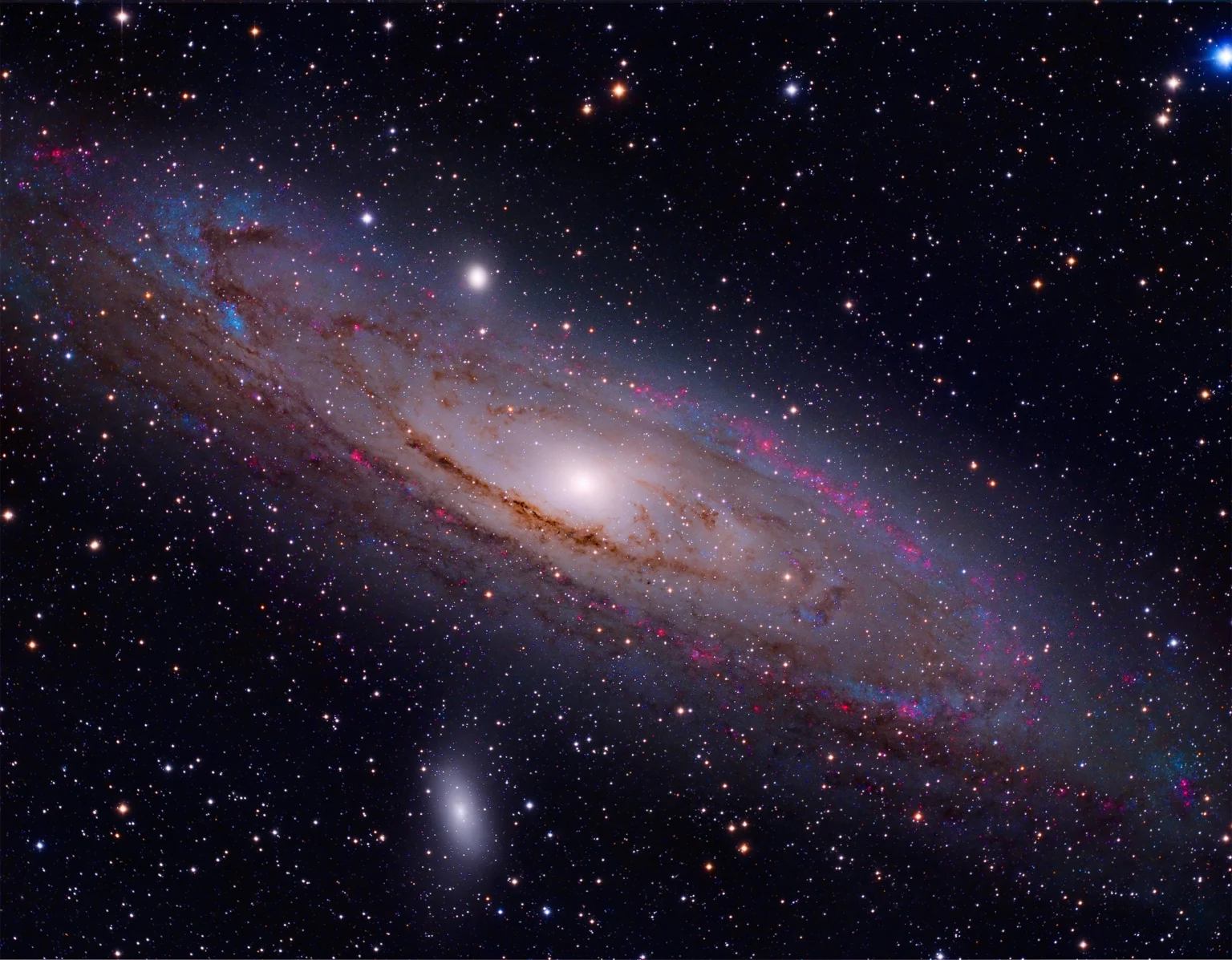
The Milky Way looks serene from Earth. On a clear night far from city lights, it stretches like a pale river of stars across the darkness, ancient and silent. For most of human history, it was a symbol of wonder, a celestial pathway for myths and dreams. Yet as our telescopes sharpened and our instruments grew more sensitive, we began to realize something unsettling.
The galaxy is not gentle.
It is a place of explosions that outshine entire galaxies, of black holes that devour stars, of radiation storms that would sterilize planets in moments. It contains colossal structures that stretch tens of thousands of light-years and mysterious signals that flicker for milliseconds and vanish. It hides objects so dense that a teaspoon of their material would weigh more than a mountain, and regions so energetic they can tear atoms apart.
These discoveries are not speculative horrors. They are measured, imaged, detected, and analyzed with rigorous science. They are real. And they reveal that our cosmic home is far more dangerous—and far more extraordinary—than we once imagined.
Here are ten of the scariest things ever discovered in the Milky Way.
1. Sagittarius A* — The Supermassive Black Hole at Our Galaxy’s Heart
At the very center of the Milky Way lies a monster.
Astronomers have tracked the orbits of stars near the galactic core for decades. These stars move at astonishing speeds, whipping around an invisible point with such velocity that only something extraordinarily massive could hold them in place. The culprit is Sagittarius A*, a supermassive black hole containing about four million times the mass of our Sun.
Unlike stellar black holes formed from collapsing stars, Sagittarius A* dominates the gravitational center of the galaxy. It is relatively quiet compared to some active galactic nuclei in distant galaxies, but “quiet” is a relative term. Occasionally, it flares in X-rays and infrared light as matter spirals inward and heats to extreme temperatures.
If you could approach it, you would find a region where gravity becomes so intense that not even light can escape. The event horizon marks a boundary beyond which all paths lead inward. Inside, according to classical general relativity, lies a singularity—a point where density becomes infinite and our understanding of physics breaks down.
Sagittarius A* is currently about 26,000 light-years away from Earth, posing no immediate danger. But its presence is a stark reminder: at the heart of our galaxy lies an object that warps space and time themselves.
2. Magnetars — The Most Powerful Magnets in the Universe
Some stars die quietly. Others go out in violence. But a few leave behind something even more terrifying.
Magnetars are a rare type of neutron star—ultra-dense remnants of massive stars that have undergone supernova explosions. What makes magnetars extraordinary is their magnetic field strength. They possess the strongest magnetic fields known in the universe, trillions of times stronger than Earth’s magnetic field.
One of the most studied examples is SGR 1806-20. In 2004, it emitted a giant flare so powerful that it briefly affected Earth’s ionosphere, despite being about 50,000 light-years away.
If a magnetar were located within a few thousand kilometers of Earth—a purely hypothetical scenario—its magnetic field could strip data from credit cards and disrupt atomic structures. At closer distances, it would be catastrophic for life.
Magnetars occasionally produce starquakes—fractures in their crusts—that release enormous bursts of gamma rays. These flares can momentarily outshine everything else in the galaxy in gamma-ray wavelengths.
They are cosmic landmines, scattered through the Milky Way, waiting for the next eruption.
3. Eta Carinae — A Star on the Brink of Explosion
About 7,500 light-years from Earth lies Eta Carinae, one of the most massive and luminous star systems in our galaxy. Eta Carinae is not a single star but a binary system, with at least one component estimated to be more than 100 times the mass of the Sun.
In the 19th century, Eta Carinae underwent a massive eruption known as the Great Eruption, briefly becoming one of the brightest stars in the sky. It ejected vast amounts of material, forming the Homunculus Nebula that surrounds it today.
Stars this massive live fast and die young. Eta Carinae is expected to end its life in a supernova or possibly a hypernova explosion. Such an explosion would release immense energy and produce heavy elements forged in its core.
Although it is far enough away that it is unlikely to harm Earth directly, the thought of a nearby star capable of unleashing such energy is sobering. Supernovae can emit intense radiation and cosmic rays. In rare alignments, certain types of stellar explosions can generate gamma-ray bursts—narrow beams of radiation that, if directed at a planet, could severely damage its atmosphere.
Eta Carinae is a ticking cosmic clock, reminding us that stellar lifecycles can end in unimaginable violence.
4. The Fermi Bubbles — Gigantic Structures Towering Above the Galaxy
In 2010, data from the Fermi Gamma-ray Space Telescope revealed something astonishing: two enormous lobes of gamma-ray emission extending above and below the galactic center. These structures, now called the Fermi Bubbles, stretch roughly 25,000 light-years in each direction.
They are vast—comparable in size to half the visible Milky Way disk.
Scientists believe they may have formed from past energetic activity near Sagittarius A*, perhaps from jets of material launched when the black hole consumed large amounts of gas. Another possibility involves intense star formation and supernova-driven winds in the galactic center.
The Fermi Bubbles glow in high-energy gamma rays, indicating extreme processes at work. Their sheer scale suggests that our galaxy’s center was far more active in the past than it appears today.
The discovery was unsettling because it showed that the Milky Way is not a static, quiet structure. It has experienced episodes of explosive energy release on galactic scales.
5. Rogue Black Holes Wandering the Galaxy
Not all black holes sit neatly at galactic centers or remain bound in binary systems. Some wander.
When massive stars explode in asymmetric supernovae, the resulting neutron stars or black holes can receive powerful “kicks,” sending them hurtling through space at high speeds. These rogue black holes drift silently through the galaxy, invisible unless they interact with nearby matter.
In 2022, astronomers reported evidence of a candidate isolated black hole detected through gravitational microlensing—an effect predicted by Einstein’s general relativity, where a massive object bends and magnifies the light of a background star.
A rogue black hole passing through a planetary system could disrupt orbits. If one passed near our solar system—an extremely unlikely scenario—it could gravitationally disturb comets in the Oort Cloud, potentially increasing impact risks over long timescales.
They are dark predators, impossible to see directly, detectable only by their gravitational influence.
6. The Boötes Void-Like Dark Regions Within the Galaxy
While the true Boötes Void lies outside our galaxy, the Milky Way contains its own terrifying dark regions—vast molecular clouds so dense that they block visible light entirely.
One example is the Great Rift, a series of dark dust lanes slicing through the bright band of the Milky Way. These regions contain cold, dense gas where stars are born. But they are also opaque barriers, hiding what lies behind them.
Within these clouds, gravity slowly pulls gas together, forming protostars. Yet the same regions can harbor intense radiation fields, shock waves from nearby supernovae, and turbulent motions that create chaotic environments.
They are wombs of creation and chambers of obscurity. If something catastrophic occurred within them, we might not see it until long after its light finally pierced the dust.
7. Fast Radio Bursts from Within the Galaxy
Fast radio bursts, or FRBs, are millisecond-long flashes of radio waves that release enormous amounts of energy. For years, they were detected only from distant galaxies, making their origins mysterious.
Then, in 2020, astronomers detected an FRB from within the Milky Way, traced to a magnetar known as SGR 1935+2154. This confirmed that at least some FRBs originate from magnetars.
The burst was brief but powerful. If a similar burst occurred closer to Earth, it could potentially disrupt radio communications and satellite systems, depending on its intensity and orientation.
FRBs demonstrate that our galaxy is capable of producing sudden, extreme events that unfold faster than the blink of an eye.
8. Hypervelocity Stars Fleeing the Galactic Core
Some stars in the Milky Way are moving so fast that they can escape the galaxy’s gravitational pull entirely. These hypervelocity stars are thought to be ejected through interactions with Sagittarius A* or through close encounters in dense star clusters.
One such star, known as S5-HVS1, travels at a speed exceeding 1,700 kilometers per second.
These stellar refugees are evidence of the immense gravitational forces near the galactic center. When binary star systems venture too close to the supermassive black hole, one star can be captured while the other is flung outward at extraordinary speed.
The existence of hypervelocity stars reveals that the galactic center is not merely a passive anchor. It is a dynamic and sometimes violent region capable of slingshotting entire stars into intergalactic space.
9. The Possibility of Gamma-Ray Bursts Within the Milky Way
Gamma-ray bursts are among the most energetic events in the universe. While most detected GRBs originate in distant galaxies, they can occur in the Milky Way under specific circumstances.
Long-duration gamma-ray bursts are associated with the collapse of massive stars into black holes, while short-duration bursts are linked to neutron star mergers.
If such an event occurred within a few thousand light-years and its narrow beam were directed at Earth, it could damage the ozone layer and increase harmful ultraviolet radiation reaching the surface.
Although current observations suggest no immediate threat, the mere existence of such phenomena in principle within our galaxy underscores how delicate planetary habitability can be.
10. The Eventual Collision with the Andromeda Galaxy
The Milky Way does not exist in isolation. It is gravitationally bound to the Andromeda Galaxy, our nearest large galactic neighbor.
Measurements show that Andromeda and the Milky Way are moving toward each other. In about four to five billion years, the two galaxies are expected to collide and merge.
Individual stars are unlikely to collide directly due to vast distances between them. However, gravitational interactions will dramatically reshape both galaxies. Gas clouds will compress, triggering waves of star formation. Orbits of stars—including potentially our Sun—will be altered.
The night sky, if anyone is there to see it, will blaze with new stellar births and distorted structures.
On cosmic timescales, even galaxies are not permanent. They collide, merge, and transform.
A Fragile Haven in a Dangerous Galaxy
The Milky Way is our home. It nurtured the formation of the Sun, the Earth, and life itself. Yet it is also filled with forces and phenomena that defy comprehension in their scale and intensity.
Supermassive black holes warp spacetime. Magnetars unleash magnetic fury. Massive stars teeter on the brink of explosive death. Invisible dark matter halos shape galactic structure. High-energy bursts flicker across space with terrifying speed.
And yet, here we are.
Earth resides in a relatively calm region of the galaxy, far from the chaotic central core. Our Sun is stable. Our magnetic field shields us from much radiation. For now, we are safe.
But the discoveries listed above remind us that safety is contextual and temporary in a dynamic universe. The Milky Way is not a static painting of stars. It is an evolving, sometimes violent ecosystem of cosmic phenomena.
To study it is to confront both wonder and fear. To understand it is to recognize our smallness—and our extraordinary luck.
In the end, the scariest thing about the Milky Way may not be its black holes or exploding stars. It may be the realization that we live inside a galaxy capable of such extremes, and that we have only begun to understand the forces shaping it.
The night sky still looks peaceful. But now we know what hides behind that quiet glow.