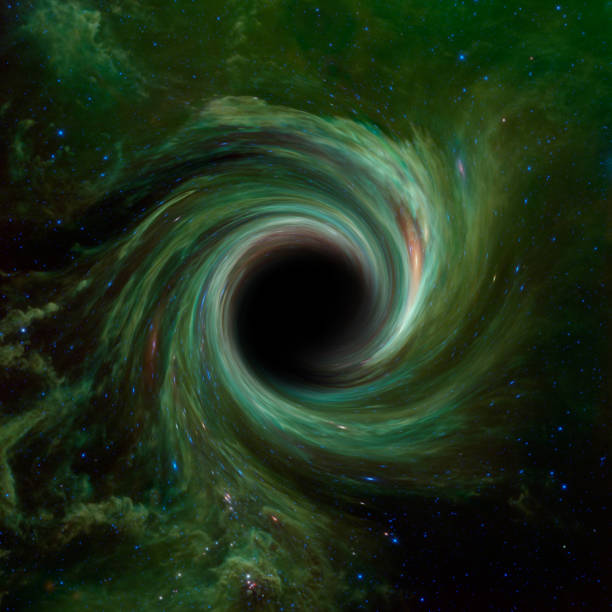
Few ideas in modern science ignite the imagination like the thought of falling into a black hole. These objects, predicted by Einstein’s theory of general relativity and now observed indirectly through gravitational waves and direct imaging, are among the most extreme entities in the universe. A black hole is not a cosmic vacuum cleaner roaming space, devouring everything in its path. It is a region of spacetime where gravity has become so intense that beyond a certain boundary—the event horizon—nothing, not even light, can escape.
To fall into one would not be like tumbling into a pit. It would be a journey through the deepest laws of physics, a descent into a realm where space and time themselves are distorted beyond recognition. What would happen to your body? How would gravity, radiation, and relativistic effects reshape your experience? Science cannot yet describe what happens at the singularity itself, but it can describe, with remarkable precision, the stages leading up to that final unknown.
The following is a scientifically grounded exploration of what would happen to your body if you fell into a non-rotating, uncharged black hole. The exact experience would differ depending on the black hole’s mass, but the fundamental physics remains the same.
1. You Would First Encounter the Accretion Disk’s Inferno
Long before you reached the event horizon, you would likely encounter the black hole’s accretion disk. Many black holes are surrounded by swirling disks of gas and dust spiraling inward. As matter falls toward the black hole, gravitational energy converts into heat through friction and compression. The temperatures in these disks can reach millions of degrees.
If you approached such a black hole without protection, the intense radiation would be lethal long before gravity itself became your primary concern. X-rays and gamma rays emitted from the superheated plasma would flood your body with ionizing radiation, breaking molecular bonds and destroying cells. This is not poetic exaggeration. High-energy radiation strips electrons from atoms, damages DNA, and causes catastrophic tissue failure.
Even if you somehow avoided the densest part of the accretion disk, the environment would be awash in extreme electromagnetic radiation. Your body, evolved for Earth’s gentle sunlight, would be overwhelmed almost instantly.
2. Gravitational Tidal Forces Would Begin to Stretch You
As you drifted closer, gravity would not feel like a uniform pull. It would feel uneven. The gravitational force on your feet—closer to the black hole—would be stronger than the force on your head. This difference is known as a tidal force.
On Earth, tidal forces from the Moon stretch oceans slightly, producing tides. Near a black hole, tidal forces become enormous.
If the black hole were relatively small, perhaps a few times the mass of the Sun, these tidal forces would intensify rapidly as you approached the event horizon. The difference in gravitational pull between your feet and head would grow to devastating levels.
Your body would begin to elongate. Bones, muscles, organs—all would experience differential gravitational acceleration. The process has a dramatic name: spaghettification.
3. Spaghettification Would Tear Your Body Apart
Spaghettification is not a metaphor in physics; it is a direct consequence of extreme tidal gravity. As the gravitational gradient increases, your body would be stretched along the direction toward the black hole and compressed sideways.
Your spine would be pulled apart. Your internal organs would be stretched into elongated strands. The forces required to overcome molecular bonds are immense, but near a stellar-mass black hole, tidal forces exceed them well before you cross the event horizon.
Eventually, the difference in gravitational pull between adjacent parts of your body would surpass the structural integrity of tissue. Cells would rupture. Atoms would be torn from molecules. Your body would disintegrate into a stream of matter, stretched thin like a cosmic filament.
This process would occur in fractions of a second for a small black hole.
4. Time Would Appear to Slow from the Outside
If someone were observing you from a safe distance, they would see something strange. As you approached the event horizon, your motion would appear to slow down.
This is gravitational time dilation, a prediction of general relativity. The stronger the gravitational field, the slower time passes relative to distant observers.
From the outside perspective, you would appear to freeze at the edge of the event horizon, becoming increasingly redshifted as your light stretched to longer wavelengths. Eventually, you would fade from view.
From your own perspective, however, nothing unusual would happen at the horizon itself—assuming the black hole is large enough that tidal forces are not yet lethal. Time would feel normal to you. You would cross the event horizon without noticing a distinct boundary.
This difference between perspectives is one of the most profound and unsettling aspects of black hole physics.
5. You Would Cross the Event Horizon Without Warning
The event horizon is not a physical surface. It is a boundary in spacetime, a point of no return. There is no wall, no glowing barrier. If the black hole were supermassive—like the one at the center of the Milky Way—the tidal forces at the horizon could be relatively mild.
In such a case, you could pass the event horizon without immediate destruction. You would not feel a jolt. There would be no sudden flash.
But once inside, all paths through spacetime would lead inward. The singularity would lie in your future the way tomorrow lies in your future now. Moving toward it would be as inevitable as moving forward in time.
Escape would no longer be physically possible.
6. The Outside Universe Would Appear Distorted
Inside the event horizon, your view of the universe would change dramatically. Light from outside could still reach you for a while, depending on your trajectory. However, gravitational lensing would distort your field of vision.
The entire external universe might appear compressed into a bright, shrinking patch above you. Light from different directions would bend, creating warped images of stars and galaxies.
Relativistic effects would intensify. Frequencies of light would shift. Time dilation would continue relative to distant observers. The geometry of spacetime would no longer resemble anything familiar.
It would be a visual experience unlike any other—beautiful and horrifying at once.
7. Tidal Forces Would Eventually Become Overwhelming
Even if you survived crossing the event horizon of a supermassive black hole, tidal forces would increase as you moved closer to the singularity.
The mathematics of general relativity shows that as the radial coordinate approaches zero, tidal forces diverge. The difference in gravitational acceleration between parts of your body would grow without bound.
At some point, regardless of the black hole’s size, these forces would exceed the strength of atomic bonds. Your body would be pulled apart at the molecular level.
Atoms would separate into nuclei and electrons. Eventually, even nuclei might be disrupted.
The process would not be gradual in a human sense. It would unfold rapidly, driven by the curvature of spacetime itself.
8. Your Atoms Would Be Compressed Toward Extreme Densities
As your remains approached the central region, they would be forced into smaller and smaller volumes. In classical general relativity, this leads to a singularity—a point of infinite density.
Infinite density is almost certainly a sign that our current theories are incomplete. Quantum gravity effects, not yet fully understood, should become important at such scales.
However, from the standpoint of known physics, matter falling toward the singularity would be crushed into extreme densities, beyond anything encountered elsewhere in the universe.
The familiar structure of matter—atoms, nuclei, particles—would no longer apply in any meaningful way.
9. Information About You Would Raise Profound Paradoxes
Even after your physical destruction, a deeper mystery would remain. What happens to the information describing your body?
Quantum mechanics states that information cannot be destroyed. Yet if you fall into a black hole that eventually evaporates via Hawking radiation, the radiation appears random. Does it encode the information that once described you?
This is the black hole information paradox. It is not merely philosophical; it strikes at the heart of fundamental physics.
Some theoretical frameworks suggest that information is preserved in subtle correlations in Hawking radiation. Others propose holographic principles, where information is encoded on the event horizon’s surface.
Your fall would thus contribute to one of the deepest unsolved problems in modern science.
10. Your Final Moments Would Be Unknown
As you approached the singularity, classical physics would lose predictive power. The curvature of spacetime would become extreme. Quantum gravitational effects would dominate.
We do not yet possess a complete theory of quantum gravity. Therefore, we cannot describe with certainty what happens at the exact center.
Does spacetime tear itself apart? Does the singularity resolve into a finite structure? Does it connect to another region of spacetime? Current evidence does not allow definitive answers.
What we can say is that within a finite amount of your own proper time after crossing the event horizon, you would reach this central region. Your journey would end not in fire or explosion, but in a breakdown of known physical law.
The ultimate fate of your matter—and the information it carried—remains one of the great open questions of theoretical physics.
The Terror and the Truth
Falling into a black hole is terrifying not because it is dramatic, but because it is real. Black holes exist. Their gravitational fields behave exactly as predicted by general relativity. The tidal forces, the time dilation, the event horizon—all are grounded in well-tested physics.
Yet black holes also mark the limits of our understanding. They are places where our most successful theories collide and fail to fully describe reality.
Your body would not survive such a fall. It would be stretched, torn, and compressed by forces beyond imagination. Time and space would warp. The external universe would distort and fade. And at the end, you would encounter a region where science itself still searches for answers.
In contemplating such an extreme fate, we glimpse both the power and the humility of physics. We can calculate with precision what gravity would do to flesh and bone. But we cannot yet describe the final chapter.
The black hole stands as a reminder that the universe is not built for human comfort. It is vast, indifferent, and governed by laws that operate whether we understand them or not.
And somewhere, in the dark heart of a collapsed star, those laws continue their relentless, silent work.