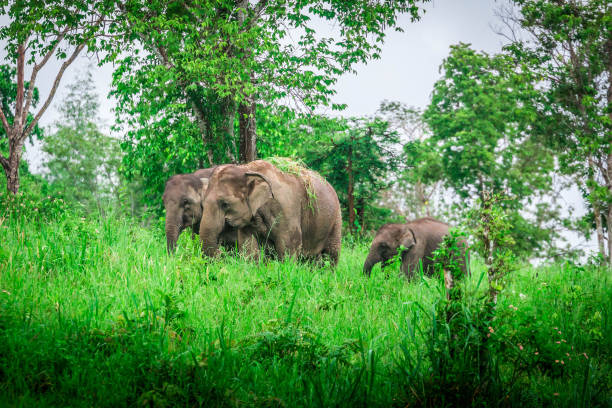
Few animals have inspired as much awe as elephants. They are giants of the natural world—massive, quiet-footed, and strangely gentle for creatures that can weigh as much as a truck. They move through forests and savannas like living monuments, and yet what truly makes elephants legendary is not their size or strength, but their mind.
For centuries, humans have repeated the phrase: “An elephant never forgets.” It appears in folklore, children’s stories, and everyday conversation. But unlike many animal myths, this one is rooted in reality. Elephants do appear to possess an extraordinary memory, capable of recognizing individuals after decades, recalling migration routes across vast landscapes, and remembering the locations of water holes even after years of drought.
But why?
What is happening inside an elephant’s brain that allows such powerful memory? Is it simply because their brains are large? Or is there something more specialized—something shaped by evolution, social life, and survival?
To understand why elephants seem unable to forget, we must step into the world of neuroscience, animal behavior, and evolution. The answer is not magical, but it is astonishing.
The Myth and the Reality of Elephant Memory
The idea that elephants never forget is not literally true. Elephants can forget, just as any biological brain can. Their memories are not perfect recordings of the past. They can make mistakes, become confused, or fail to recall information. But the reason the phrase survives is that elephants demonstrate memory skills that appear far beyond what most animals can do.
Elephants have been observed recognizing family members after separations lasting many years. They remember the voices and scents of individuals. They respond differently to the calls of familiar elephants compared to strangers. They show signs of recalling danger, such as the scent of predators or the sound of hostile humans. They remember pathways and seasonal changes across enormous territories. They can even recognize the bones of deceased relatives and behave with what looks like mourning or reverence.
These behaviors suggest something remarkable: elephants do not just remember facts. They remember experiences. They remember relationships. They remember emotional meaning.
That kind of memory is deeply tied to brain architecture.
Elephant Brains: A Giant Organ with Unique Design
The elephant brain is one of the largest brains on Earth. An adult elephant brain can weigh around 4 to 6 kilograms, depending on species and individual size. This makes it much larger than the human brain, which weighs about 1.3 to 1.4 kilograms on average.
But raw brain weight is not the whole story. A whale’s brain can be larger than an elephant’s, yet whales do not display the same kind of land-based navigational memory or complex family recognition that elephants are famous for. Memory depends not just on brain size, but on brain structure and the distribution of neurons.
What makes the elephant brain truly fascinating is its complexity. It is packed with folds, ridges, and deep grooves that increase surface area, allowing for more neural circuitry. Like humans, elephants have highly developed cerebral cortices—the outer layer of the brain involved in perception, decision-making, and complex cognition.
Yet elephants also possess something even more striking: an unusually large and intricate temporal lobe system, the region most associated with memory and emotional processing.
This is where the real story begins.
The Hippocampus: The Brain’s Memory Library
In humans, the hippocampus is one of the most critical brain structures for forming new memories. It helps convert short-term experiences into long-term stored information. Damage to the hippocampus can cause severe memory impairment, where a person can no longer form new memories, even if old memories remain intact.
Elephants have a well-developed hippocampus. While its relative size compared to overall brain volume is not always dramatically larger than in some other mammals, its connectivity and relationship with surrounding memory-related structures appears highly specialized.
The hippocampus is deeply involved in spatial memory—remembering where things are. This is essential for elephants. They migrate across landscapes that can stretch hundreds of kilometers. They must remember water sources, feeding grounds, safe routes, and the locations of seasonal vegetation.
Unlike smaller animals that live in limited territories, elephants inhabit huge ecological maps. Their survival depends on long-term navigation.
A strong hippocampus is not a luxury for elephants. It is life insurance.
The Temporal Lobes: The Elephant Brain’s Emotional Memory Engine
If the hippocampus is the librarian of memory, the temporal lobes are the storytellers. In mammals, the temporal lobes are heavily involved in processing sound, recognizing individuals, and storing emotionally meaningful memories.
Elephants have extremely large temporal lobes compared to many other animals. Scientists have suggested that this is one reason elephants show advanced social recognition, communication skills, and emotional memory.
Elephants rely heavily on sound. They communicate through low-frequency rumbles that can travel through the air and even through the ground. They can detect vibrations through their feet and interpret distant calls. Their survival and social life depend on remembering voices.
The temporal lobe is where sound becomes meaning. It helps an elephant distinguish between the call of a sister, a rival, a calf, or a dangerous stranger.
More importantly, the temporal lobes work closely with the limbic system—the brain network involved in emotions. This means elephant memory is deeply intertwined with emotional experience.
They don’t just remember “this place has water.” They remember “this place saved us during drought.” They don’t just remember “this voice belongs to another elephant.” They remember “this elephant is family.”
Emotion strengthens memory. That is true in humans, and it appears to be true in elephants.
The Amygdala: Fear, Survival, and Long-Term Recall
Another key structure in memory is the amygdala. In humans and many other animals, the amygdala plays a major role in emotional learning, especially fear-based learning. It helps the brain tag certain experiences as dangerous or important.
Elephants have large and complex amygdalae, which likely contributes to their ability to remember threats over long periods. This makes evolutionary sense.
An elephant may encounter a predator, a poacher, or a hostile human only a few times in its life. But if it forgets that danger, it may not survive the next encounter. Elephants that remembered threats passed on that knowledge—directly through behavior and indirectly through survival.
Researchers have observed that elephants can distinguish between different human groups based on clothing color, scent, and voice. In areas where elephants have been attacked by humans, they show heightened stress responses when they detect human cues. They may flee sooner, form defensive circles around calves, or become more alert.
This suggests elephants can form long-lasting memories of danger and connect them to specific sensory patterns.
The amygdala does not store memories like a filing cabinet. Instead, it intensifies memory formation in the hippocampus and cortex when an event is emotionally significant. It is like a stamp that says: “Never forget this.”
In elephants, that stamp may be exceptionally powerful.
Neurons and the Elephant Brain: It’s Not Just Size
One of the most surprising discoveries in modern neuroscience is that bigger brains do not always mean more neurons in the cortex. Neurons are the computational units of the brain, and their number and connectivity matter greatly.
Elephants have a very high number of neurons overall, but a huge portion of their neurons are located in the cerebellum, a brain region involved in movement coordination and fine motor control. This is logical, since elephants must coordinate enormous bodies, trunks, delicate trunk movements, and complex walking patterns.
However, elephants also have sophisticated cortical networks. Their prefrontal cortex, the region linked to decision-making and social judgment, is developed enough to support problem-solving and emotional intelligence.
Memory is not only about storing information. It is about organizing it, connecting it, retrieving it at the right moment, and using it to guide behavior. Elephants appear to have neural architecture that supports this kind of flexible memory.
Their memory is not robotic. It is adaptive.
Social Life: The Evolutionary Reason Elephants Remember So Much
Elephants do not live solitary lives. Their intelligence is deeply shaped by their social world.
Elephant societies are among the most complex of any land mammal. Female elephants typically live in tight family groups led by a matriarch, usually the oldest and most experienced female. The matriarch is not simply a leader by strength. She is a leader by memory.
She remembers migration routes. She remembers where food appears after rains. She remembers which water holes last the longest during drought. She remembers the locations of safe shelters and the regions where predators are common.
Her knowledge is not abstract. It is survival knowledge. In harsh conditions, the memory of an old matriarch can mean the difference between life and death for the entire herd.
Studies have shown that elephant herds led by older matriarchs often respond more appropriately to threats. They are better at recognizing danger and making decisions. This suggests that long-term memory improves group survival.
Evolution strongly rewards this.
In species where survival depends on experience, natural selection favors individuals who can store and retrieve information across decades.
Elephants live long lives—often 60 to 70 years. Their memory has time to accumulate. And their social structure gives memory a purpose: passing wisdom to younger generations.
Learning by Observation: Memory as Cultural Transmission
Elephants are not born knowing everything they need. Calves learn by watching older elephants. They observe how to use the trunk to drink water, how to strip bark from trees, how to avoid danger, and how to interact socially.
This learning requires memory. But more importantly, it creates what scientists call culture: behaviors passed through social learning rather than genetics.
Elephants show evidence of cultural knowledge, such as preferred migration routes and feeding techniques that differ between populations. When older elephants die, younger elephants may lose access to critical information, causing disruptions in herd behavior.
This cultural dimension makes elephant memory even more valuable. Their brains are not just storing personal experiences. They are storing the history of their community.
In a way, an elephant herd is a living library, and the matriarch is the oldest book.
Emotional Memory: Why Elephants Remember Pain and Love
Elephants are known for strong emotional bonds. They greet each other with touching trunks, rubbing bodies, and vocalizations. They show distress when separated. They care for injured members. They attempt to lift weak calves. They sometimes remain near dead elephants, touching bones and tusks.
These behaviors suggest elephants form memories that are emotionally weighted.
In neuroscience, emotionally charged experiences are more likely to be stored long-term. This happens in humans too. You may forget what you ate three weeks ago, but you remember a moment of heartbreak, fear, or joy from years ago. Emotion signals importance to the brain.
Elephants likely experience a similar effect. Their brains may strongly encode events tied to bonding, trauma, or survival.
This is why elephants can appear to remember cruelty. In areas affected by poaching, elephants have been known to become more aggressive or more fearful toward humans. Trauma can shape behavior long after the event has passed.
But memory is not only about fear. It is also about affection. Elephants can recognize companions after long separations and show excitement. They can remember social alliances and rivalries.
Their memory is deeply social. It carries the emotional fingerprints of their relationships.
Scent Memory: The World Through the Elephant’s Nose
Humans rely heavily on vision. Elephants rely heavily on smell.
An elephant’s sense of smell is among the most powerful in the animal kingdom. Their trunks contain thousands of muscles and function like living sensory tools. They can pick up subtle chemical cues from the air, identify water sources, detect predators, and recognize other elephants.
Scent is strongly tied to memory because smell information goes directly into brain regions associated with emotion and long-term recall. In humans, smells can trigger sudden memories with vivid emotional detail. This happens because olfactory pathways connect closely with the limbic system.
Elephants likely experience this effect on a much larger scale. Their environment is filled with scent signals: the smell of rain, the smell of distant herds, the smell of ripe fruit, the smell of danger.
When elephants “remember” a place, they may not remember it visually like humans do. They may remember it chemically. The land itself has a scent map, and elephants are skilled at reading it.
This may help explain their ability to navigate long distances and return to specific locations after years.
Spatial Memory: The Mental Map of a Giant Traveler
One of the most impressive elephant abilities is long-distance navigation. Elephants can travel across deserts, grasslands, forests, and river systems, often following routes that appear to be consistent over generations.
They do not rely on written maps. They do not have GPS. Yet they find water holes and seasonal feeding grounds with precision that seems almost supernatural.
This is spatial memory in action.
The hippocampus plays a major role in building mental maps. In many animals, including rodents and humans, hippocampal neurons called place cells activate when an individual is in a specific location. Other neurons, called grid cells, help measure distance and direction.
Elephants likely have sophisticated versions of these neural systems. Their brains must integrate memory with sensory cues like smell, sound, and even ground vibrations.
They may also use environmental markers such as mountain ranges, tree formations, and riverbeds. Over time, these cues become part of a vast internal map.
This map is not simply stored as a picture. It is stored as a network of associations: this smell leads to water, this direction leads to safety, this valley leads to food during drought.
Their memory is not just long-term. It is functional.
Do Elephants Actually Remember for Decades?
Evidence strongly suggests that elephants can retain certain memories for decades.
Researchers have observed elephants recognizing calls of individuals they had not encountered in many years. Elephants in captivity have been reunited after long separations and shown clear signs of recognition, excitement, and emotional response. Wild elephants have been seen reacting differently to familiar versus unfamiliar elephants, even when the familiar one had not been seen for long periods.
The best examples often involve matriarchs remembering distant water sources. During severe droughts, older matriarchs have led herds to places that younger elephants had never visited, implying knowledge stored from past drought periods.
These are not short-term memories. These are life-long survival memories.
In neuroscience, long-term memory storage requires stable neural pathways. The brain strengthens certain synaptic connections through processes such as long-term potentiation, where repeated or meaningful stimulation makes a connection more durable.
In elephants, the combination of emotional significance and repeated life experience may create exceptionally strong memory networks.
Intelligence and Memory: More Than Just Storage
Memory is not the same as intelligence, but the two are deeply linked. Elephants display behaviors that suggest advanced cognition: problem-solving, tool use, cooperation, empathy, and even self-recognition.
Some elephants have passed the mirror self-recognition test, a classic measure of self-awareness. This suggests they possess a sense of self, which is often connected to advanced memory processing.
Self-awareness requires remembering one’s own body, identity, and past experiences. It requires recognizing “this is me.” It requires a mind capable of building an internal narrative.
Elephants may not think exactly like humans, but they seem to have complex inner lives. Their memory may function as part of that mental richness.
They do not simply store information like a hard drive. They interpret it, connect it, and respond to it socially.
Elephant Memory Compared to Human Memory
Humans have extraordinary memory capabilities, but our memory is also flawed. We forget constantly. We distort past events. We misremember details. Our brains are designed not to preserve everything, but to preserve what matters.
Elephants appear to operate similarly, but with different priorities. Their memory seems especially strong in areas crucial to their survival: geography, water sources, social bonds, and threats.
Humans often use written language and technology to outsource memory. We store information in books, phones, and computers. Elephants cannot do that. Their memory must remain biological. Their brain is their archive.
Also, elephants have much longer lifespans than many mammals. A human may live 70 or 80 years, while an elephant can live a similar length. That means their brains are designed to retain useful knowledge across decades, not just years.
Both species have long childhoods, extended learning periods, and complex social lives. These traits tend to evolve alongside advanced memory.
In many ways, elephants and humans are cognitive cousins shaped by similar evolutionary pressures, even though our lineages are very different.
Trauma and the Dark Side of Elephant Memory
There is a painful truth hidden inside the phrase “elephants never forget.” A powerful memory system does not only preserve good experiences. It also preserves suffering.
Elephants have been subjected to intense human violence, especially through poaching and habitat destruction. Many elephant populations have experienced the loss of family members, often killed in front of them. Calves have been orphaned. Herd structures have been shattered.
In some regions, elephants show signs of what appears to be long-term psychological stress. They may become unusually aggressive, anxious, or unpredictable. They may show abnormal social behaviors.
While it is difficult to diagnose animals with human psychological conditions, the evidence suggests elephants can carry long-lasting emotional scars. Their memory may store trauma with haunting clarity.
This is not surprising. The same brain structures that strengthen survival memory—like the amygdala—also strengthen traumatic memory.
Elephant memory is powerful, but that power comes with a cost.
Why Evolution Built Such Powerful Memory in Elephants
Evolution does not create traits because they are impressive. It creates traits because they increase survival and reproduction.
Elephants evolved in environments where memory is a survival weapon. Their habitats often include seasonal changes, drought cycles, and unpredictable resources. Water may be abundant one year and scarce the next. Food sources shift with rainfall. Predators threaten calves. Humans pose enormous danger.
In such conditions, remembering the landscape is essential.
Elephants also evolved in complex social groups where relationships matter. Cooperation helps defend calves. Knowledge sharing improves survival. Social stability depends on recognizing individuals and remembering past interactions.
A strong memory system allows elephants to maintain alliances, avoid conflicts, and support kin.
In addition, elephants have slow reproduction rates. Females have long pregnancies and raise calves for years. Losing a calf is a major evolutionary loss. Therefore, natural selection favors any cognitive ability that improves calf survival, including remembering safe areas and dangerous ones.
Over millions of years, the elephant brain became a machine built for long-term knowledge.
Not because elephants wanted wisdom, but because nature demanded it.
Can Elephants Forget Anything?
Despite their reputation, elephants can forget. Like any brain, theirs is not infinite. Memory fades if it is not reinforced. Some information becomes irrelevant and disappears. Older elephants can show signs of aging, and aging can affect cognition.
However, elephants appear to have an impressive ability to retain key survival memories for extremely long periods. Their forgetting is selective. They do not waste memory on trivial details. They store what matters.
And perhaps that is the secret behind their legendary recall. Their brain is not burdened with meaningless clutter. It is tuned by evolution to preserve the information most essential to life.
In that sense, elephants may forget less not because they are supernatural, but because their memory system is extremely well adapted.
The Real Answer: Why Elephants “Never Forget”
Elephants are not magical creatures with perfect recall, but they do have one of the most powerful memory systems in the animal kingdom. Their remarkable memory comes from a combination of brain structure, social complexity, and evolutionary necessity.
They have large and highly developed temporal lobes, strong limbic system structures like the amygdala, and hippocampal networks built for spatial mapping. They rely heavily on smell and sound, both deeply tied to memory. They live long lives, which allows memories to accumulate and remain useful. They survive in environments where remembering water, danger, and migration routes is essential. They form deep social bonds, making individual recognition and emotional memory crucial.
Their memory is not just about intelligence. It is about survival, love, fear, and history.
When people say “elephants never forget,” they are touching on a real truth: elephants carry the past with them in a way that feels almost human. They remember where they came from, who they belong to, and what the world has done to them.
And that is why elephants inspire such deep respect. They are not just animals walking through the landscape. They are living minds, shaped by time, holding memories that may stretch back decades.
In an age where humans often forget too quickly—forget ecosystems, forget responsibility, forget the cost of destruction—the elephant stands as a reminder of something powerful.
Some memories are too important to lose.