Most people think of weather as something that happens in Earth’s atmosphere. We check forecasts before traveling, watch storms develop on radar, and prepare for hurricanes, floods, or snowstorms. These events affect our daily lives, but they all occur relatively close to the surface of our planet.
Far above the clouds, however, another kind of weather is constantly unfolding.
It is invisible to our eyes. It does not bring rain or snow. It does not create thunderstorms in the traditional sense. Yet it has the power to disrupt satellites, interfere with GPS navigation, affect radio communications, damage spacecraft, and even shut down electrical power grids across entire regions.
This phenomenon is known as space weather.
Space weather originates from our Sun, a star that appears calm and steady from Earth but is actually a dynamic, turbulent, and sometimes violent object. The Sun continuously releases energy, radiation, and streams of charged particles into space. Most of the time, Earth’s magnetic field protects us from these solar emissions. But when solar activity becomes particularly intense, the effects can ripple through our technological civilization in surprising and sometimes dangerous ways.
In the modern world, where electricity powers nearly every aspect of society, understanding space weather has become more important than ever. The same star that makes life possible on Earth can also pose risks to the infrastructure upon which billions of people depend.
Understanding Space Weather
Space weather refers to the changing environmental conditions in space that are influenced primarily by the Sun.
Just as Earth’s weather involves wind, temperature, pressure, and storms, space weather involves solar radiation, magnetic fields, and streams of charged particles moving through the solar system.
The Sun is constantly sending material outward into space. This flow, called the solar wind, carries charged particles such as electrons and protons across vast distances.
Earth exists within this stream.
Most of the time, the solar wind is relatively steady. However, the Sun occasionally produces bursts of energy and matter that dramatically alter conditions throughout the solar system.
When these solar events reach Earth, they can interact with our planet’s magnetic field and atmosphere, creating effects that range from beautiful auroras to widespread technological disruptions.
Space weather is therefore not weather in the traditional sense. Instead, it is the changing state of the space environment surrounding Earth and other planets.
The Sun: The Source of Space Weather
To understand space weather, we must first understand the Sun.
The Sun is not a solid object. It is an enormous sphere of hot plasma—a state of matter in which electrons have been separated from atomic nuclei.
At its core, nuclear fusion converts hydrogen into helium, releasing immense amounts of energy.
Every second, the Sun produces more energy than humanity could use in millions of years.
Most of this energy reaches Earth as sunlight and heat, supporting life across the planet.
Yet the Sun is also magnetically active.
Its magnetic field twists, stretches, tangles, and reconnects in complex ways. These magnetic processes can release enormous bursts of energy into space.
The Sun is therefore not merely a source of light and warmth. It is also the engine that drives space weather throughout the solar system.
The Dynamic Surface of the Sun
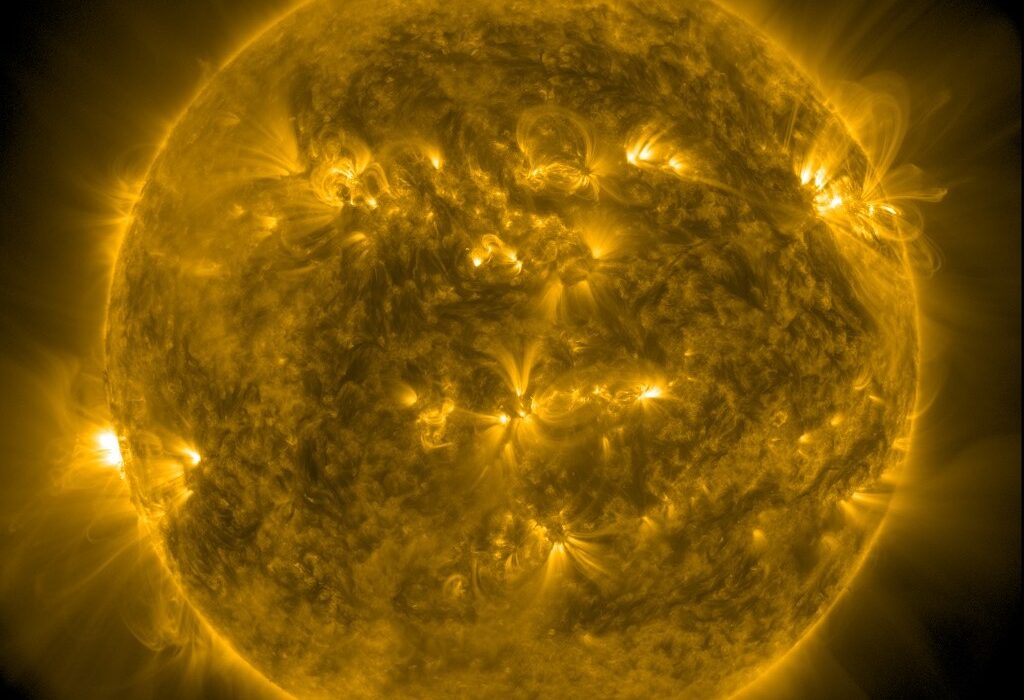
From a distance, the Sun appears smooth and unchanging.
Through powerful telescopes, however, astronomers observe a very different reality.
The solar surface constantly churns with activity.
Hot plasma rises from the Sun’s interior and sinks back down again. Powerful magnetic fields emerge from beneath the surface, creating regions of intense activity.
These regions often appear as dark patches known as sunspots.
Sunspots are cooler than their surroundings, making them appear darker when viewed against the bright solar surface.
Although they may seem insignificant, sunspots often mark areas where powerful magnetic forces are concentrated.
Many major space weather events originate near these active regions.
What Are Sunspots?
Sunspots have fascinated observers for centuries.
They can vary enormously in size. Some are larger than Earth itself.
The number of sunspots visible on the Sun changes over time according to a roughly 11-year cycle known as the solar cycle.
During solar minimum, relatively few sunspots are present.
During solar maximum, sunspots become much more numerous.
The solar maximum phase is typically associated with increased solar activity, including solar flares and coronal mass ejections.
Because of this relationship, astronomers closely monitor sunspot activity as an indicator of potential space weather conditions.
When many large sunspots appear, the likelihood of significant solar storms generally increases.
Solar Flares: Explosions on the Sun
One of the most dramatic forms of solar activity is the solar flare.
A solar flare occurs when magnetic energy stored within the Sun’s atmosphere is suddenly released.
The amount of energy involved is almost impossible to comprehend.
A powerful solar flare can release energy equivalent to billions of nuclear bombs exploding simultaneously.
These events emit radiation across the electromagnetic spectrum, including visible light, ultraviolet radiation, and X-rays.
The radiation travels at the speed of light.
As a result, the effects of a solar flare can begin reaching Earth in just over eight minutes.
Solar flares can disrupt radio communications, affect satellite operations, and alter conditions in Earth’s upper atmosphere.
They represent some of the most energetic events in the solar system.
Coronal Mass Ejections
While solar flares release enormous amounts of energy, another phenomenon often poses a greater threat to technological systems.
These events are known as coronal mass ejections, commonly abbreviated as CMEs.
A coronal mass ejection occurs when the Sun ejects billions of tons of plasma into space.
This plasma carries embedded magnetic fields and can travel at speeds exceeding several million kilometers per hour.
Unlike solar flare radiation, which arrives within minutes, a CME typically takes one to several days to reach Earth.
When a CME strikes Earth’s magnetic field, the results can be dramatic.
The interaction can trigger geomagnetic storms capable of affecting satellites, communication systems, and electrical infrastructure.
Some of the most significant space weather events in recorded history have been caused by powerful coronal mass ejections.
The Solar Wind
Even in the absence of major solar storms, the Sun continuously emits the solar wind.
This stream of charged particles flows outward in all directions.
The solar wind shapes much of the space environment throughout the solar system.
Planets, moons, comets, and spacecraft all exist within its influence.
The solar wind is not constant.
Its speed, density, and magnetic properties vary over time.
Changes in the solar wind contribute to everyday space weather conditions.
Most of the time, Earth handles these variations without difficulty.
However, periods of enhanced solar wind activity can intensify geomagnetic disturbances and increase the likelihood of technological impacts.
Earth’s Magnetic Shield
Fortunately, Earth possesses an important defense system.
Our planet generates a magnetic field produced by movements within its molten outer core.
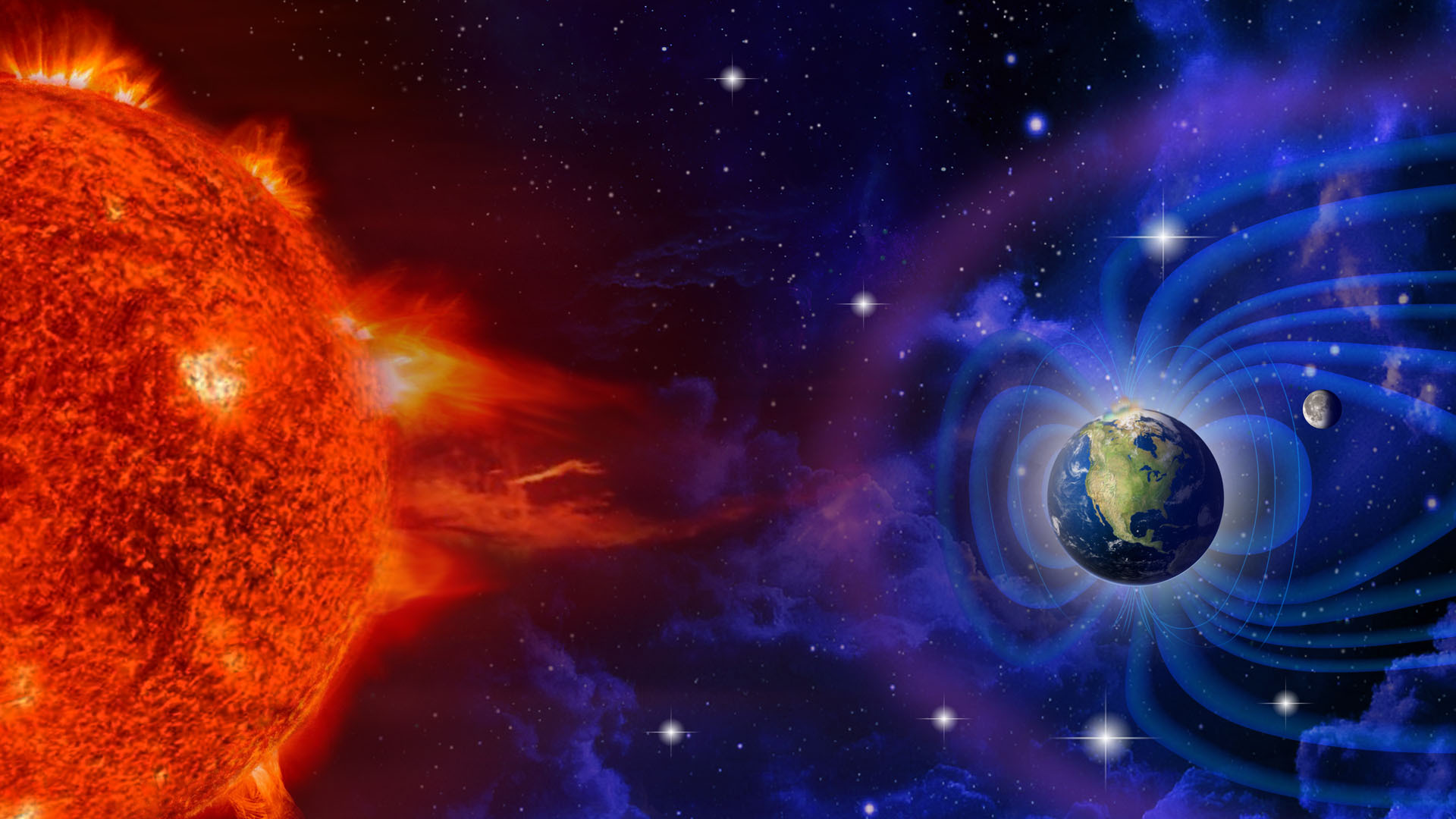
This magnetic field extends far into space, creating a protective region known as the magnetosphere.
The magnetosphere acts like a giant shield.
It deflects much of the solar wind and prevents large amounts of harmful charged particles from reaching Earth’s surface.
Without this protection, life on Earth would face far greater exposure to energetic radiation from space.
The magnetosphere is not invulnerable, however.
Powerful solar storms can compress, distort, and energize this magnetic shield, creating conditions that affect both space-based and ground-based technologies.
What Happens During a Geomagnetic Storm?
When a coronal mass ejection reaches Earth, its magnetic field interacts with Earth’s own magnetic field.
If conditions are favorable, large amounts of energy can be transferred into the magnetosphere.
This process can trigger a geomagnetic storm.
During a geomagnetic storm, Earth’s magnetic environment becomes highly disturbed.
Charged particles accelerate through space.
Electrical currents intensify within the magnetosphere and upper atmosphere.
Magnetic fields fluctuate rapidly.
These disturbances can last for hours or even days.
Although people on the ground may not notice anything unusual, critical technologies can experience significant effects.
Geomagnetic storms represent one of the primary reasons why space weather matters to modern civilization.
The Beautiful Side of Space Weather
Not all space weather effects are harmful.
Some produce some of the most spectacular natural displays on Earth.
Auroras, commonly known as the Northern and Southern Lights, occur when charged particles from space interact with gases in Earth’s upper atmosphere.
These interactions cause atmospheric atoms and molecules to emit light.
The result is a breathtaking display of glowing curtains, arcs, and waves dancing across the sky.
Green, red, purple, and blue colors ripple across polar regions in patterns that seem almost magical.
Strong geomagnetic storms can push auroras much farther from the poles than usual.
During particularly intense events, auroras may become visible in regions where they are rarely seen.
These displays are beautiful reminders that Earth remains connected to the activity of our star.
Why Modern Society Depends on Electricity
To appreciate the importance of space weather, consider how dependent modern civilization has become on electrical power.
Electricity powers homes, hospitals, transportation systems, communication networks, financial institutions, water treatment facilities, and countless other services.
A large-scale power outage affects far more than lighting.
It can disrupt food distribution, emergency services, telecommunications, healthcare, and transportation.
Modern economies rely on continuous access to electricity.
This dependence means that any threat to electrical infrastructure deserves serious attention.
Space weather represents one such threat.
While major geomagnetic storms are relatively rare, their potential consequences can be substantial.
How Space Weather Affects Power Grids
The connection between solar activity and electrical power grids may seem surprising.
After all, the Sun is approximately 150 million kilometers away.
Yet geomagnetic storms can create electrical effects that reach directly into power systems on Earth.
When Earth’s magnetic field changes rapidly during a geomagnetic storm, electric fields can be induced within the ground.
This process follows basic principles of electromagnetism.
Changing magnetic fields generate electric currents.
These currents can flow through long conductive structures such as pipelines, railway systems, and power transmission lines.
In power grids, these induced currents are known as geomagnetically induced currents.
These currents can enter transformers and other critical equipment.
Under severe conditions, they can cause overheating, damage components, and disrupt normal operations.
Transformers: The Vulnerable Heart of the Grid
Transformers are among the most important pieces of electrical infrastructure.
They adjust voltage levels, allowing electricity to be transmitted efficiently across long distances.
Modern power grids depend heavily on large transformers.
Unfortunately, transformers can be vulnerable to geomagnetically induced currents.
When excessive currents enter a transformer, they may push it beyond normal operating conditions.
This can lead to overheating, reduced efficiency, and physical damage.
Replacing large transformers is not always easy.
Some require months to manufacture and install.
As a result, protecting these critical components has become a major focus of space weather preparedness efforts.
The Famous Quebec Blackout of 1989
One of the most significant examples of space weather affecting a power grid occurred in March 1989.
A powerful geomagnetic storm struck Earth following intense solar activity.
The storm generated geomagnetically induced currents within the electrical grid serving the Canadian province of Quebec.
Within seconds, portions of the power system failed.
Millions of people lost electricity.
The blackout lasted approximately nine hours.
Although power was eventually restored, the event demonstrated that space weather could produce real-world consequences for modern infrastructure.
The Quebec blackout became a turning point in efforts to understand and mitigate space weather risks.
The Carrington Event
Perhaps the most famous solar storm in history occurred in 1859.
Known as the Carrington Event, it remains the strongest geomagnetic storm ever reliably recorded.
The event was named after astronomer Richard Carrington, who observed an extraordinary solar flare shortly before the storm reached Earth.
Telegraph systems around the world experienced disruptions.
Operators reported sparks, shocks, and equipment failures.
Some telegraph lines continued operating even after being disconnected from their power supplies because geomagnetically induced currents provided enough electricity to transmit messages.
Auroras appeared at unusually low latitudes, illuminating skies far from the polar regions.
If a storm of similar magnitude occurred today, its effects could be far more significant because modern society depends heavily on vulnerable technologies.
Satellites and Space Weather
Power grids are not the only systems affected by space weather.
Satellites are particularly vulnerable because they operate directly within the space environment.
Energetic particles can damage electronic components, interfere with communications, and degrade solar panels.
Changes in Earth’s upper atmosphere can also increase atmospheric drag on low-Earth-orbit satellites.
This drag can alter orbital paths and complicate satellite operations.
Because satellites support navigation, communications, weather forecasting, scientific research, and national security, their protection is a major concern.
Space weather forecasting helps operators prepare for periods of increased solar activity.
GPS and Navigation Systems
Many people rely on GPS technology without giving it much thought.
Navigation systems guide aircraft, ships, vehicles, smartphones, and emergency responders.
GPS signals travel through Earth’s upper atmosphere before reaching receivers on the ground.
Space weather can alter conditions in this region, introducing errors into navigation systems.
During severe geomagnetic storms, positioning accuracy may decrease.
Although most users never notice these effects, industries requiring high precision pay close attention to space weather forecasts.
Reliable navigation has become an essential part of modern infrastructure.
Communication Disruptions
Radio communication systems can also experience problems during solar storms.
High-frequency radio waves interact with Earth’s ionosphere, a region of charged particles in the upper atmosphere.
Solar flares and geomagnetic storms can alter ionospheric conditions.
As a result, radio signals may weaken, become distorted, or disappear entirely.
Airlines, maritime operators, emergency responders, military organizations, and remote communities sometimes depend on these communication systems.
Understanding space weather helps reduce the risks associated with communication disruptions.
Risks to Astronauts
Astronauts face unique challenges during solar storms.
Earth’s atmosphere and magnetic field provide substantial protection for people on the ground.
Astronauts operating in space do not enjoy the same level of shielding.
Energetic particles released during solar events can increase radiation exposure.
For astronauts aboard spacecraft or future missions to the Moon and Mars, this represents a serious concern.
Space agencies continuously monitor solar activity to protect crews from potentially hazardous radiation events.
As human exploration expands beyond Earth orbit, space weather forecasting will become even more important.
Predicting Space Weather
Fortunately, scientists do not simply wait for solar storms to arrive.
A global network of observatories and spacecraft monitors the Sun continuously.
Solar telescopes track sunspots and active regions.
Spacecraft observe solar flares, coronal mass ejections, and solar wind conditions.
These observations help researchers forecast space weather much as meteorologists forecast atmospheric weather.
Although prediction remains challenging, significant progress has been made.
Scientists can often provide warnings ranging from minutes to several days before major events affect Earth.
These forecasts allow operators of critical infrastructure to take protective actions.
How Power Companies Prepare
Electric utilities increasingly incorporate space weather into their planning.
Operators monitor forecasts issued by scientific agencies and space weather centers.
When severe geomagnetic storms are expected, utilities may adjust operating procedures.
Additional monitoring can be activated.
Power flows may be managed differently.
Equipment can be protected from excessive stress.
These measures help reduce vulnerability during periods of heightened solar activity.
While no system can eliminate risk entirely, preparedness significantly improves resilience.
The Growing Importance of Space Weather Awareness
Human civilization is becoming more technologically connected every year.
Electricity, satellites, communication networks, and digital systems form the backbone of modern society.
This increasing dependence means that space weather can have broader consequences than ever before.
A century ago, a major solar storm might primarily have affected telegraph systems.
Today, it could influence power grids, navigation networks, financial transactions, transportation systems, internet infrastructure, and space-based technologies.
As technology advances, understanding our relationship with the Sun becomes increasingly important.
Space weather is no longer a niche scientific topic.
It is a practical concern for governments, industries, and individuals worldwide.
The Sun and Earth’s Future
The Sun has influenced Earth for billions of years.
Its energy drives climate, supports ecosystems, and makes life possible.
Yet the Sun is not merely a passive source of light.
It is an active star whose magnetic behavior continues to shape the space environment surrounding our planet.
Fortunately, humanity’s understanding of solar activity has grown enormously.
Modern instruments provide insights that previous generations could scarcely imagine.
Scientists now observe solar storms as they develop, track their journeys through space, and estimate their potential impacts.
This knowledge allows society to prepare rather than simply react.
Conclusion
Space weather is the ever-changing set of conditions in space driven primarily by activity on the Sun. Through solar flares, coronal mass ejections, and variations in the solar wind, our star constantly influences the environment surrounding Earth. While Earth’s magnetic field provides substantial protection, powerful solar storms can still trigger geomagnetic disturbances capable of affecting modern technology.
Among the most important concerns is the vulnerability of electrical power grids. Geomagnetically induced currents generated during severe space weather events can enter transmission systems and transformers, potentially causing disruptions, equipment damage, and large-scale blackouts. Historical events such as the Quebec blackout of 1989 and the Carrington Event of 1859 demonstrate that solar activity can have significant consequences on Earth.
As humanity becomes increasingly dependent on electricity, satellites, communication networks, and digital infrastructure, understanding space weather grows more critical. Through scientific monitoring, forecasting, and preparedness efforts, societies can reduce risks and strengthen resilience against solar storms.
The story of space weather is ultimately a reminder of our connection to the Sun. Though separated by 150 million kilometers of space, the activity of our nearest star continues to shape our technological world. The same Sun that sustains life also challenges our ingenuity, encouraging us to better understand the dynamic cosmic environment in which Earth exists.