Across the immense darkness of the universe, stars appear calm and eternal. They shine steadily for millions or even billions of years, quietly fusing atoms in their blazing cores and lighting the galaxies in which they live. To an observer on Earth, the stars seem permanent, almost timeless. Yet every star carries within it the certainty of an ending. Some fade slowly into obscurity, cooling into silent remnants. Others meet their fate in one of the most violent events known to science. When certain stars die, they do not simply fade away. They explode.
This tremendous stellar explosion is known as a supernova. It is one of the most powerful phenomena in the universe, capable of releasing more energy in a single moment than an entire galaxy emits over long periods of time. For a brief span of weeks or months, a single dying star can shine brighter than billions of stars combined. What once appeared as an ordinary point of light suddenly blazes across the cosmos, announcing a catastrophic transformation taking place millions or even billions of light-years away.
Supernovae are not merely cosmic fireworks. They play a profound role in shaping the universe. They forge heavy elements, scatter them through space, trigger the birth of new stars, and sometimes leave behind exotic objects such as neutron stars or black holes. The iron in human blood, the calcium in our bones, and the gold in jewelry were all created in ancient stellar explosions long before the Earth formed.
In this way, supernovae connect humanity directly to the life cycles of stars. They are the violent endings that make cosmic creation possible.
Understanding the Life of a Star
To understand a supernova, one must first understand the life of a star. Stars are enormous spheres of hot gas, primarily composed of hydrogen and helium. Their brilliance comes from nuclear fusion occurring deep within their cores. Under extreme pressure and temperature, hydrogen atoms fuse together to form helium, releasing vast amounts of energy in the process.
This energy pushes outward, while gravity pulls inward. The balance between these two forces allows a star to remain stable for long periods of time. As long as nuclear fusion continues in the core, the star shines steadily and maintains its structure.
But stars cannot burn forever. Eventually, the hydrogen fuel in the core begins to run out. When this happens, the star enters a new stage of evolution. The details of this transformation depend heavily on the star’s mass.
Small stars like the Sun evolve gently. They expand into red giants, shed their outer layers, and leave behind compact remnants known as white dwarfs. These stars do not explode.
More massive stars follow a far more dramatic path. As their cores exhaust hydrogen, they begin fusing heavier elements such as helium, carbon, oxygen, and silicon. Each stage of fusion creates new elements and releases energy, but these processes occur increasingly rapidly as the star approaches the end of its life.
Eventually, the core begins producing iron. Iron represents a critical turning point in stellar evolution. Unlike lighter elements, iron does not release energy when fused. Instead, fusion involving iron consumes energy. Once a star’s core becomes dominated by iron, the delicate balance between pressure and gravity collapses.
What follows is one of the most violent transformations in the cosmos.
The Moment of Catastrophe
In the final moments of a massive star’s life, the core becomes unstable. Without the energy produced by fusion to support it, gravity begins to win the battle that has raged inside the star for millions of years.
The core collapses inward with incredible speed. Within a fraction of a second, matter falls toward the center at thousands of kilometers per second. The density rises dramatically until atoms themselves begin to break apart. Electrons and protons are crushed together to form neutrons, creating an incredibly dense core composed primarily of neutron matter.
At this point, the collapsing core reaches a critical density. It can no longer compress further, and the collapse suddenly halts. The infalling outer layers slam into this newly formed neutron core and rebound outward in a powerful shock wave.
This shock wave travels through the star, tearing it apart from the inside. The outer layers are blasted into space at tremendous velocities, releasing an enormous burst of energy. In a matter of seconds, the star that once shone steadily for millions of years is completely destroyed.
The resulting explosion is a supernova.
The Extraordinary Brightness of a Supernova
When a supernova occurs, its brightness can be staggering. For a short period, the exploding star may outshine an entire galaxy.
Astronomers measure the brightness of celestial objects using a system known as magnitude. A typical star in a distant galaxy might be faint and barely detectable with powerful telescopes. When that star becomes a supernova, it can suddenly become millions or even billions of times brighter.
This brightness is not only dramatic but also scientifically valuable. Because supernovae can be seen across enormous distances, they serve as cosmic beacons that help astronomers study distant regions of the universe.
The light from a supernova can travel billions of years before reaching Earth. When scientists observe these explosions, they are witnessing events that occurred long before our planet existed. Each supernova becomes a message sent across cosmic time.
The Two Major Types of Supernovae
Although all supernovae involve stellar explosions, astronomers have discovered that they arise through different mechanisms. The two main categories are known as Type I and Type II supernovae.
Type II supernovae occur when massive stars exhaust their nuclear fuel and undergo core collapse. These stars are typically at least eight times more massive than the Sun. Their immense gravity drives the collapse that ultimately leads to the explosion.
Type I supernovae arise through a different process involving white dwarf stars. A white dwarf is the dense remnant left behind when a Sun-like star finishes its life. Normally, a white dwarf remains stable for billions of years.
However, if a white dwarf exists in a binary star system, it may begin pulling matter from its companion star. As this material accumulates, the white dwarf grows more massive. Eventually, it can approach a critical limit known as the Chandrasekhar limit, approximately 1.4 times the mass of the Sun.
Once this limit is exceeded, the white dwarf becomes unstable. A runaway nuclear reaction ignites throughout the star, releasing immense energy almost instantly. The white dwarf is completely obliterated in a thermonuclear explosion.
Unlike core-collapse supernovae, these explosions leave no stellar remnant behind.
The Birth of Neutron Stars
Not every supernova destroys a star entirely. In many cases, the core that collapses during the explosion remains intact as an incredibly dense object known as a neutron star.
Neutron stars are among the most extreme objects in the universe. They typically contain more mass than the Sun, yet they are only about twenty kilometers in diameter. A teaspoon of neutron star material would weigh billions of tons on Earth.
These objects rotate rapidly and possess extraordinarily strong magnetic fields. Some neutron stars emit beams of radiation that sweep across space like cosmic lighthouses. When these beams pass across Earth, astronomers detect regular pulses of radio waves. Such objects are known as pulsars.
The discovery of pulsars in the twentieth century provided powerful evidence supporting the theory of supernova explosions.
The Formation of Black Holes
In some cases, the collapsing core of a massive star becomes even more extreme. If the core’s mass exceeds a certain threshold, not even neutron pressure can stop the collapse. Gravity continues pulling matter inward until it forms a region of spacetime so dense that nothing can escape.
This object is known as a black hole.
Black holes represent one of the most mysterious outcomes of stellar evolution. Their gravitational pull is so strong that even light cannot escape once it crosses a boundary known as the event horizon.
Many black holes in our galaxy likely formed during ancient supernova explosions. These hidden remnants continue to influence their surroundings long after the explosion has faded.
The Creation of Heavy Elements
One of the most important consequences of supernova explosions is the creation of heavy elements. The universe began primarily with hydrogen and helium produced during the Big Bang. Elements heavier than these were forged inside stars.
However, many of the heaviest elements require the extreme conditions present during supernova explosions. The immense temperatures and pressures allow atomic nuclei to capture neutrons rapidly, forming elements such as gold, uranium, and platinum.
When the star explodes, these newly created elements are blasted into space. Over time, they become part of interstellar clouds that eventually form new stars, planets, and even living organisms.
Every atom of iron in Earth’s crust and every atom of calcium in our bones was once created inside a star and scattered across the galaxy by a supernova.
In this sense, supernovae are cosmic alchemists, transforming simple elements into the complex materials that make life possible.
Supernova Remnants: The Aftermath of an Explosion
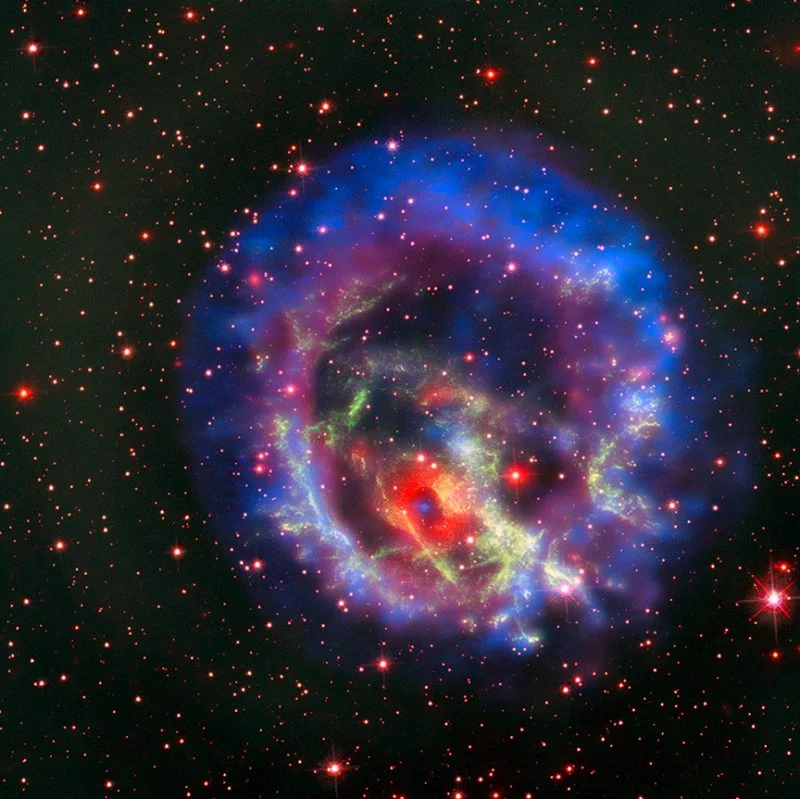
Long after the initial flash of a supernova fades, the explosion leaves behind expanding clouds of gas and dust known as supernova remnants.
These remnants can persist for tens of thousands of years. As the expanding material interacts with surrounding interstellar gas, it forms intricate structures of glowing filaments and shock waves.
Supernova remnants are laboratories for studying extreme physics. They reveal how shock waves accelerate particles to near the speed of light and how magnetic fields shape cosmic structures.
Some of the most beautiful astronomical images ever captured show these remnants glowing in vibrant colors across the darkness of space. Though they are the aftermath of destruction, they also represent the beginning of new cosmic cycles.
Supernovae and the Birth of New Stars
Ironically, the death of one star can trigger the birth of many others. When a supernova explodes, the shock waves travel outward through surrounding interstellar clouds.
These shock waves compress regions of gas and dust, causing them to collapse under their own gravity. This collapse can lead to the formation of new stars and planetary systems.
In this way, supernovae act as catalysts for star formation. They help recycle material throughout galaxies, ensuring that cosmic matter continues evolving through successive generations of stars.
The Sun itself may have formed in a region influenced by earlier supernova explosions.
Supernovae as Cosmic Distance Markers
Certain types of supernovae have become essential tools for measuring distances across the universe. Type Ia supernovae are particularly valuable because they occur when white dwarfs reach nearly the same critical mass before exploding.
Because these explosions have similar intrinsic brightness, astronomers can compare their observed brightness with their expected brightness to estimate how far away they are.
Using these stellar explosions as “standard candles,” scientists have measured distances to galaxies billions of light-years away.
Observations of distant Type Ia supernovae led to one of the most surprising discoveries in modern cosmology: the expansion of the universe is accelerating. This finding suggests the presence of a mysterious phenomenon known as dark energy.
Thus, supernovae have helped reveal fundamental aspects of the universe’s evolution.
Famous Supernova Observations in Human History
Throughout history, several supernovae have appeared bright enough to be seen with the naked eye. Ancient astronomers carefully recorded these sudden “new stars” appearing in the sky.
One of the most famous occurred in the year 1054. Chinese and Middle Eastern observers documented a brilliant star that remained visible in daylight for weeks. Today, astronomers know that this event produced the Crab Nebula, a spectacular supernova remnant located about 6,500 light-years from Earth.
Another notable explosion occurred in 1604, observed by the astronomer Johannes Kepler. This supernova was the last one visible to the naked eye within our own galaxy.
Modern telescopes now detect thousands of supernovae in distant galaxies each year. These observations provide valuable data for understanding stellar evolution and cosmic expansion.
Detecting Supernovae in the Modern Era
Today’s astronomers use advanced technology to detect and study supernovae across vast cosmic distances. Large telescopes scan the sky repeatedly, searching for sudden changes in brightness that may signal an exploding star.
When a potential supernova is discovered, astronomers quickly direct other instruments toward it. Spectroscopy allows scientists to analyze the light from the explosion and determine its composition, velocity, and type.
Space-based observatories also play an important role. Telescopes that detect X-rays and gamma rays reveal energetic processes occurring during the explosion.
With these tools, astronomers can study supernovae in unprecedented detail, uncovering new insights into the physics of extreme cosmic events.
The Continuing Mystery of Stellar Explosions
Despite decades of research, many aspects of supernova explosions remain mysterious. Scientists are still refining models that explain exactly how shock waves form and propagate through collapsing stars.
The precise mechanisms that trigger certain explosions, especially those involving white dwarfs, are still under investigation. Some supernovae behave in unexpected ways, challenging existing theories.
Researchers continue to study these events using powerful computer simulations and observations from cutting-edge telescopes.
Each new supernova observed in the universe adds another piece to the puzzle of stellar death.
Humanity’s Connection to Cosmic Explosions
Supernovae may seem distant and abstract, occurring far beyond the boundaries of our solar system. Yet they are deeply connected to our existence.
Without these explosions, the universe would contain only simple elements like hydrogen and helium. The complex chemistry required for planets, oceans, and life would never have emerged.
Every human being is, in a very real sense, made from the ashes of ancient stars.
Long before Earth formed, countless supernovae scattered heavy elements across the galaxy. These materials eventually became part of the cloud that collapsed to form the Sun and its planets.
Thus, the atoms in our bodies carry a cosmic history stretching back billions of years.
The Ever-Changing Universe
Supernovae remind us that the universe is not static or unchanging. It is a dynamic, evolving cosmos where stars are born, live their lives, and ultimately die in spectacular ways.
These explosions shape galaxies, distribute elements, and drive the cycles of cosmic creation. They represent both destruction and renewal.
For astronomers and physicists, studying supernovae offers a glimpse into the most extreme conditions nature can produce. For everyone else, they provide a powerful reminder of the universe’s immense scale and beauty.
The next time we look up at the night sky, we may see only quiet points of light. Yet somewhere among those distant stars, one may already be nearing the end of its life. At any moment in the vast universe, a star may collapse and explode, briefly lighting the darkness with unimaginable brilliance.
A supernova is not merely the death of a star. It is a transformation that reshapes the cosmos and echoes across time.