Tyrannosaurus rex was one of the largest land predators ever to live, combining a massive skull, powerful jaws, sharp teeth, and a muscular body built to handle enormous prey. Living in western North America near the end of the Cretaceous Period, roughly 68 to 66 million years ago, this dinosaur occupied the top of its food web. Fossils reveal much about its anatomy, growth, feeding habits, and possible hunting behavior, although important questions remain about how it hunted and how much it relied on scavenging.
Understanding T. rex means looking beyond its fearsome reputation. Its size and strength were only part of what made it successful. Its senses, bone-crushing bite, changing body proportions as it grew, and ability to exploit large animals all contributed to its role in an ancient ecosystem.
How large was Tyrannosaurus rex?
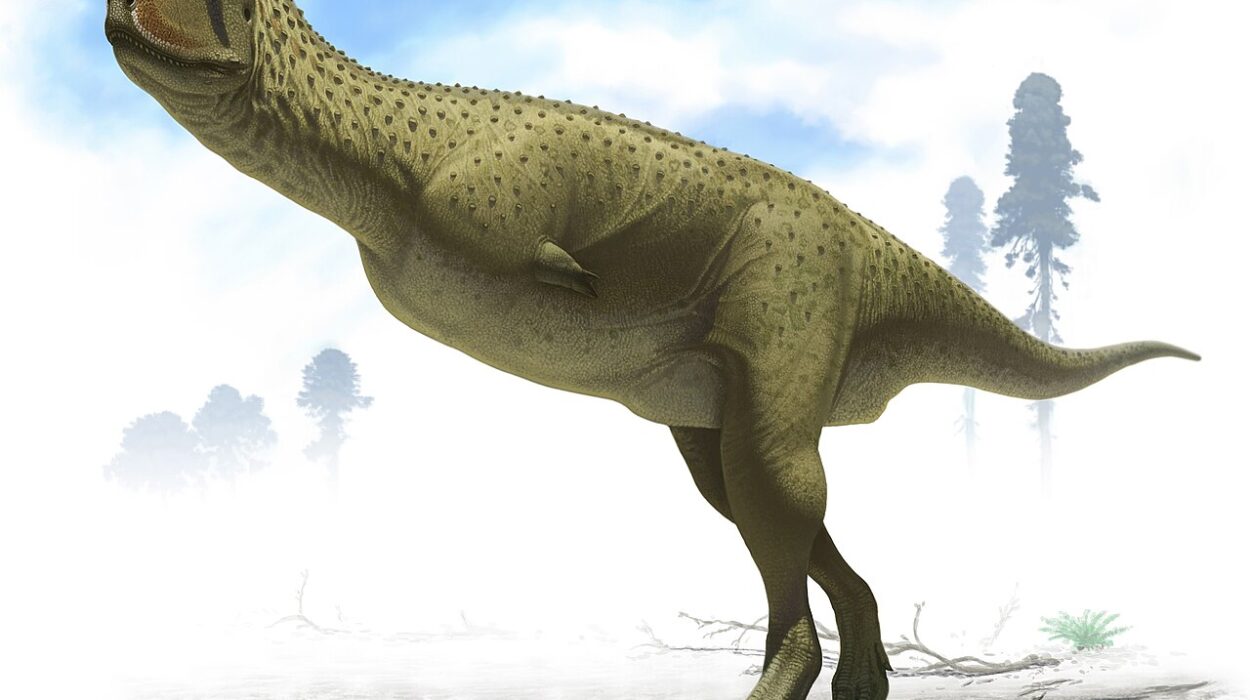
Adult T. rex was an enormous animal, measuring approximately 40 feet long from snout to tail and standing around 12 to 13 feet tall at the hips. The largest known individuals reached roughly 40 feet or more in length, although estimates vary depending on the specimen and the method used to reconstruct its body.
Mass is more difficult to determine because soft tissues, body fat, and other features rarely fossilize. Estimates for large adults commonly fall in the range of several tons, with particularly massive individuals approaching or exceeding 8 tons in some reconstructions. These figures are estimates rather than direct measurements, and researchers continue to refine them as new fossils and analytical methods become available.
The dinosaur’s enormous skull was one of its most distinctive features. A large adult could have a skull roughly 5 feet long, equipped with powerful jaw muscles and thick teeth designed to withstand substantial forces. Its broad skull helped accommodate the muscles needed for biting, while the strong bones of the head resisted the stresses produced when the jaws closed on prey.
Despite its size, T. rex was not simply a heavy, slow-moving mass. Its body included strong hind limbs, a substantial tail, and a relatively compact torso. The tail acted as a counterbalance to the head and body, helping maintain stability during movement. Its arms, by contrast, were remarkably short relative to its overall size, although they were muscular and ended in two clawed fingers.
The short arms remain one of the animal’s most recognizable features, but their precise function is uncertain. They may have assisted with limited tasks at close range, yet their size and range of motion suggest they were not the primary tools for capturing prey. The head, jaws, and hind limbs were much more important to the animal’s overall feeding and locomotion.
Where and when did Tyrannosaurus rex live?
T. rex lived during the Late Cretaceous, near the end of the age of non-avian dinosaurs. Its known fossils come from western North America, including areas that are now part of the United States and Canada. At that time, the region supported a variety of environments, including coastal plains, river systems, forests, and floodplains.
The Western Interior Seaway, a broad inland sea, divided much of North America during parts of the Cretaceous. The environments surrounding this seaway supported diverse plant communities and large populations of herbivorous dinosaurs. These animals provided the food resources needed to sustain a large carnivore such as T. rex.
Its ecosystem included horned dinosaurs such as Triceratops and duck-billed dinosaurs such as Edmontosaurus. Other predators and scavengers also occupied the region, but T. rex was among the dominant terrestrial carnivores of its time.
The species existed relatively close to the end of the Cretaceous, when a major asteroid impact triggered a mass extinction approximately 66 million years ago. The impact and its environmental consequences contributed to the disappearance of all non-avian dinosaurs. Birds, which evolved from theropod dinosaurs, survived and remain the living descendants of that broader dinosaur lineage.
What did Tyrannosaurus rex eat?
T. rex was a carnivore that consumed other animals, including large herbivorous dinosaurs. Its likely prey included horned dinosaurs such as Triceratops and duck-billed dinosaurs such as Edmontosaurus. Fossil evidence indicates that its feeding habits were not limited to one type of prey.
The animal’s teeth were especially well suited to eating large vertebrates. Unlike the thin, blade-like teeth of some meat-eating dinosaurs, T. rex had thick, rounded teeth with serrated edges. These teeth could penetrate flesh and withstand the considerable stresses associated with biting into bone.
Its jaws could do more than slice through meat. The combination of strong jaw muscles, robust teeth, and a reinforced skull allowed T. rex to crush bones and access the nutritious tissue inside them. This feeding strategy is known as osteophagy, or bone eating. Bone fragments and damage associated with feeding provide evidence that the dinosaur could process carcasses more thoroughly than many modern predators.
Eating bone also helped T. rex obtain nutrients that would otherwise remain inaccessible. Marrow, the tissue inside many bones, is rich in fat and can provide substantial energy. By breaking bones and consuming portions of them, the dinosaur could exploit more of a carcass than a predator limited to soft tissue.
Its diet probably changed with age as well. Juvenile T. rex had more slender bodies, narrower skulls, and relatively different proportions from adults. Their teeth and jaws were suited to a different feeding style than the bone-crushing apparatus of a fully grown individual. Younger animals may have pursued smaller, more agile prey or fed on different portions of carcasses, reducing competition with adults and allowing the species to use a wider range of food resources.
The exact composition of the diet remains uncertain. Fossils can establish that an animal ate particular prey when distinctive feeding evidence survives, but they rarely preserve a complete record of everything an individual consumed throughout its life.
How powerful was the bite of Tyrannosaurus rex?
The bite of T. rex was among the most powerful known for any terrestrial animal. Researchers estimate bite force by combining evidence from skull anatomy, jaw-muscle reconstructions, tooth geometry, and biomechanical models. These methods suggest that a large adult could generate forces sufficient to crush substantial bones.
Bite force is the amount of force exerted by the jaws, usually measured at a particular point along the tooth row. It is not the same as pressure, which depends on how that force is distributed over an area. The shape and position of a tooth therefore influence how a bite damages its target, even when the overall force remains the same.
The dinosaur’s skull was adapted to withstand repeated heavy loading. During a powerful bite, forces travel through the teeth and jaw into the surrounding bones. A skull that could resist these stresses would allow the animal to bite into tough tissues, fracture bone, and maintain contact with struggling prey.
Its teeth also had a shape suited to resisting breakage. Broad, sturdy crowns were better able to withstand heavy loads than the narrow teeth of predators specialized primarily for slicing. Serrations along the edges helped cut tissue as the teeth penetrated and moved through it.
The combination of strong jaws and durable teeth had consequences for both hunting and scavenging. A predator capable of crushing bones could exploit carcasses that other carnivores might leave partly untouched. It could also inflict devastating injuries on living prey, potentially shortening a struggle and reducing the risks associated with bringing down a large animal.
However, bite-force estimates depend on assumptions about muscle size, posture, and the mechanics of the skull. They should be understood as scientific reconstructions rather than direct measurements from a living dinosaur.
Was Tyrannosaurus rex a hunter or a scavenger?
The evidence indicates that T. rex was capable of both hunting living animals and scavenging carcasses. These behaviors are not mutually exclusive. Modern large carnivores routinely hunt when opportunities arise and consume dead animals when doing so offers an efficient source of food.
A large predator must balance the energy gained from a meal against the costs and risks of obtaining it. Chasing and subduing a powerful herbivore can require substantial effort and may cause serious injury. Feeding on an already dead animal avoids much of that danger, provided the carcass is accessible and has not been exhausted or claimed by competitors.
T. rex had several features consistent with active predation. Its forward-facing eyes provided overlapping fields of view that supported depth perception. Its strong legs could carry its large body, and its skull and teeth were capable of inflicting severe injuries. Fossilized prey bones bearing tooth marks also reveal that tyrannosaurs interacted directly with the bodies of large herbivores, although such marks alone do not always distinguish a kill from feeding after death.
One particularly important type of evidence is a healed injury. If a prey animal survived a wound inflicted by a predator, the resulting bone growth can preserve evidence of the injury and the animal’s recovery. Some dinosaur fossils show damage consistent with attacks by large carnivores. Such injuries support the possibility of predation, though assigning every wound to a specific predator or event can be difficult.
Other fossils preserve bite marks on bones that were not healed. These marks establish that feeding occurred, but they do not necessarily show whether the animal was alive when bitten. A predator could have inflicted the damage during a hunt, or it could have fed on the carcass afterward.
For this reason, the long-standing debate over whether T. rex was primarily a hunter or a scavenger cannot be resolved by a single tooth mark or anatomical feature. The evidence is best explained by a flexible feeding strategy that included both behaviors. Its ability to overpower prey and exploit carcasses would have made it an effective large carnivore in a changing environment.
How fast could Tyrannosaurus rex run?
The running speed of T. rex remains uncertain, but its enormous mass placed important limits on how quickly it could accelerate and how safely it could move at high speed. Early popular depictions often portrayed the dinosaur as an extremely fast runner. More recent biomechanical work has emphasized the substantial forces that its skeleton would have experienced during rapid movement.
Speed estimates depend on several factors, including leg proportions, muscle mass, stride length, and the ability of bones and joints to withstand impacts. Computer models can test how different combinations of these features might affect movement, but the results depend on assumptions about anatomy and physiology that cannot be measured directly.
Walking and running also place different demands on the body. During running, an animal’s feet strike the ground with greater forces, and its muscles must generate enough power to support and propel its mass. For a dinosaur weighing several tons, those demands would have been considerable. A fast sprint could potentially increase the risk of falls or skeletal injury.
It is therefore difficult to assign T. rex a single reliable top speed. The animal was capable of effective terrestrial movement, but its exact maximum speed is not established. It may have relied more on strength, persistence over short distances, and the ability to deliver powerful bites than on sustained high-speed pursuit.
A successful hunt also does not necessarily require a spectacular sprint. A predator can approach within striking distance, exploit cover or terrain, target vulnerable individuals, or take advantage of an animal that is injured or distracted. The fossil record cannot reveal precisely how often T. rex used each tactic, but its anatomy is consistent with a powerful predator whose hunting strategy did not depend entirely on extreme speed.
What did Tyrannosaurus rex’s senses reveal about its behavior?
The skull and braincase of T. rex provide clues about how it perceived its surroundings. Its eyes faced generally forward, creating overlapping visual fields that would have helped it judge distances. This ability would have been useful when approaching prey, navigating uneven terrain, and coordinating movements of the head and body.
The size and shape of the eye sockets suggest that vision was important, although the sockets alone cannot establish exactly how well the dinosaur saw. Fossilized braincases and reconstructions of the brain cavity provide additional information about sensory anatomy, but the soft tissues responsible for vision and other senses are rarely preserved directly.
Tyrannosaurs also appear to have had a well-developed sense of smell. The anatomy of the skull and the regions associated with olfaction support the view that chemical cues played a significant role in their sensory world. A strong sense of smell could have helped the animal locate carcasses, recognize its environment, and detect nearby animals.
Hearing was another important part of its sensory system. The inner ear, which helps animals detect sound and maintain balance, can sometimes be studied through the bony structures that surrounded it. These structures provide clues about auditory capabilities, though they do not allow researchers to reconstruct the dinosaur’s complete hearing range with certainty.
Together, vision, smell, and hearing would have helped T. rex respond to its environment. However, sensory anatomy cannot tell us exactly how it behaved in every situation. It is possible to infer the kinds of information available to the animal without assuming that it used those senses in precisely the same ways as modern mammals or birds.
How did Tyrannosaurus rex grow from a juvenile into an adult?
T. rex underwent substantial changes in body shape as it matured. Young individuals were more lightly built, with relatively slender skulls and legs. As they grew, their bodies became more robust, their skulls broadened, and their jaws developed the structure associated with powerful adult biting.
These changes are known as ontogenetic changes, meaning changes that occur during an organism’s development. They matter because a juvenile and an adult T. rex did not necessarily fill exactly the same ecological role. Differences in body size, strength, and feeding anatomy could have allowed individuals of different ages to exploit different prey or feeding opportunities.
Scientists study dinosaur growth by examining the internal structure of fossilized bones. Many bones preserve growth marks that record changes in bone deposition over time. In some cases, these marks can be used to estimate growth rates and approximate age at death.
Bone histology, the study of microscopic bone structure, has helped establish that T. rex grew rapidly during part of its life. Like many large animals, it passed through periods of changing growth rates rather than increasing in size at a uniform pace. Growth patterns varied among individuals, and not every fossil preserves the same amount of information.
The distinction between juvenile and adult anatomy is also important when identifying fossils. A young tyrannosaur may look quite different from a fully grown one, and researchers must consider age-related changes when deciding whether specimens represent different species or different stages of the same species.
These developmental differences help explain how T. rex could dominate an ecosystem throughout its life. As individuals grew, their changing anatomy likely altered which prey they could handle, how they competed for food, and how they interacted with other carnivores.
What does the fossil evidence tell us?
Nearly everything known about T. rex comes from fossils. These include bones, teeth, footprints in the broader fossil record of dinosaurs, and traces of interactions with other animals. Each type of evidence reveals different aspects of the dinosaur’s life, and the strongest reconstructions emerge when several independent lines of evidence agree.
The most recognizable fossils are skeletal remains. Skull fragments, vertebrae, ribs, limb bones, and other elements allow researchers to reconstruct body proportions and estimate how the animal moved. When more of a skeleton is preserved, scientists can compare the relationships among bones and develop more complete estimates of body size and anatomy.
Fossils are rarely perfect records of entire animals. Bones may be scattered, crushed, weathered, or distorted by the sediments that buried them. Some specimens preserve only a few elements, while others contain much of the skeleton. Researchers must account for missing or damaged parts when estimating an animal’s size and appearance.
Teeth are especially informative because they can preserve distinctive shapes and wear patterns. Their serrated edges, robust crowns, and distribution in the jaws reveal how the animal processed food. Tooth marks on the bones of other dinosaurs provide additional evidence of feeding interactions.
Some bones bear deep grooves, punctures, or other damage consistent with bites from large carnivores. In certain cases, the size and spacing of the marks can help narrow down the likely animal responsible. Yet identifying the exact source of a bite is not always possible, particularly when several related predators had similar teeth.
Healed injuries offer a different kind of evidence. Bone can remodel during recovery, leaving changes that remain visible in a fossil. These changes may indicate that an animal survived trauma long enough for healing to occur. Such fossils can reveal aspects of survival and injury, although they rarely establish the precise circumstances that caused the damage.
The fossil record is incomplete because preservation requires a particular set of conditions. An animal must die in a place where its remains can be buried, and those remains must avoid destruction long enough for fossilization to occur. Even then, erosion or geological changes may later destroy the fossil or leave it undiscovered. The dinosaurs known to science therefore represent only a portion of the animals that once lived.
What can fossilized footprints and other traces tell us?
Trace fossils preserve evidence of an animal’s activity rather than its body. Examples include footprints, trackways, burrows, and marks left by feeding. For dinosaurs, these traces can reveal movement and behavior that skeletal fossils cannot show directly.
Footprints can provide clues about foot shape, stride length, and the direction of travel. A sequence of tracks may show whether an animal was moving steadily or changing its pace, although speed estimates require assumptions about leg length and the mechanics of walking. Tracks can also preserve evidence of interactions among animals when multiple trackways occur together.
Attributing a footprint to T. rex specifically can be difficult. Many large theropod dinosaurs had broadly similar feet, and a footprint generally does not preserve the detailed anatomical features needed to identify a species with certainty. A large three-toed track may indicate a meat-eating dinosaur without proving that the trackmaker was a tyrannosaur.
The same caution applies to evidence of group behavior. Trackways that appear to show several animals traveling in the same direction may suggest that they were moving through an area at around the same time. They do not necessarily demonstrate that the animals hunted cooperatively or maintained a social group. Establishing those behaviors requires stronger evidence than proximity alone.
Trace fossils are valuable precisely because they preserve actions rather than anatomy. When interpreted carefully and combined with skeletal evidence, they help scientists build a more complete picture of dinosaur life while keeping clear distinctions between direct observations and possible explanations.
How do scientists reconstruct the life of Tyrannosaurus rex?
Reconstructing T. rex requires several scientific disciplines. Paleontologists study the fossils themselves, anatomists compare the bones with those of living animals, and biomechanical researchers investigate how the skeleton may have functioned. Geologists establish the age and environmental context of the rocks in which the fossils occur.
Comparative anatomy is especially useful because the closest living relatives of non-avian dinosaurs are birds, while crocodilians provide another important point of comparison among living reptiles. These animals cannot serve as exact substitutes for T. rex, but their anatomy, growth, and movement help scientists understand how certain biological structures can function.
Biomechanical models test whether a proposed movement or feeding behavior is physically plausible. Researchers can estimate how muscles might have attached to bones, calculate how forces would travel through a skull, and investigate the stresses that limbs would experience during movement. Such models are valuable for testing hypotheses, but their results depend on assumptions about soft tissues, muscle performance, and posture.
Fossil evidence can also be analyzed using techniques such as computed tomography, or CT scanning. This method uses X-rays to produce cross-sectional images of internal structures. It can reveal features inside fossilized skulls and bones without requiring researchers to break them apart, helping them study braincases, tooth roots, and internal bone anatomy.
Scientific interpretations change when new specimens or better methods become available. An estimate of body mass may be revised when a more complete skeleton is discovered. A proposed feeding behavior may become more or less convincing when researchers identify additional bite marks or examine their distribution across different fossils.
These revisions are part of the scientific process, not evidence that nothing can be known. The basic picture of T. rex as a huge, meat-eating theropod with a powerful bite is supported by extensive evidence. More specific questions, such as its precise running speed, preferred hunting tactics, and degree of social interaction, remain open to further investigation.
Why Tyrannosaurus rex remains scientifically important
T. rex offers an unusually detailed opportunity to study the biology of a large extinct predator. Its fossils preserve evidence of anatomy, growth, feeding, injury, and interactions with other animals. Together, these clues help scientists understand how an animal of such great size could function on land and survive within a complex ecosystem.
Its evolutionary success did not depend on a single extraordinary feature. A powerful bite, robust teeth, strong hind limbs, effective senses, and substantial body size worked together to make it an effective carnivore. Changes during growth likely expanded the range of ecological roles the species could occupy over its lifetime.
At the same time, T. rex illustrates the limits of studying extinct animals. Fossils preserve only fragments of past lives, and behavior must often be inferred from anatomy and traces of activity. Researchers can establish some conclusions with high confidence while leaving others unresolved.
That combination of strong evidence and meaningful uncertainty is what makes T. rex more than a familiar symbol of prehistoric danger. Its bones preserve a record of how life functioned tens of millions of years ago, allowing scientists to reconstruct an ancient predator while continuing to test the details of its remarkable biology.