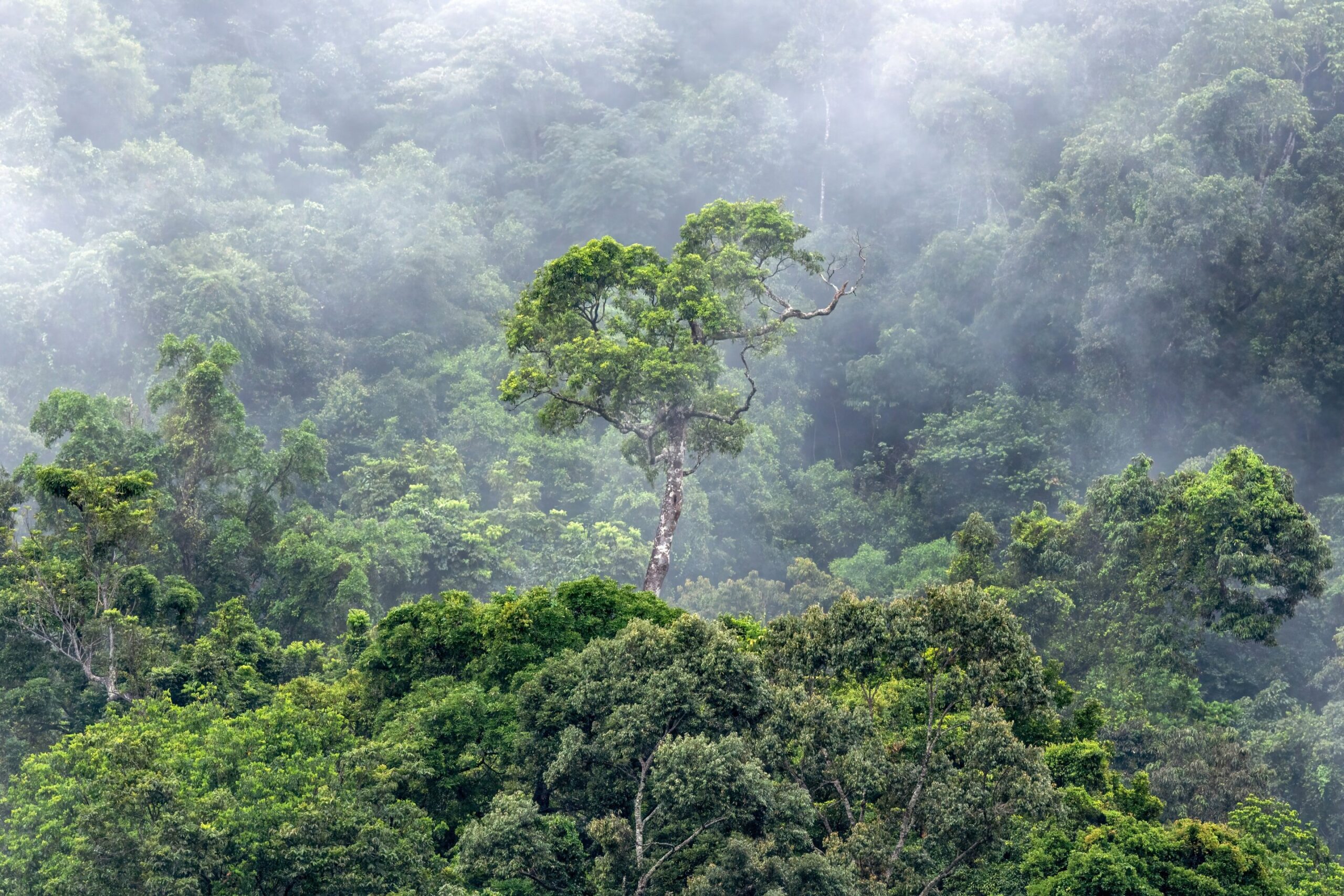
Stand beneath a tropical forest canopy and you feel it immediately. The air is heavy, alive, almost breathing. Sunlight filters through layers of green, and somewhere above, invisible rivers of moisture are rising into the sky. For generations, people have known that forests and rain are somehow connected. Now, a new study led by the University of Leeds has placed a number on that relationship—and the result is as staggering as it is urgent.
According to the research, every single hectare of tropical forest generates about 2.4 million liters of rainfall each year. That is enough water to fill an Olympic-sized swimming pool. And it doesn’t just fall back onto the trees themselves. It travels outward, nourishing farms, filling rivers, sustaining cities, and keeping entire economies afloat.
For years, rainfall has been seen as a gift of nature, something that arrives from distant oceans or shifting weather systems. But this study reveals something more intimate and more profound: tropical forests are not just recipients of rain. They are makers of it.
Measuring the Invisible Rivers in the Sky
Rain does not come with a label that says where it was born. Tracing its origins has long been a challenge for scientists. To untangle this mystery, researchers combined satellite observations with simulations from the latest generation of climate models. This approach helped reduce long-standing uncertainty about how much rainfall forests actually generate.
The team then went further. They asked a bold question: if forests are producing rain, what is that rain worth?
To answer it, they applied a simplified economic valuation, estimating the monetary value of rainfall delivered to surrounding regions. The findings were stark. In the Brazilian Amazon, rainfall generated by forests is worth roughly US$20 billion per year to regional agriculture alone.
That figure towers over the financial incentives currently aimed at protecting or restoring the Amazon, which amount to only a fraction of that value. The rain falling on crops, quietly and reliably, is far more economically powerful than many of the programs designed to safeguard the forest itself.
The study, titled “Quantifying tropical forest rainfall generation”, appears in the journal Communications Earth & Environment, offering what the researchers describe as the most comprehensive and robust evidence yet of the value of tropical forests’ rainfall provision.
How Trees Turn Sunlight Into Storms
The mechanism behind this watery miracle is called evapotranspiration. It sounds technical, but the process is elegantly simple. Sunlight strikes leaves. The leaves release moisture into the air. That moisture rises, gathers, and eventually returns to Earth as rain.
Across the tropics, each square meter of forest contributes about 240 liters of rainfall annually. In the Amazon, that number rises to around 300 liters per square meter.
These numbers are not abstract. They represent billions upon billions of droplets lifted skyward every year, stitched together into clouds that drift and break over fields and rivers.
Dr. Jess Baker, the study’s lead author from the University of Leeds’ School of Earth, Environment and Sustainability, calls this the strongest evidence yet of the value of tropical forests in producing rain. At a time when tropical deforestation continues despite international efforts to stop it, the research highlights just how much is at stake.
The forest is not merely a landscape. It is an engine. And when parts of that engine are removed, the consequences ripple outward.
When Crops Depend on Forests They Never See
One of the study’s most striking insights lies in the relationship between forests and crops. It turns out that producing enough rainfall to sustain some major crops requires moisture generated by more forest area than the crops themselves occupy.
Take cotton. It requires 607 liters of moisture per square meter. That amount of water is equivalent to what two square meters of intact forest can produce. Soybeans need 501 liters per square meter, which corresponds to about 1.7 square meters of intact forest.
This means a cotton field is not sustained by its soil alone. It is supported by distant stands of trees, lifting water into the sky day after day. Soybean fields, too, are quietly linked to the forest canopy through invisible atmospheric pathways.
Agriculture and forests are often portrayed as competitors for land. Yet this research reveals a more complicated truth. In many cases, agriculture depends on forests for the rainfall that makes farming possible in the first place.
The Cost of Losing the Rainmakers
The Amazon has lost around 80 million hectares of forest over recent decades. According to the study’s estimates, this deforestation may have reduced rainfall-generation benefits by almost US$5 billion annually.
That loss does not remain confined to spreadsheets. It touches food production, hydropower, and water security. It echoes through harvests and energy supplies.
In Brazil, about 85% of agriculture is rain-fed. Farmers depend directly on seasonal rains rather than irrigation systems. Reduced rainfall and delayed wet seasons have already affected soy and maize yields in regions with high levels of deforestation.
The implications stretch beyond fields of grain. Declining rainfall linked to forest loss threatens drinking water supplies, river transport in remote areas, and hydropower generation. Even the carbon-storage capacity of remaining tropical forests may be affected, as shifts in rainfall patterns alter the delicate balance that sustains them.
What begins as the felling of trees can end as empty reservoirs, struggling crops, and strained economies.
The Value We Forgot to Count
Despite repeated international pledges to halt deforestation by 2030, forest loss continues across much of the tropics. One reason, the authors argue, is that the rainfall generated by forests has largely been absent from economic and legal frameworks.
When policymakers weigh the costs and benefits of land use, timber, cattle, and crops have clear market prices. Rain does not. At least, it didn’t.
By quantifying the value of forest-driven rainfall, the researchers hope to shift the conversation. If the Amazon alone produces rainfall worth US$20 billion each year, that is not an abstract environmental service. It is a financial force.
Dr. Callum Smith, a co-author of the study, emphasizes that recognizing this connection could ease tensions between agricultural and conservation interests. Tropical forests make it rain, supplying water that agriculture relies on. Understanding that link may help build broader support for protecting forests overall.
The argument is no longer only about biodiversity or climate, though those remain vital. It is also about economics, food security, and national resilience.
Why This Research Matters
At its heart, this study changes how we see a forest.
It is not only a collection of trees or a reservoir of carbon. It is a living water tower, a vast biological system that pulls moisture from leaves to sky and redistributes it across landscapes. Every hectare producing 2.4 million liters of rainfall per year represents a quiet, continuous service that sustains farms, powers dams, fills rivers, and quenches cities.
As climate and water pressures intensify, the value of reliable rainfall grows ever more critical. By placing a monetary figure on forest-generated rain, this research makes visible what was previously overlooked. It reveals that protecting tropical forests is not simply an environmental cause. It is an economic strategy and a water security policy rolled into one.
When forests fall, the sky may change with them. But when forests stand, they do more than store carbon or shelter wildlife. They breathe moisture upward, stitch clouds together, and send life-giving rain back to Earth.
In a world searching for solutions to climate stress and water scarcity, the message is clear. The forest is not just beneath our feet. It is above us too, in every drop of rain it helps create.
Study Details
Quantifying tropical forest rainfall generation, Communications Earth & Environment (2026). DOI: 10.1038/s43247-025-03159-3