Deep within the circular, metallic heart of a machine known as the Experimental Advanced Superconducting Tokamak, or EAST, a miniature sun flickers to life. This is the stage for one of the most complex dances in modern science: the quest for nuclear fusion. For decades, researchers have been chasing the dream of a clean, limitless energy source, trying to replicate the same process that powers the stars. But to bottle a star, one must contend with the temperamental nature of plasma—a roiling, ultra-hot state of matter that resists being contained. For years, scientists have bumped up against a stubborn ceiling, an invisible barrier in physics that dictated just how much fuel they could cram into these machines before the whole system collapsed. Now, a team of researchers in China has found a way to shatter that ceiling, stepping into a strange and promising new territory known as the density-free regime.
The Invisible Ceiling of the Star Machine
To understand the magnitude of this breakthrough, one must first look at the precarious environment inside a tokamak. A tokamak is a doughnut-shaped device designed to trap plasma using powerful magnetic fields. For fusion to occur—specifically the fusion of deuterium and tritium—the plasma must be heated to a staggering 150 million kelvin, or about 13 keV. At these temperatures, the atoms are moving so fast and with such violence that they overcome their natural repulsion and fuse together, releasing a tremendous amount of energy. The efficiency of this process is tied directly to how many fuel particles you can pack into the space; in the language of physics, the power scales with the square of the fuel density. Logic suggests that if you want more power, you simply add more fuel.
However, the universe rarely makes things that simple. In the world of conventional tokamak operation, there has always been a hard limit. As scientists tried to increase the density of the plasma to boost power, they inevitably hit an empirical upper limit. Once the plasma became too crowded, it would become unstable. These instabilities are not just minor hiccups; they are violent disruptions that can break the magnetic confinement entirely, causing the plasma to crash into the walls of the machine and potentially damaging the sophisticated hardware. This density limit has long been a “No Trespassing” sign on the road to fusion ignition, forcing researchers to operate within narrow, less-than-optimal parameters to keep their machines safe.
A Delicate Balance Between Fire and Steel
For a long time, this limit was seen as an unavoidable fact of life in plasma physics. But a new perspective began to emerge through the work of D.F. Escande and his colleagues from the French National Center for Scientific Research and Aix-Marseille University. They proposed a theory called plasma–wall self organization, or PWSO. This theory suggested that the density limit wasn’t an absolute law of nature, but rather a consequence of how the plasma interacted with the metallic container holding it. The theory predicted that if a scientist could achieve a “delicate balance” between the hot plasma and the physical sputtering of the metal walls, they could enter a “density-free regime.” In this theoretical space, the old rules would no longer apply, and the plasma could remain stable even as its density climbed to heights previously thought impossible.
Turning this theory into reality fell to a team co-led by Professor Zhu Ping from the Huazhong University of Science and Technology and Associate Professor Yan Ning from the Hefei Institutes of Physical Science. They looked at the EAST device—China’s fully superconducting tokamak—and wondered if they could find the key to this density-free kingdom. The challenge was that they couldn’t just change the plasma once it was already running hot; they had to curate the environment from the very moment the spark was lit. It required a level of precision that felt like trying to balance a needle on its point while a hurricane swirled around it.
Mastering the Chaos of the Startup
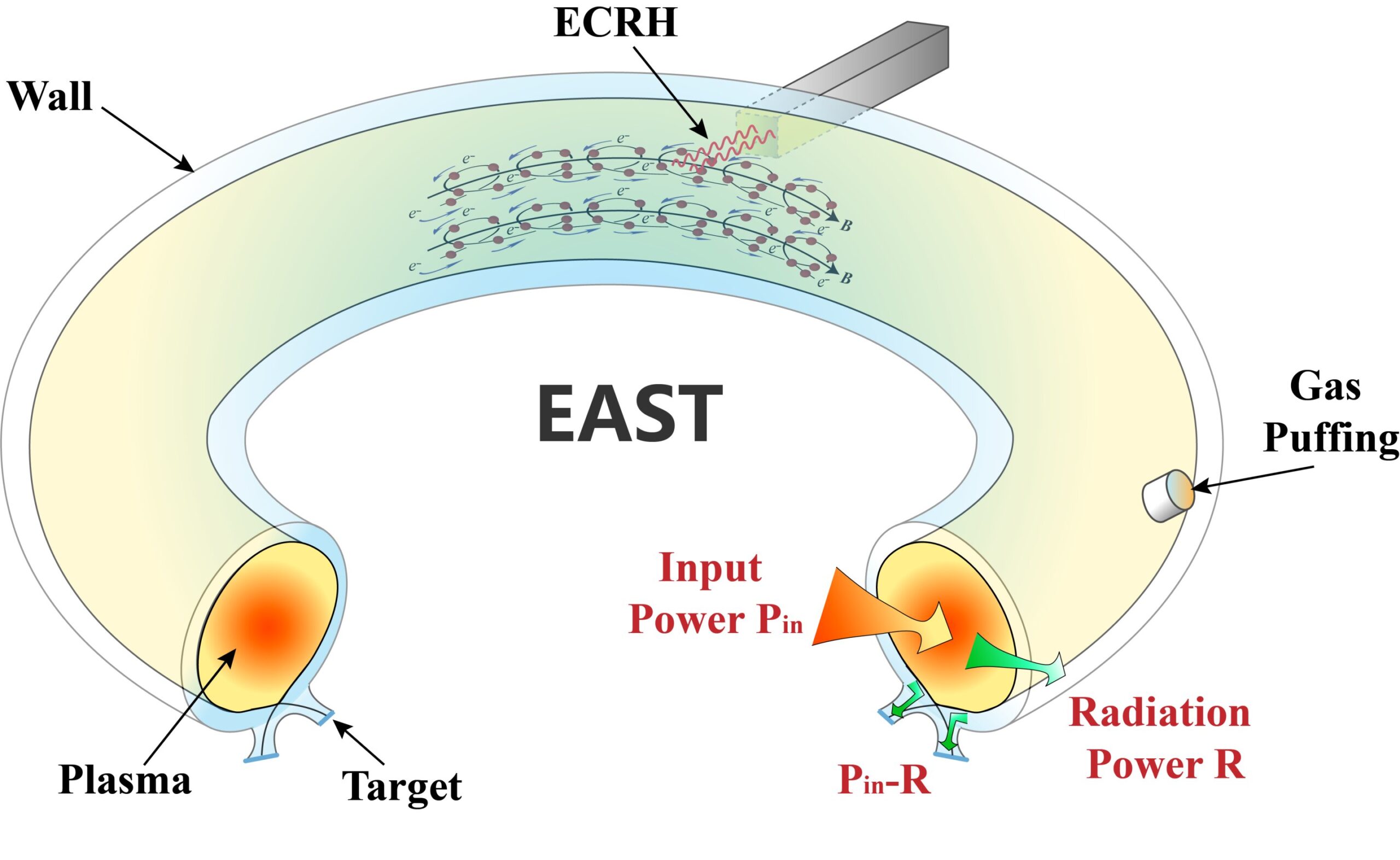
The breakthrough on EAST didn’t happen by accident; it was the result of a meticulously choreographed startup phase. The researchers realized that the secret to the density-free regime lay in the first few moments of the discharge. By carefully controlling the initial pressure of the fuel gas and utilizing electron cyclotron resonance heating during the startup, they were able to optimize the interaction between the plasma and the walls from the very beginning. This wasn’t just about heat; it was about preventing the plasma from “poisoning” itself.
Usually, as plasma density increases, it begins to interact more aggressively with the tokamak’s walls. This interaction releases impurities from the metal into the plasma, which causes energy losses and triggers the dreaded instabilities. By mastering the plasma–wall self organization, the team managed to significantly reduce these impurities and the resulting energy leaks. They pushed the plasma further and further, increasing the density as the startup phase came to a close. To their amazement, the plasma didn’t buckle. It didn’t flicker or crash. Instead, it crossed the old empirical boundary and entered the density-free regime, maintaining a stable state at densities that would have traditionally spelled disaster for the experiment. They had successfully verified the physical concept of the density-free regime for the first time in history.
Mapping the Path to an Endless Horizon
The success of these experiments on EAST has opened a door that many feared might remain locked forever. By proving that the density limit can be bypassed through smart engineering and a deeper understanding of plasma-wall interactions, the team has provided a new map for the future of energy. This isn’t just a win for the EAST team; it is a signal to the entire global fusion community that the hurdles to ignition might be lower than they appeared. As Professor Zhu Ping noted, “The findings suggest a practical and scalable pathway for extending density limits in tokamaks and next-generation burning plasma fusion devices.”
The journey, of course, is far from over. While the team has accessed this regime, the next step is to see how it holds up under even more extreme conditions. Associate Professor Yan Ning explained that the research team is already looking toward the future, planning to apply this new method during “high-confinement operation on EAST in the near future in an attempt to access the density-free regime under high-performance plasma conditions.” They want to see if this stability remains when the “artificial star” is burning at its absolute brightest and hottest.
Why This Leap Into the Unknown Matters
This research matters because it addresses one of the most significant “bottlenecks” in human history. For decades, the promise of nuclear fusion—a source of energy that is clean, sustainable, and virtually inexhaustible—has been tempered by the reality of how difficult it is to control. The density limit was a wall that prevented us from reaching the levels of power needed to make fusion a viable commercial reality. If we cannot pack enough fuel into a tokamak to achieve ignition, the dream of fusion remains a laboratory curiosity rather than a global solution.
By experimentally accessing the density-free regime, these researchers have shown that the “limit” was more of a hurdle than a wall. This work provides the physical insights necessary to break through long-standing obstacles and move closer to fusion ignition. If we can operate at higher densities without triggering instabilities, we can generate more power from smaller, more efficient devices. This breakthrough on EAST represents a fundamental shift in our understanding of how plasma behaves, bringing us one step closer to a world where the power of the stars is no longer a distant light in the sky, but a steady, glowing reality here on Earth.
More information: Jiaxing Liu et al, Accessing the density-free regime with ECRH-assisted Ohmic start-up on EAST, Science Advances (2026). DOI: 10.1126/sciadv.adz3040. www.science.org/doi/10.1126/sciadv.adz3040