A nearby dwarf galaxy called UGCA 320 appears to have a dark matter core extending well beyond its visible stars, challenging predictions of the standard cosmological model. Astronomers found that models involving self-interacting dark matter explain the observations better than several competing explanations, although the results do not yet establish what dark matter is made of.
Dark matter is thought to provide much of the gravitational force that holds galaxies together, but its distribution inside galaxies remains a puzzle. One long-standing problem is that observations of small galaxies often reveal a relatively smooth concentration of dark matter at their centers, while the leading cosmological model predicts a much denser central region.
UGCA 320, a nearby dwarf galaxy rich in gas, offers an especially interesting case. A new analysis suggests that its dark matter is spread across an unusually large central core, with an estimated radius of roughly 7.6 to 12 kiloparsecs. That is several times larger than the region occupied by most of its stars.
The finding adds to the questions surrounding the nature of dark matter and whether the standard model needs to be modified to explain how it behaves inside small galaxies.
Why the shape of dark matter matters
The standard cosmological model, known as Lambda Cold Dark Matter (ΛCDM), describes dark matter as relatively slow-moving particles that interact primarily through gravity.
Under this model, dark matter should form a dense central concentration, known as a cusp. Its density increases sharply toward the center of a galaxy.
Observations of some small galaxies, however, point to a different arrangement: a core, where dark matter density remains relatively flat across the central region.
This disagreement is known as the cusp-core problem.
Several explanations have been proposed. One possibility is that dark matter behaves differently from the cold, collisionless particles assumed in the standard model. Alternatives include warm dark matter, self-interacting dark matter and fuzzy dark matter.
Another explanation does not require changing dark matter itself. Repeated episodes of star formation and supernova explosions could redistribute matter in a galaxy’s center, pushing dark matter outward and transforming a cusp into a core.
The team led by Qinwei Yuan of Nanjing University in China investigated whether these explanations could account for the unusually extended core in UGCA 320.
Measuring the galaxy’s hidden mass
To map the galaxy’s mass distribution, the researchers combined observations from several astronomical instruments.
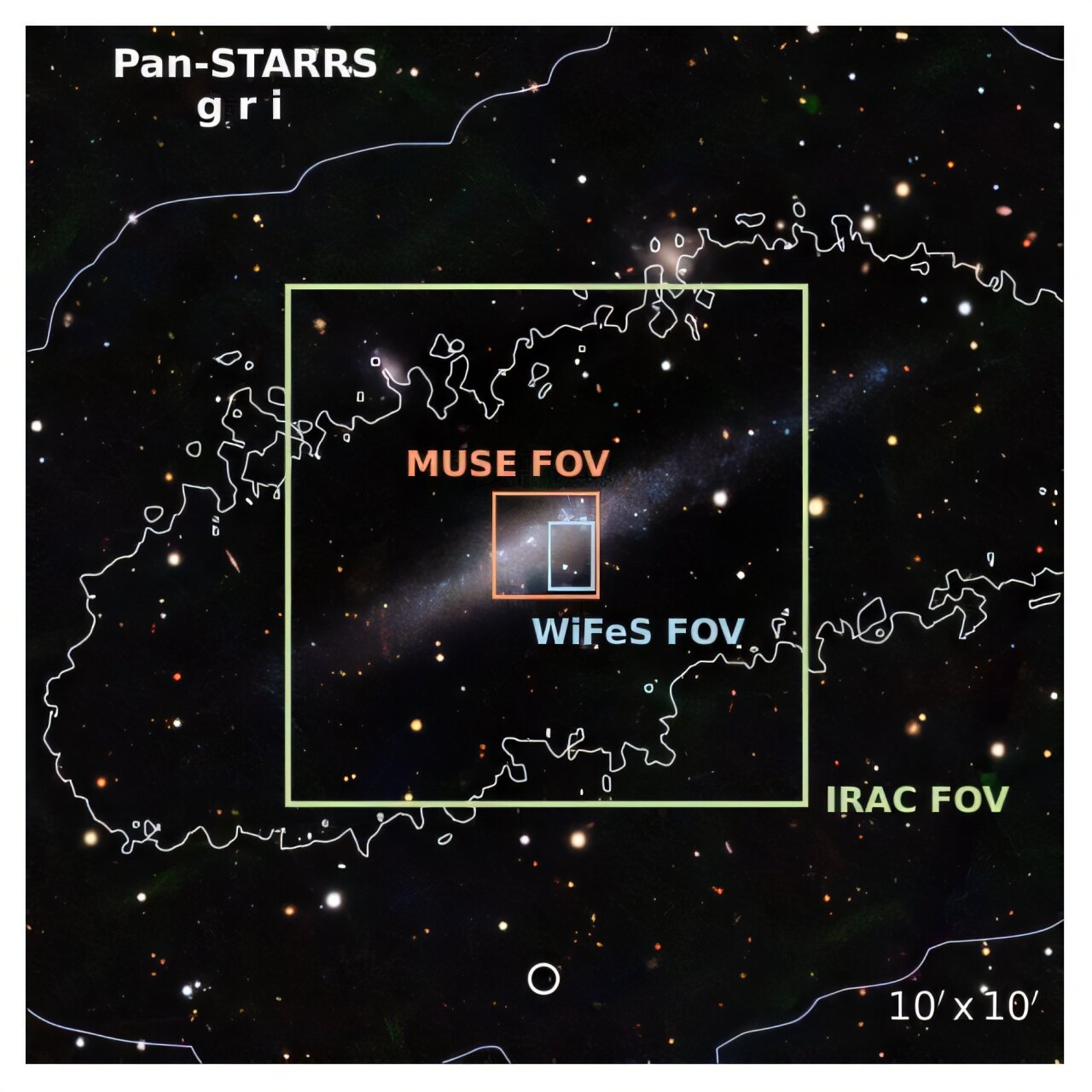
Radio measurements from the MeerKAT telescope traced neutral hydrogen gas, while optical observations from the MUSE and WiFeS instruments captured hydrogen-alpha emission associated with gas near regions of star formation. Infrared images from the Spitzer telescope helped locate the stars.
The researchers used these observations to reconstruct how quickly the galaxy rotates at different distances from its center.
They applied a three-dimensional technique called a tilted-ring model, which represents a galaxy as a series of concentric rings. Each ring can have its own orientation and rotational speed, allowing astronomers to account for variations in the galaxy’s structure.
The resulting rotation curve shows how rotational speed changes with distance from the center. By estimating the gravitational contributions of gas and stars, the team could separate the effects of ordinary matter from those of dark matter.
They then compared the remaining rotation curve with several mathematical descriptions of dark matter halos.
These included the Navarro-Frenk-White model, which predicts a central cusp under the standard cosmological framework, and the pseudo-isothermal and Burkert models, which describe flatter central distributions. A generalized Navarro-Frenk-White model allowed the researchers to examine how strongly concentrated or flattened the dark matter distribution might be.
The results favored a core rather than a cusp. The standard cuspy profile provided a poor fit to the observations.
A core extending far beyond the stars
Two of the best-fitting models produced dark matter core radii of 7.62 kiloparsecs (about 24,850 light-years) and 11.97 kiloparsecs (about 39,000 light-years).
For comparison, UGCA 320’s stellar body has an effective radius of approximately 2 kiloparsecs (6,600 light-years). This measurement describes the radius containing half of the galaxy’s total starlight.
In other words, the inferred dark matter core extends considerably farther than the region containing most of the galaxy’s visible light.
“Such a large dark matter core radius is uncommon among dwarf galaxies,” the team writes in the paper.
The size of the core is important because not all proposed explanations for the cusp-core problem can easily produce such an extended structure.
Which dark matter explanation fits?
The researchers examined how well three alternative dark matter models could explain the observations.
Warm dark matter consists of particles that are lighter and move faster than the cold dark matter assumed in the standard model. Such particles can suppress the formation of small-scale structures and potentially produce flatter central distributions.
However, reproducing UGCA 320’s core would require a warm dark matter particle mass of about 0.003 keV. Other observations rule out particle masses below roughly 3 to 6.6 keV, making this explanation difficult to reconcile with existing constraints.
Fuzzy dark matter, another proposed alternative, consists of extremely lightweight particles with wave-like behavior. Although this model can also reproduce the core’s general shape, the required particle mass does not agree with the range favored by other constraints.
Self-interacting dark matter, or SIDM, performed better.
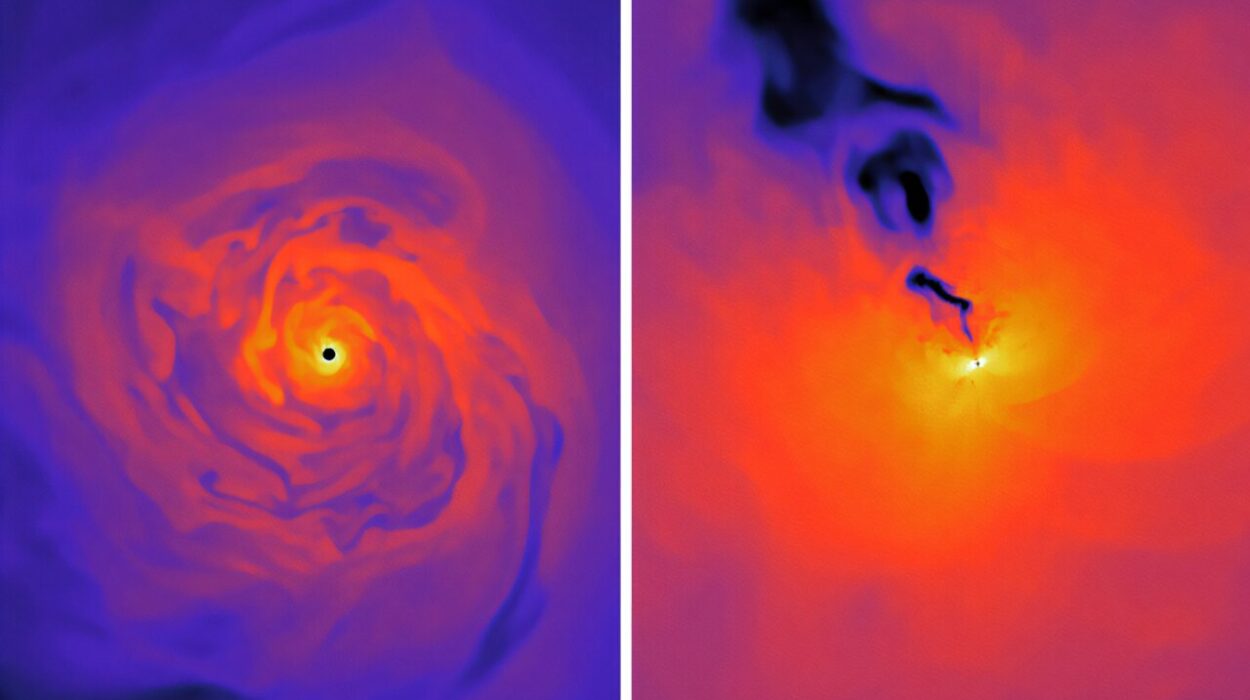
Unlike the standard cold dark matter scenario, SIDM allows dark matter particles to interact with one another through collisions. These interactions can transfer kinetic energy from outer regions toward the center of a halo, redistributing dark matter and producing a flatter central density.
The interaction strength needed to explain UGCA 320 falls within the range found in other studies of galaxies of similar size.
The researchers also considered whether ordinary matter could account for the unusually large core. Repeated bursts of star formation and the resulting supernova explosions can disturb a galaxy’s gravitational structure, potentially pushing dark matter away from its center. Infalling clumps of matter may also contribute.
But simulations suggest that these processes typically produce cores around 0.1 to 2 kiloparsecs across, considerably smaller than the 7-to-12-kiloparsec range inferred for UGCA 320.
The possibility has not been completely ruled out, however. Existing studies have not yet established whether supernova activity could generate cores this large in a small galaxy like UGCA 320.
A possible challenge to the standard model
Among the explanations tested, self-interacting dark matter provides the best match to the observations. That does not mean the researchers have established that dark matter particles actually collide, or that the standard cosmological model is wrong.
The result comes from modeling the galaxy’s rotation and comparing the inferred mass distribution with different theoretical predictions. The preference for one model over another is evidence in favor of that explanation, not direct detection of dark matter particles or their interactions.
The findings nevertheless highlight a potential difficulty for the conventional cold dark matter picture: explaining a core that extends so far beyond the visible stellar body may require physics not included in its simplest form.
“Our results are broadly consistent with the SIDM scenario, while appearing to be in tension with WDM and FDM predictions,” the team concludes.
The paper was posted to the arXiv preprint server.