Earth’s earliest animals may have spent millions of years evolving at an unusually slow pace because they reproduced by cloning themselves. New research suggests environmental stress and growing competition eventually pushed these organisms toward sexual reproduction, triggering a dramatic increase in biodiversity that helped reshape life on the planet.
The first animals on Earth appeared hundreds of millions of years ago, yet for a surprisingly long time, they changed very little. Scientists have long wondered why evolution seemed to stall after these pioneering creatures emerged.
Now, researchers from the University of Cambridge believe they have uncovered an important piece of that mystery. Their findings suggest that the way these ancient animals reproduced may have limited competition and slowed evolutionary change for millions of years. Only when environmental pressures increased did sexual reproduction become advantageous, opening the door to a burst of diversification that transformed the history of life.
The study was published in Nature Ecology & Evolution.
A Long Period of Evolutionary Slowdown
During the Ediacaran Period, which lasted from 635 million to 539 million years ago, life on Earth underwent a major transformation. After billions of years dominated by microbes, the first animals emerged.
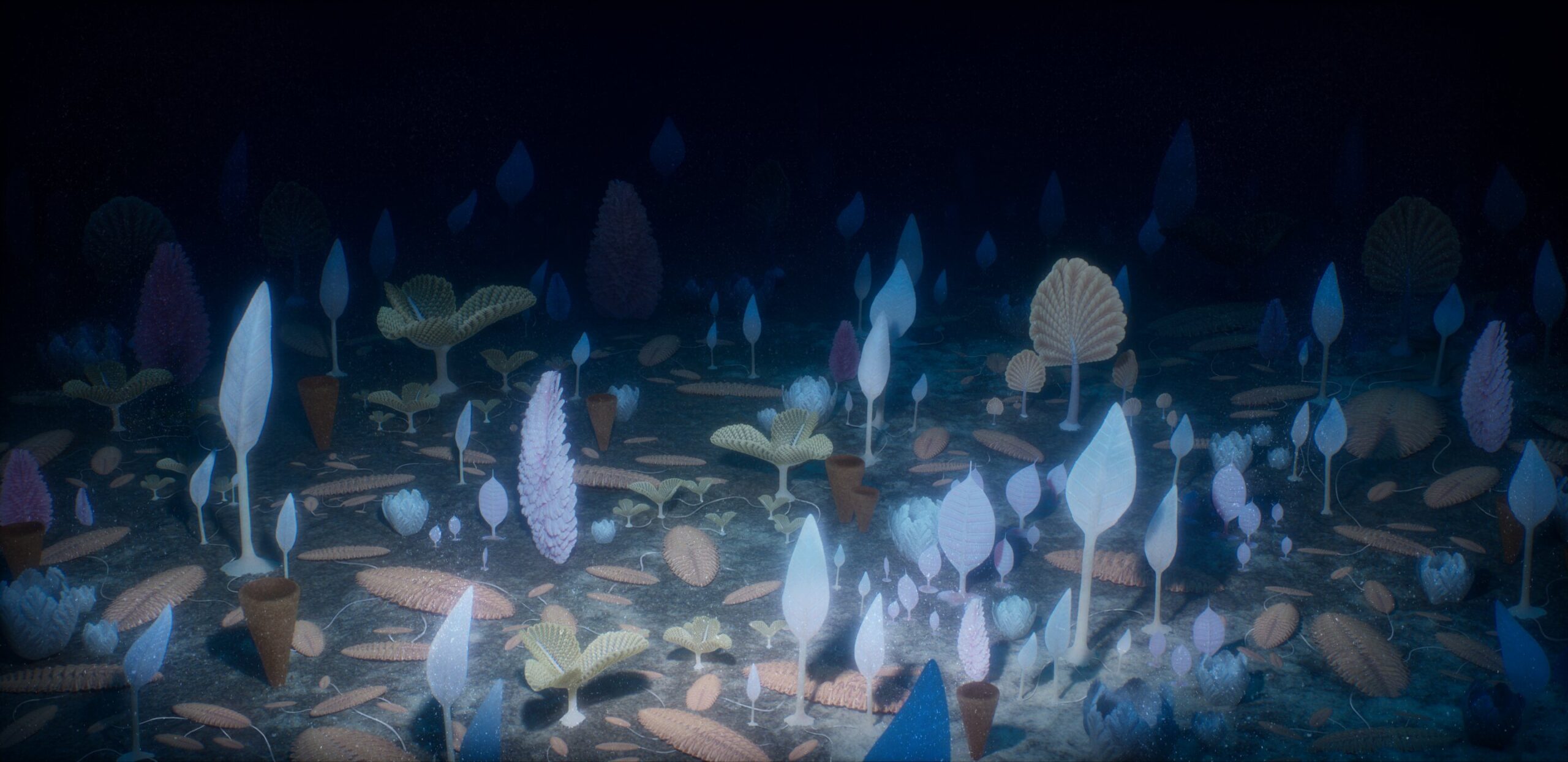
Some of these creatures were surprisingly large. Organisms such as Fractofusus could reach heights of up to two meters, although many were much smaller.
Despite being classified as animals, these organisms looked nothing like modern creatures. They resembled ferns more than familiar animal forms and appear to have lacked mouths, organs, and the ability to move. Scientists believe they absorbed nutrients directly from the surrounding water.
Although these early animals flourished, they eventually vanished from the fossil record around the start of the Cambrian Period, making it difficult for researchers to determine how they relate to modern life.
One of the most important clues about their biology comes from how they reproduced.
Cloning Instead of Sex
Previous research had shown that many Ediacaran animals reproduced asexually. Rather than producing offspring through sexual reproduction, they created genetically identical clones.
They did this using structures similar to the runners or stolons seen in modern strawberry plants. New individuals grew outward from parent organisms while remaining physically connected.
According to lead author Dr. Emily Mitchell of Cambridge’s Department of Zoology, life during this period was relatively comfortable.
“Life was pretty nice during the Ediacaran, so the need for sex was rather limited,” Mitchell explained. With little competition and abundant resources, there was little pressure for major evolutionary change.
The researchers suspected that this reproductive strategy may have played a central role in slowing diversification among early animal communities.
Fossils Reveal Clues from an Ancient Seafloor
To investigate, Mitchell and co-author Professor Andrea Manica turned to fossils from Mistaken Point in Newfoundland, one of the richest Ediacaran fossil sites in the world.
The team combined laser scanning, spatial analysis, and artificial intelligence to examine patterns preserved within these ancient communities.
Their goal was to understand how reproduction influenced competition and species diversity.
The researchers first demonstrated that stolon-based reproduction limited competition among neighboring organisms. Because connected individuals shared resources, there was less incentive to compete for survival.
As Manica explained, neighboring organisms linked by runners effectively shared nutrients rather than fighting over them.
This cooperative arrangement may have created stable communities, but it also reduced the evolutionary pressures that often drive adaptation and innovation.
Simulating Ancient Ecosystems
To test their ideas, the researchers built computer models that recreated possible Ediacaran ecosystems under different reproductive strategies.
The simulations were run thousands of times. A simple neural network helped identify which scenarios most closely matched patterns observed in the fossil record.
The team used a technique known as Approximate Bayesian Computation, which allowed them to work backward from real fossil data to estimate how organisms spread across environments and how intensely they competed for resources.
The results revealed a consistent pattern.
Limited dispersal associated with asexual reproduction could explain why early animal communities contained relatively few species. Organisms remained clustered near their parent colonies, reducing opportunities for expansion and diversification.
The fossil evidence and modeling results pointed toward a strong connection between reproductive strategy and the pace of evolution.
Stress Changed Everything
The researchers found that conditions likely began to change as life expanded from deeper marine environments into shallower waters.
Unlike the relatively stable deep ocean, shallow-water habitats exposed organisms to a wide range of environmental challenges. Tides, storms, shifting temperatures, and fluctuating nutrient levels created a more unpredictable world.
Under these conditions, survival became more difficult.
Mitchell noted that repeated environmental disturbances would have dramatically altered evolutionary pressures. Organisms suddenly faced situations in which parts of their populations could be wiped out multiple times each year.
Such stress appears to have encouraged a shift toward sexual reproduction.
Unlike cloning, sexual reproduction creates genetic variation among offspring. That variation can help populations adapt to changing conditions and exploit new environments.
According to the researchers, the move toward sexual reproduction was accompanied by much greater dispersal distances as organisms spread into new habitats and competed for resources more aggressively.
The Beginning of a Biodiversity Boom
The transition had major consequences.
As reproduction changed and organisms colonized new areas, species diversification increased significantly. The researchers argue that this process helps explain a second wave of evolutionary expansion during the Ediacaran.
Instead of remaining relatively static, animal communities began generating greater biological diversity.
This trend continued into the Cambrian Period, when the emergence of mobile animals accelerated evolutionary change even further.
The findings suggest that competition and environmental stress acted as powerful evolutionary forces, transforming ecosystems that had previously remained relatively stable.
Rather than being obstacles, challenging conditions may have provided the spark that allowed animal life to diversify on a much larger scale.
Why This Matters
Understanding why evolution accelerated during Earth’s earliest animal history helps scientists explain one of paleontology’s most enduring puzzles: why the first animals appeared long before biodiversity truly took off.
This study suggests that reproduction was not merely a biological detail—it may have been a major driver of evolutionary speed. By showing how asexual reproduction, limited competition, and restricted dispersal slowed diversification, the research provides a new explanation for millions of years of evolutionary stagnation.
The findings also highlight the profound role of environmental stress, competition, and sexual reproduction in shaping life’s history. What began as a survival response to increasingly difficult conditions may have helped launch one of the most important periods of biological diversification ever seen on Earth, setting the stage for the rich variety of animal life that would follow.