The story begins with something that has never been seen. Dark matter does not glow, does not reflect, and does not absorb light. Yet its absence from sight has never made it absent from scientific concern. For decades, physicists have been drawn toward a class of particles that could quietly resolve two deep puzzles at once. These particles are called axions, and although they remain hypothetical, they occupy a unique place in modern physics because they promise to explain why certain nuclear interactions respect time symmetry while also offering a compelling candidate for dark matter.
Axions are imagined as extraordinarily light particles that were created in the early universe and still linger today, drifting through space and through us, rarely interacting with the ordinary matter we know. Their defining trait is subtlety. They interact very weakly, almost never announcing themselves. But theory allows for one rare moment of revelation. In the presence of a strong magnetic field, an axion can convert into a photon, a particle of light. That faint transformation is the narrow doorway through which scientists hope to catch a glimpse of the invisible.
Listening for Light in a Magnetic Silence
In Italy, a large and coordinated effort has grown around this idea. The QUAX collaboration, short for Quest for Axions or QUaerere AXion, brings together researchers from multiple institutes with a single ambition: to listen for axions using instruments known as haloscopes. These devices are designed to detect the whisper of light that would appear if axions pass through a powerful magnetic field and convert into photons.
Two such haloscopes operate at Italian national laboratories, one at the Laboratori Nazionali di Legnaro and another at the Laboratori Nazionali di Frascati. Together, they form the experimental heart of a search that has been steadily evolving for years. The collaboration recently reported the results of its latest investigation in a paper published in Physical Review Letters, describing a search that pushes into new territory by operating at higher frequencies than many earlier efforts.
“Our paper follows the INFN (Istituto Nazionale di Fisica Nucleare) research line on axions, active since 2015,” Giosuè Sardo Infirri and Pino Ruoso, members of the QUAX collaboration, explained. Their work is not an isolated attempt but the culmination of a long research trajectory that has gradually refined both the instruments and the questions they are capable of asking.
A Cavity Tuned to the Unknown
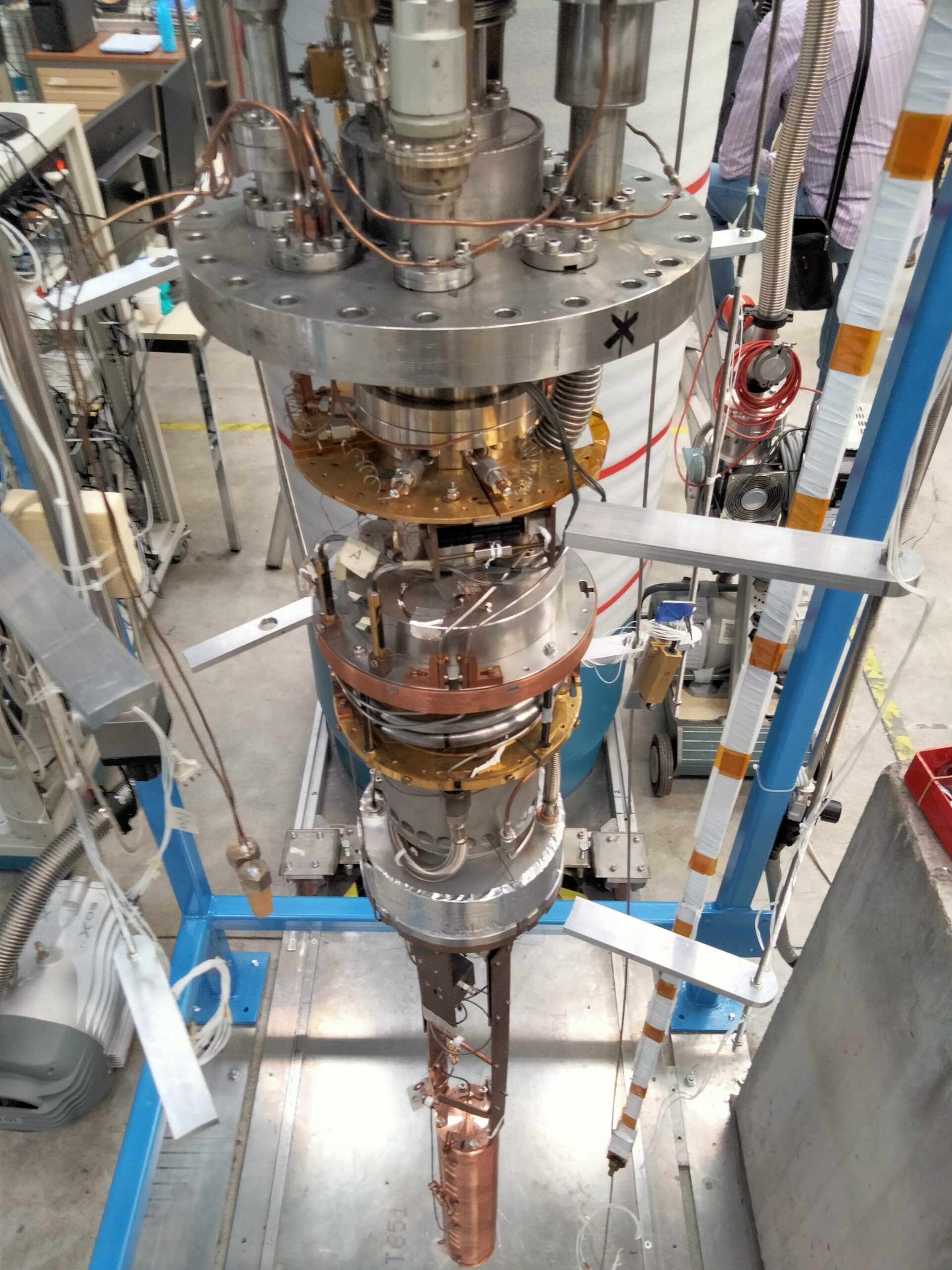
At the center of the experiment lies a microwave cavity made of copper, immersed in a strong magnetic field. This cavity is not just a container but a finely tuned resonator, designed to amplify an otherwise imperceptible signal. If an axion enters the cavity and converts into a photon, it would deposit an extremely small amount of power at a specific frequency. That frequency corresponds directly to the axion’s mass, a value that remains unknown.
“The QUAX collaboration is looking for power deposited by the interaction of axions with virtual photons coming from the magnetic field,” said Sardo Infirri and Ruoso. “The signal is then a very low power excess at a specific frequency that we don’t know, above noise. To detect this small signal, we use a copper cavity inserted in the magnetic field.”
The challenge is immense. The expected signal is buried beneath layers of noise, and the frequency at which it might appear cannot be predicted in advance. To confront this uncertainty, the cavity is designed to be tunable. By physically opening the cavity in a clamshell-like mechanism, researchers can change its resonant frequency and therefore the axion mass range they are probing.
“By opening the cavity, we change its frequency, and therefore the possible converted axion mass,” the authors said. “For any cavity aperture we can then confront between pure noise and the presence of a signal.”
This slow, methodical scanning across frequencies transforms the experiment into a careful listening exercise, one that demands patience and precision rather than dramatic flashes of discovery.
Cooling the Universe to Hear Its Quietest Voice
To give the axion even the slightest chance to be heard, the entire system must be cooled to extreme temperatures. The cavity and its readout electronics are housed in a dilution refrigerator that brings the apparatus down to about 70 millikelvin, just fractions of a degree above absolute zero. At these temperatures, thermal noise is reduced to a minimum, allowing the detection chain to approach quantum-limited sensitivity.
Within this frozen environment, any genuine signal would stand out not by being loud, but by being just a little less silent than expected. The converted photons would be collected by a carefully coupled antenna and amplified using a detection chain designed to preserve even the faintest excess of power.
The effort reflects a central paradox of modern experimental physics. To find something vast and cosmologically significant, researchers must first master the art of measuring almost nothing at all.
Exploring a High-Mass Frontier
One of the defining features of the recent QUAX search is its focus on a high-mass region of axion parameter space that has been less explored by other experiments. Because the axion mass is unknown, a comprehensive search must cover a wide range of possible values. The QUAX instruments are designed to be sensitive above 40 microelectronvolts, a region of particular interest following recent theoretical predictions.
“Our aim is to build a high frequency haloscope (i.e. working above 10 GHz, with sensitivity reaching theoretically motivated models),” said Sardo Infirri and Ruoso. “The paper contains the last big step of the collaboration toward this goal.”
This emphasis on higher frequencies represents both a technical and conceptual advance. It requires adapting the haloscope design to operate effectively in a regime where signals are even harder to detect, while also opening a new window onto axion masses that could plausibly account for dark matter.
What It Means to Find Nothing
The recent search did not reveal any signals consistent with axion-to-photon conversion. In popular imagination, such an outcome might sound like failure. In science, it is something quite different. The absence of a signal carries information, and in this case, it confirms that the instrument works as intended while narrowing the landscape of viable theories.
“Our initial search sets a basis for a working haloscope that could work autonomously at high frequency,” said Sardo Infirri and Ruoso. The experiment demonstrated that the system can be tuned and operated in a partly automated way, scanning across frequencies with the stability required for long-term data collection.
“Our contribution to the scientific community is the adaptation of the haloscope to higher frequencies, which opens a new interval of axion masses to be probed,” they added. “The important implications of an axion search are the following: if an axion trace is found, we will have the first evidence of dark matter, while the absence of it will only exclude some theoretical models of this dark matter.”
In other words, even silence speaks. Each excluded possibility sharpens the focus of future searches, guiding the next generation of experiments toward the most promising ground.
Letting the Machines Listen on Their Own
The QUAX collaboration is already looking ahead. Plans are underway to further increase the sensitivity of the haloscopes at both Italian laboratories and to expand the range of axion masses they can investigate. More and better cavities are envisioned, each one extending the reach of the search.
“In our next studies, we also plan to extend the probed region as much as we can, using more and better cavities,” said Sardo Infirri and Ruoso. “We would also like to automate the system completely, so that we can switch it on and let it acquire data autonomously.”
This vision reflects a quiet confidence in the experimental approach. The search for axions is not a single dramatic event but a long-term commitment to careful measurement, incremental improvement, and unwavering attention to detail.
Why This Search Matters
At its core, the hunt for axions is about more than a single particle. It is about confronting one of the most profound mysteries in physics: the nature of dark matter. If axions are detected, they would provide the first direct evidence of the substance that makes up a significant portion of the universe yet remains unseen. Such a discovery would reshape our understanding of cosmology and fundamental physics in one decisive moment.
Even without a detection, the work matters. Each experiment like QUAX refines the tools, tests the theories, and maps the boundaries of what is possible. By pushing haloscopes into higher frequencies and demonstrating their stability and tunability, the collaboration has expanded the experimental frontier. In doing so, it has transformed the search for dark matter from a distant aspiration into a precise, methodical exploration of the invisible universe, one quiet frequency at a time.
More information: G. Sardo Infirri et al, Search for Postinflationary QCD Axions with a Quantum-Limited Tunable Microwave Receiver, Physical Review Letters (2025). DOI: 10.1103/4dv9-72t5.