Quantum computers are often described as machines of the future, but in reality they already exist, humming quietly in laboratories, wrestling with problems that ordinary computers would take far longer to solve. Their promise is extraordinary. By drawing on the strange rules of quantum mechanics, these machines can explore many possibilities at once, opening paths to calculations that are effectively closed to even the fastest supercomputers of today. Yet for all their potential, quantum computers remain fragile creations. Their most basic elements are so delicate that even small disturbances can cause the entire calculation to unravel.
At the heart of this fragility lies a problem that researchers have long struggled to control: errors. Among the most disruptive of these is a phenomenon known as leakage, a failure mode that does not merely introduce a small mistake but can remove a quantum bit entirely from the computation. Now, scientists have reported a new way to address this issue, offering a path toward quantum machines that grow more reliable as they grow larger, rather than collapsing under their own complexity.
The Strange Vulnerability of a Qubit
To understand why leakage is such a threat, it helps to consider how quantum computers store information. Conventional computers rely on bits that exist in one of two states, either 0 or 1. Quantum computers use qubits, which can exist in combinations of states at the same time. This remarkable flexibility gives quantum machines their power, but it also leaves them exposed. A qubit is not a robust switch etched into silicon; it is a finely balanced quantum system that must remain within a narrow range of energy levels to function properly.
Leakage occurs when a qubit is pushed beyond this range. Instead of staying within the energy levels that define its usable states, the qubit suddenly jumps to a higher energy level. When that happens, it effectively leaves the computation. It can no longer represent information correctly, and worse, its misbehavior can interfere with neighboring qubits. A single leak can ripple outward, contaminating an entire calculation.
This is not a rare or exotic problem. Leakage can be triggered by the very processes designed to protect quantum information. Quantum Error Correction, one of the main strategies for managing mistakes in quantum systems, involves a complex choreography of operations that can themselves introduce leakage. Even the hardware that supports these operations can nudge qubits out of place. Another known strategy is to shift a qubit’s frequency to bring it back into line, but that approach demands extra hardware, making it difficult to scale up to large systems.
The challenge, then, has been to find a way to suppress leakage without adding layers of complexity that would undermine the very goal of building large, practical quantum computers.
A Subtle Push Back to Order
In a study published in Physical Review Letters, Jian-Wei Pan of the University of Science and Technology of China and his colleagues describe a different approach. Rather than redesigning the hardware or relying on elaborate correction schemes, the team focused on a simpler idea: gently nudging leaking qubits back to where they belong.
Their method uses microwave pulses to correct leakage directly. When a qubit strays into a higher energy level, a carefully tuned microwave signal can guide it back down into its proper computational state. Crucially, this process is designed to work without disturbing the ongoing calculation. The qubit returns to participation as if it had never wandered off.
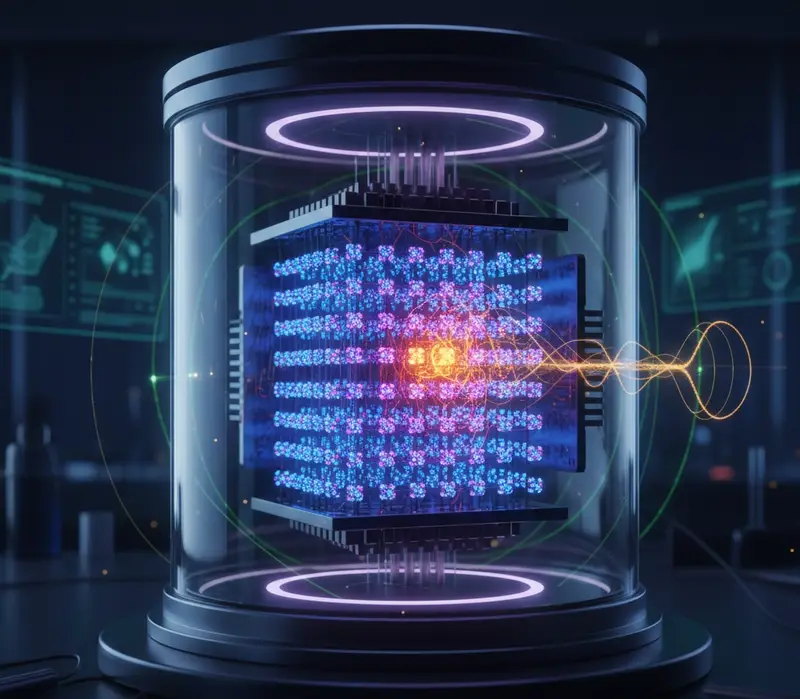
This idea was not tested in theory alone. The researchers implemented it on a custom-built quantum processor known as Zuchongzhi 3.2, which contains an array of 97 qubits. These include data qubits, which hold the information needed for the calculation itself, and ancilla qubits, which act as helpers that detect and correct errors in the data qubits. Together, they form a miniature quantum ecosystem in which errors can be introduced, observed, and addressed.
Making Errors on Purpose to Learn How to Heal Them
To see whether their approach truly worked, the team did something that might sound counterintuitive. They deliberately induced leakage, forcing qubits into higher energy levels where they should not be. This allowed the researchers to observe how leakage spread through the system and to test whether their microwave pulses could reliably reverse the damage.
Once leakage was induced, microwave pulses were applied to the data qubits to remove the error and return them to their computational states. At the same time, the ancilla qubits were reset using another microwave pulse, ensuring that any residual errors were fully cleared. This coordinated action was essential. Correcting the data qubits without addressing the ancilla qubits would leave traces of the problem behind, ready to resurface later.
The results were striking. Compared with running the system without any leakage suppression, the new method reduced leakage errors by more than a factor of 70. What had once been a persistent and accumulating threat was transformed into a manageable, fleeting disturbance.
When Bigger Starts to Mean Better
Perhaps the most surprising outcome of the experiment emerged when the researchers tested their method across different parts of the qubit array. They examined both small and large sections of the processor, expecting, as many before them had, that increasing the number of qubits would make error management more difficult. Historically, this has been one of the central frustrations of quantum computing. Adding more qubits often introduces more opportunities for errors, causing performance to degrade rather than improve.
This time, the opposite happened. As the system grew larger, the quantum computer became more reliable. The error rate went down as more qubits were included. This behavior is widely regarded as one of the most important goals in the field. A quantum computer that improves with scale is no longer trapped by its own fragility. It begins to resemble a platform that can be expanded toward practical usefulness.
The researchers emphasize that this success stems from the simplicity and scalability of their approach. Because the method relies entirely on microwave control, it avoids the need for additional hardware that could complicate large-scale designs. In their words, “Our results demonstrate the viability of all-microwave control architectures for suppressing critical errors at scale, paving the way for more advanced quantum error correction implementations.”
Why This Quiet Advance Could Change the Future
The significance of this work extends beyond a single experiment or processor. Leakage has long been one of the most stubborn obstacles in quantum computing, not because it is poorly understood, but because it is so difficult to control without making systems unwieldy. By showing that leakage can be suppressed efficiently using tools already integral to quantum hardware, this research points toward a future in which reliability does not come at the cost of scalability.
Quantum computing has often been described as a balancing act between power and control. The more powerful the system becomes, the harder it is to keep it stable. What this study suggests is that the balance may not be as unforgiving as once thought. With carefully designed control techniques, it may be possible to build quantum machines that grow more stable as they grow larger.
This matters because the true promise of quantum computing lies not in small demonstrations, but in large, fault-tolerant systems capable of sustained, complex calculations. Every step toward reducing errors at scale brings that vision closer. By turning leakage from a catastrophic failure into a correctable event, this work marks a quiet but profound shift. It suggests that the leaks in the quantum dream can, with the right touch, be gently sealed.
More information: Tan He et al, Experimental Quantum Error Correction below the Surface Code Threshold via All-Microwave Leakage Suppression, Physical Review Letters (2025). DOI: 10.1103/rqkg-dw31