Sixty-six million years ago, the world ended in fire and shadow. A massive asteroid struck the Earth, marking the boundary between the Cretaceous and Paleogene periods. The impact triggered a global catastrophe that wiped out the dinosaurs and turned the oceans into graveyards for massive marine reptiles. While the giants fell, a quieter group of survivors managed to crawl through the wreckage largely unscathed. These were the turtles. For decades, scientists have wondered why these slow-moving reptiles possessed such a remarkable degree of resilience when so much of the world was collapsing around them. New research suggests the secret to their survival wasn’t hidden in their shells, but rather in what they chose to eat.
The Filter of the Nuclear Winter
When the asteroid hit, it kicked up a colossal cloud of debris and soot that blanketed the atmosphere, ushering in a period of darkness known as a nuclear winter. This sudden loss of sunlight was a death sentence for herbivores. Without photosynthesis, plants withered, causing the primary food source for many land-dwelling creatures to vanish. As the plants died, the starvation rippled upward through the food chain, eventually claiming the lives of the apex carnivores that hunted them. However, a study led by Serjoscha Evers from the Bavarian State Collection of Natural History (SNSB) has identified an ecological filter that allowed specific lineages to bypass this cycle of starvation.
The researchers discovered that while many species were being squeezed out of existence, turtles that specialized in a very specific diet had a massive evolutionary advantage. The team, including doctoral student Guilherme Hermanson, looked at the anatomical structures of turtle jaws across all lineages existing at the time of the impact. By examining these physical traits, they could reconstruct the dietary habits of ancient turtles. What they found was a striking correlation: those who preferred a “crunchy” diet of hard-shelled organisms were more than five times more likely to survive than those that hunted fish or relied solely on plants.
Resilience in a Hard Shell
The reason for this disparity lies in the hardiness of the food source itself. While the terrestrial and surface-level marine food webs were falling apart, mollusks, gastropods, and bivalves proved to be incredibly resilient. These creatures are often opportunists, capable of surviving in harsh conditions that would kill off more delicate species. When the Cretaceous-Paleogene boundary event occurred, these hard-shelled creatures persisted in the muck and the depths, providing a stable pantry for any predator equipped to eat them.
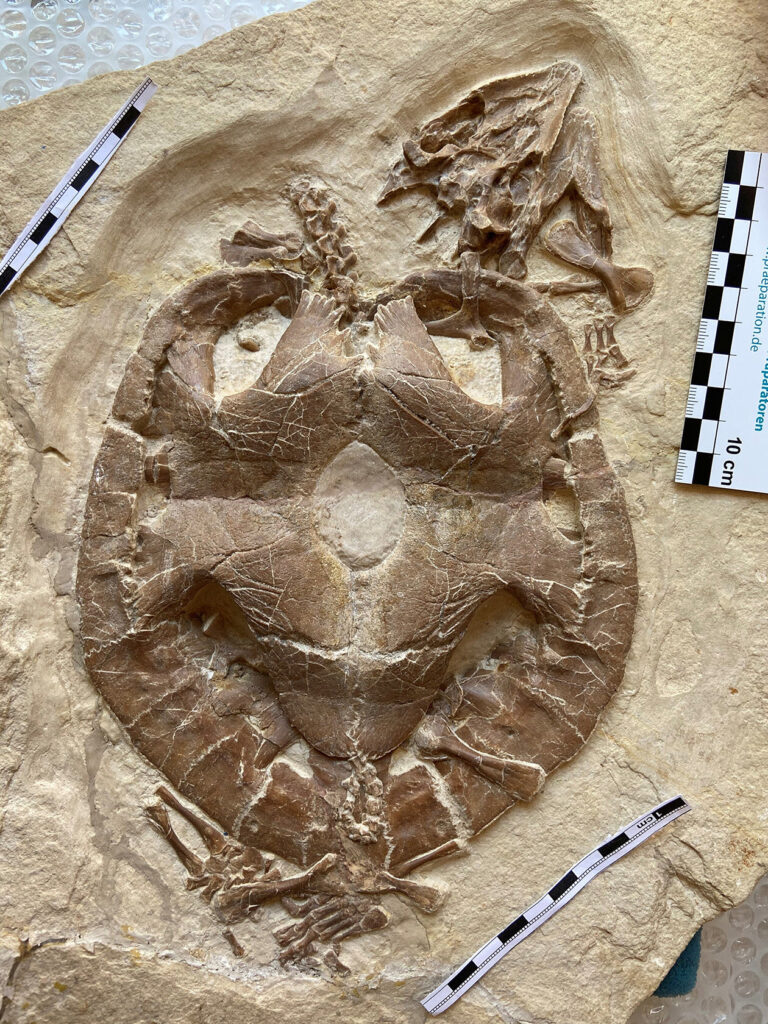
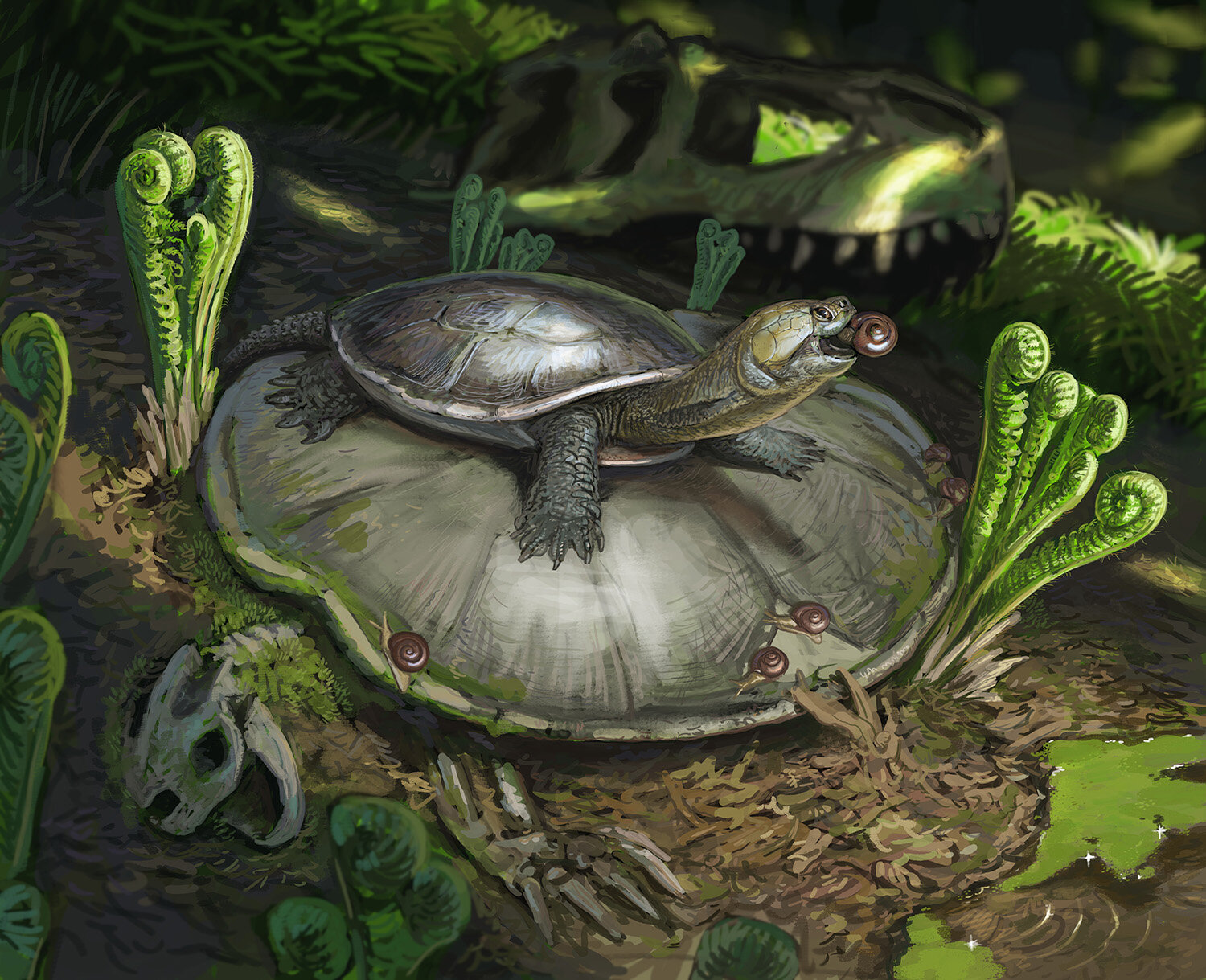
Turtles that had developed the specialized jaw anatomy needed to crush through thick shells found themselves under significantly less pressure than their peers. While herbivorous turtles watched their food disappear in the shadows and fish-eating turtles struggled as the marine food chain destabilized, the “durophagous” or shell-crushing turtles simply continued to feast on the survivors of the seafloor. The researchers used statistical models to analyze this massive dataset, confirming that this ecological adaptation was the primary factor in determining who lived and who died. It was a case of being in the right niche at the right time; their specialization, which might have seemed narrow before the impact, became a golden ticket through the mass extinction.
Why the Fossil Record of the Shell Matters
Understanding these ancient survival strategies is vital because it changes how we view the history of life’s resilience. This research proves that survival during a global catastrophe isn’t just about being the biggest, the fastest, or the strongest. Often, it is about ecological flexibility and the stability of one’s food source. By studying how turtles navigated the Cretaceous-Paleogene extinction, scientists can better understand the mechanisms of evolutionary filters.
These filters act as a sieve, allowing only those with specific traits to pass into the next era of Earth’s history. In this case, the ability to exploit gastropods and bivalves allowed a significant portion of the turtle lineage to endure a world-ending event with minimal losses. This work highlights the intricate connections between an animal’s anatomy, its diet, and its ultimate fate when the environment undergoes a sudden, violent shift. It reminds us that in the story of life on Earth, the winners are often those who find a way to thrive on the margins, eating what others cannot, and waiting for the sun to return.
Study Details
Guilherme Hermanson et al, Ecological selectivity of diet on turtle K/Pg survivorship, Biology Letters (2026). DOI: 10.1098/rsbl.2025.0790