Not all parts of the brain age in the same way, and new research suggests the cerebellum—long known for controlling movement—may also play an important role in preserving memory and thinking abilities later in life. The findings reveal that different regions of the cerebellum shrink at different rates with age, while people with larger cerebellums tend to perform better on cognitive tests as they grow older.
Growing older affects every brain differently. Some people remain mentally sharp well into old age, while others experience noticeable declines in memory and thinking. Scientists have long searched for the biological reasons behind these differences, and a new study points to an often-overlooked part of the brain that could hold an important piece of the puzzle.
The findings, published in Nature Neuroscience, suggest the cerebellum—a structure at the base of the skull commonly associated with movement and coordination—may play a much larger role in healthy cognitive aging than previously recognized.
Looking Beyond the Brain’s Usual Suspects
Most studies investigating age-related cognitive decline focus on the cerebral cortex and the hippocampus, areas well known for their roles in thinking and memory. However, Princeton University neuroscientist Federico d’Oleire Uquillas and colleagues chose a different target.
Their attention turned to the cerebellum because it contains most of the brain’s neurons, despite being much smaller than the rest of the brain. Traditionally recognized for coordinating balance, posture, and fine motor skills such as writing and typing, the cerebellum also supports a variety of functions throughout the brain and body.
The researchers suspected this neuron-rich structure could help explain why some people maintain stronger cognitive abilities as they age.
Mapping How the Cerebellum Changes With Age
To investigate, the team analyzed brain scans and cognitive test results from more than 700 healthy individuals in the United States whose data came from the Human Connectome Project.
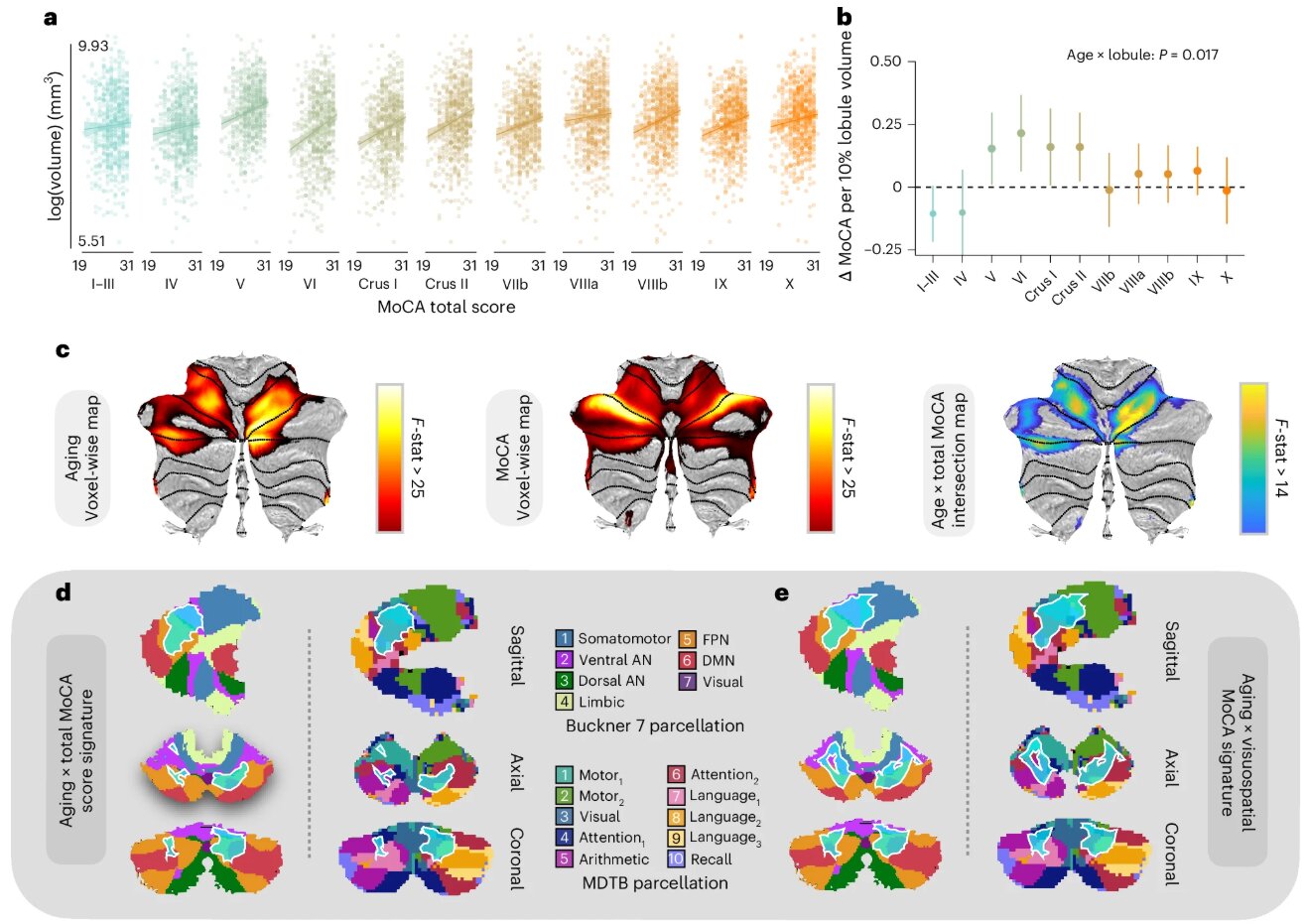
Using digital brain scans, the scientists divided the cerebellum into 11 distinct regions and measured how the volume of each changed with age.
Their analysis showed that the cerebellum does not shrink uniformly over time.
Instead, regions located toward the back of the cerebellum, which are more closely connected with higher-order thinking networks, experienced faster age-related shrinkage than front regions involved primarily in basic movement.
As the researchers explained in their paper, they identified a spatially heterogeneous pattern of aging, with specific regions associated with thinking and movement showing steeper age-related declines than others.
Larger Cerebellums Were Linked to Better Cognitive Performance
The study uncovered another important pattern.
Individuals with a larger cerebellum generally achieved higher scores on tests measuring memory and thinking abilities as they aged compared with people whose cerebellums were smaller.
To determine whether this relationship extended beyond their initial dataset, the researchers examined information from approximately 47,000 adults included in the UK Biobank and the Alzheimer’s Disease Neuroimaging Initiative.
The same overall trend appeared in these larger populations, strengthening the observed association between cerebellum size and cognitive performance during aging.
The Cerebellum’s Support May Have Limits
The researchers also explored what happens in people with Alzheimer’s disease.
Their findings suggest that while the cerebellum may help support cognitive function, its protective influence does not continue indefinitely as the disease progresses.
According to the researchers, the results support a threshold-reserve model, in which the cerebellum helps sustain thinking and memory until Alzheimer’s-related changes become widespread throughout the brain.
This indicates that although the cerebellum may contribute to cognitive resilience, its ability to compensate appears to diminish once brain pathology reaches a more advanced stage.
Important Questions Still Remain
Despite the promising findings, the researchers emphasize that their study identifies an association, not proof of cause and effect.
The results do not demonstrate that having a larger cerebellum directly causes better memory or thinking abilities in later life. Instead, they show that these characteristics occur together within the populations studied.
The team also notes that the findings may not apply equally to everyone. Much of the data came from White participants with relatively high levels of education, meaning additional research involving more diverse populations will be needed to determine how broadly the conclusions apply.
Why This Matters
The study highlights the cerebellum as a potentially important contributor to healthy brain aging, expanding scientists’ understanding beyond the brain regions that have traditionally dominated research on memory and cognition.
By showing that different parts of the cerebellum age at different rates and that larger cerebellum volume is linked with stronger cognitive performance in later life, the findings provide a new direction for investigating why some people remain mentally sharp for longer than others. Although many questions remain about cause and effect, this research offers a valuable framework for exploring how the brain supports cognitive resilience throughout the aging process.