For decades, biology textbooks have painted a simple picture of hair growth. New cells divide at the base, push older ones upward, and the hair lengthens like a conveyor belt of living matter. But a team of scientists from L’Oréal Research & Innovation and Queen Mary University of London has upended that familiar narrative, revealing that hair is not pushed outward at all. Instead, it is pulled upward by a hidden choreography of moving cells, an internal engine no one realized was there.
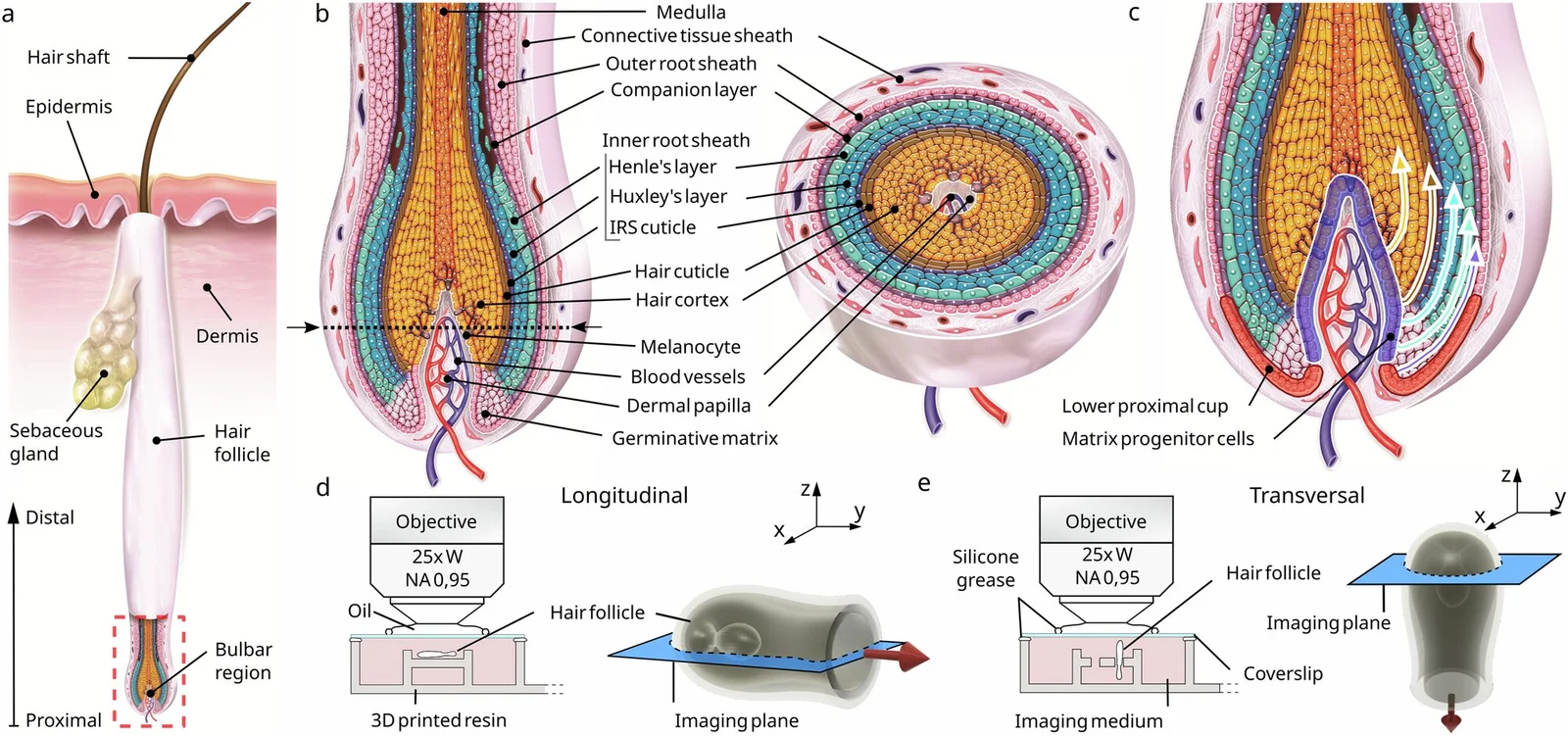
Working with living human hair follicles kept alive in culture, the researchers used advanced 3D live imaging to peer into the follicle’s depths. What they found was a twisting, spiraling movement in the outer root sheath, the protective layer encasing the hair shaft. Cells in this outer layer traveled downward in a slow spiral, and from the same region, an unexpected upward pulling force emerged. Decades of assumptions began to crumble.
As Dr. Inês Sequeira put it, “Our results reveal a fascinating choreography inside the hair follicle. For decades, it was assumed that hair was pushed out by the dividing cells in the hair bulb. We found that instead that it’s actively being pulled upwards by surrounding tissue acting almost like a tiny motor.” The idea that hair is lifted—not pushed—transforms what scientists thought they understood about one of the body’s most familiar structures.
The Moment Everything Stopped Making Sense
To test the long-accepted model of upward pushing, the team did something bold. They blocked cell division inside the follicle. If textbooks were right, hair growth should have ground to a halt. But something astonishing happened instead. Even with cell division disabled, the hair kept growing almost as if nothing had changed.
This was not a subtle hint. It was a direct contradiction of the standard story.
Next, they targeted actin, a protein responsible for helping cells move and contract. If motion, not division, was playing a far bigger role than anyone realized, then disrupting actin should affect hair growth. And it did: hair growth slowed by more than 80 percent. The pull weakened.
The evidence was suddenly overwhelming. The follicle was home to a mechanical engine, powered by moving cells, not simply a zone of pushing pressure from below. A biological machine had been hiding inside every follicle.
Computer models helped complete the picture. The simulated forces only matched real-world hair movement speeds when the pulling motion from the outer layers was included. Without that pulling mechanism, the numbers simply refused to add up.
Watching Living Cells Rewrite Textbooks
One of the breakthroughs that made this discovery possible was a novel imaging approach. The team used 3D time-lapse microscopy, watching cells move in real time instead of relying on snapshots frozen in place. What once appeared static suddenly revealed itself as dynamic.
Dr. Nicolas Tissot explained the importance of this shift. “We use a novel imaging method allowing 3D time lapse microscopy in real-time. While static images provide mere isolated snapshots, 3D time-lapse microscopy is indispensable for truly unraveling the intricate, dynamic biological processes within the hair follicle, revealing crucial cellular kinetics, migratory patterns, and rate of cell divisions that are otherwise impossible to deduce from discrete observations. This approach made it possible to model the forces generated locally.”
Through this new lens, the hair follicle no longer looked like a simple assembly line. It looked alive—full of motion, tension, and mechanical coordination. Every cell seemed to know its direction and purpose, creating a spiraling dance that produced the force needed to lift the hair.
A New Story of How Hair Lives and Grows
Once the idea of pushing fell away, the new story of pulling snapped into focus. Dr. Thomas Bornschlögl summarized this shift in the simplest possible terms. “This reveals that hair growth is not driven only by cell division—instead, the outer root sheath actively pulls the hair upward. This new view of follicle mechanics opens fresh opportunities for studying hair disorders, testing drugs and advancing tissue engineering and regenerative medicine.”
It was an elegant explanation for something no one had understood correctly until now. The outer root sheath was no passive sleeve. It was a dynamic structure generating the mechanical force required to lift hair through the skin. The follicle was part biological tissue, part microscopic machine.
And the discovery was not just about hair. It was a reminder that the body’s machinery is full of forces that operate on tiny scales, shaping the organs and structures we see every day. Biophysics, often overshadowed by molecular biology and genetics, is proving to be just as essential.
Why This Discovery Matters
While the research was performed on follicles in culture, its impact reaches far beyond the laboratory dish. By uncovering the pulling forces that move hair upward, scientists have opened a new frontier in understanding hair loss and regeneration. Many treatments today target biochemical pathways—signals, hormones, or growth factors. But this study reveals that the physical environment inside the follicle is just as important.
If hair relies on a mechanical engine to rise, then anything that weakens or disrupts that engine could contribute to thinning or loss. Treatments of the future may need to strengthen not only biological signals but also the mechanical behavior of the follicle’s outer layers.
The imaging technique itself also offers a powerful new tool. Because it captures movement in living tissue, it may allow researchers to test drugs directly on active follicles, watching in real time how they change motion, force, and growth.
This work highlights a broader truth emerging across modern biology. Life is shaped not only by molecules and genes but also by forces, tension, and motion. Every organ hides mechanical stories we are only beginning to understand. By discovering the hidden engine beneath every strand of hair, scientists have taken an important step toward rewriting the physics of life, one follicle at a time.
More information: Nicolas Tissot et al, Mapping cell dynamics in human ex vivo hair follicles suggests pulling mechanism of hair growth, Nature Communications (2025). DOI: 10.1038/s41467-025-65143-x