Deep in the arid, sun-scorched stretches of the San Juan Basin in New Mexico, the desert floor recently surrendered a secret that had been buried for tens of millions of years. For decades, the story of the world’s most famous predator, Tyrannosaurus rex, has been told through the lens of the northern badlands of Montana and Canada. We have long pictured the “king of the tyrant lizards” as a product of the north, but a single, massive bone emerging from the Kirtland Formation is now challenging that prehistoric map. This discovery does not just add another fossil to the archives; it pulls back the curtain on a mysterious family history, suggesting that the lineage of the greatest carnivore to ever walk the earth may have deep, southern roots.
An Unexpected Titan in the Dust
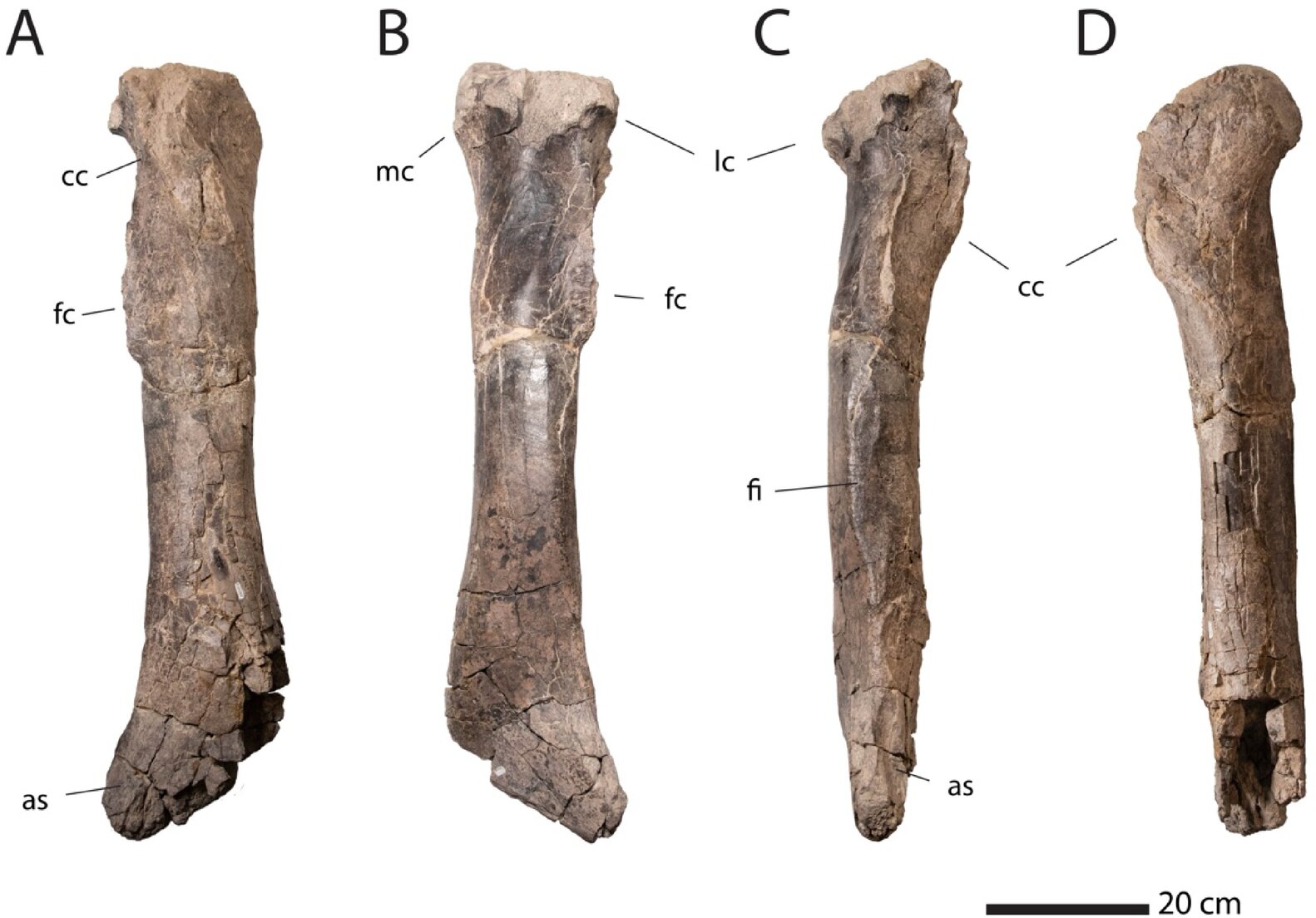
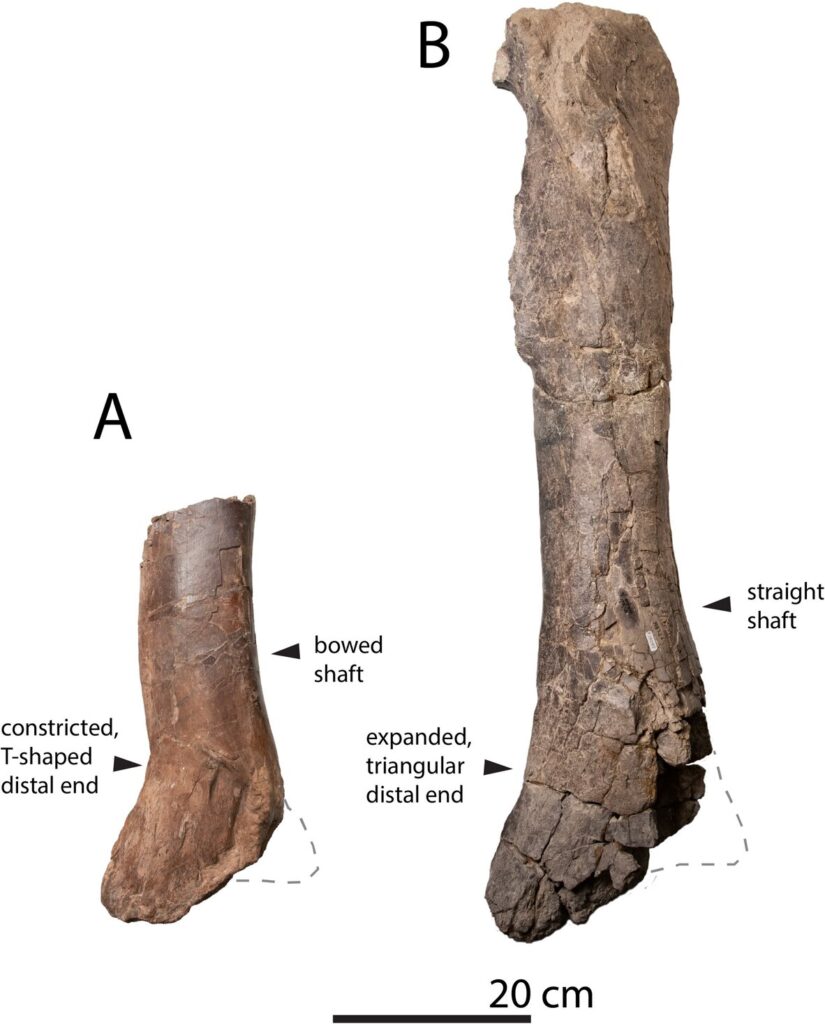
The find centered on a tibia, or shinbone, of staggering proportions. Unearthed within the Hunter Wash Member, a geological layer known for its rich fossil deposits, the bone immediately stood out due to its sheer scale. Measuring nearly one meter in length, the specimen belonged to a creature of immense power and weight. When paleontologist Nicholas Longrich and his team began the painstaking process of analyzing the find, they realized they weren’t looking at a standard predator of the era. By measuring the dimensions and density of the bone, the researchers calculated that this dinosaur would have weighed between 4 and 5.9 metric tons.
This was no mid-sized scavenger. This was a giant, a behemoth that rivaled the scale of the massive tyrannosaurs that would eventually dominate the planet. However, the most shocking revelation wasn’t how big the creature was, but when it lived. Through radiometric dating of volcanic ash layers found both above and below the fossil site, scientists were able to pin a timestamp on the find. They also analyzed the magnetic orientation of the surrounding rocks to confirm their timeline. The results placed the dinosaur in the Late Campanian period, approximately 74 million years ago.
A Ghost from the Deep Past
To put that date into perspective, one must look at the reign of T. rex itself. The famous king didn’t appear on the scene until the very end of the Cretaceous period, roughly 66 to 68 million years ago. This New Mexico giant was walking the earth millions of years before its more famous relative ever existed. This gap in time created a scientific puzzle: how did this massive creature fit into a family tree that, until now, seemed to have a missing trunk?
To solve the mystery, the research team turned to a massive dataset of 537 anatomical traits. They compared the physical characteristics of the Hunter Wash tibia against every known branch of the tyrannosaur family. Like a forensic investigation into a royal bloodline, they mapped out the subtle grooves and structures of the bone to see where it landed. The analysis concluded that this dinosaur was not a distant cousin, but an early member of the specific group that includes Tyrannosaurus. It was a close relative that shared the specialized biology of the giants, proving that the blueprint for a multi-ton super-predator was already being perfected in the American Southwest long before the end of the age of dinosaurs.
The Divided Continent of Laramidia
The discovery provides heavyweight evidence for a theory known as the southern origins hypothesis. During the Late Cretaceous, North America was split down the middle by a vast inland sea, leaving a long, narrow strip of land to the west known as Laramidia. For years, paleontologists have noticed a strange pattern in the fossils found along this landmass. The north and south seemed to host entirely different neighborhoods of dinosaurs, a phenomenon called endemicity.
In the north, in places like present-day Alberta and Montana, the landscape was inhabited by smaller tyrannosaurs known as the Albertosaurinae and the Daspletosaurini. While still formidable, they did not reach the gargantuan proportions of the true giants. The New Mexico find suggests that while the north had its own specialized hunters, the giant tyrannosaurins were evolving and thriving in the south. This implies that the lineage leading to T. rex likely began its rise in the environments of New Mexico, Utah, and Texas before eventually migrating north to claim the rest of the continent.
Chasing the Shadows of the King
While the discovery of the Hunter Wash tyrannosaur is a landmark moment, the researchers remain cautious. Science, after all, is a narrative built on evidence, and currently, that evidence is anchored largely to a single, though spectacular, bone. One shinbone cannot tell the entire life story of a species, nor can it provide the full picture of an animal’s daily life or its exact appearance. The team acknowledges that uncertainties remain and that their findings are based on the limited material currently available.
However, the implications are a beacon for future exploration. The fact that such a massive animal existed in the Late Campanian of New Mexico suggests that there are likely more pieces of the puzzle waiting beneath the silt and sandstone of the San Juan Basin. The dream for the team is the discovery of an entire skeleton, a “smoking gun” fossil that could definitively confirm the exact point of origin for the world’s most iconic predator. Until then, the tibia stands as a silent witness to a time when southern giants ruled the land.
Why This Ancient Leg Bone Matters
This research is vital because it reshapes our understanding of how evolution functions across vast landscapes and deep time. We often think of evolution as a straight line, but the Hunter Wash discovery shows it is more like a complex map. By proving that giant tyrannosaurs were already established in the south millions of years earlier than expected, scientists are uncovering the environmental pressures and geographical barriers that shaped the most famous predators in history.
Understanding the endemicity of Laramidia helps us realize that prehistoric worlds were just as diverse and regionally distinct as our own. It tells us that the “King” didn’t just appear out of thin air at the end of the Cretaceous; it was the result of a long, southern legacy of giants that spent millions of years refining the art of being a titan. This single bone reminds us that even the most well-known chapters of Earth’s history still have missing pages, waiting to be found in the dust of the desert.
Study Details
Nicholas R. Longrich et al, A large tyrannosaurid from the Late Cretaceous (Campanian) of North America, Scientific Reports (2026). DOI: 10.1038/s41598-026-38600-w