Archaeologists have identified the oldest human burials ever discovered in Patagonia, dating back more than 10,000 years to the Early Holocene. These findings provide the first direct evidence of early hunter-gatherers establishing long-term settlements along the South American Atlantic coast, a region previously thought to have been populated much later than the Pacific side.
For decades, the story of how humans first claimed the vast landscapes of South America has been told through the lens of the Pacific. While the western coast of the continent is dotted with ancient sites from the Late Pleistocene and Early Holocene, the Atlantic side has remained a frustrating mystery. Rising sea levels over the last 11,700 years likely swallowed the evidence of the first pioneers, leading many to believe that the Atlantic route was a much younger chapter in human history. However, a chance discovery in the small village of Camarones has fundamentally shifted this timeline, revealing that humans were not just passing through the Atlantic coast of Patagonia 10 millennia ago—they were making it their home.
An Unexpected Discovery in an Urban Setting
The breakthrough did not begin in a remote desert or a deep cave, but in a residential backyard. In October 2020, during the height of the COVID-19 pandemic, a homeowner in Camarones began construction on a new house. As the earth was moved, human bones emerged from the soil, triggering a police investigation. Once authorities realized the remains were not modern, they notified an archaeological team to conduct a formal excavation and analysis.
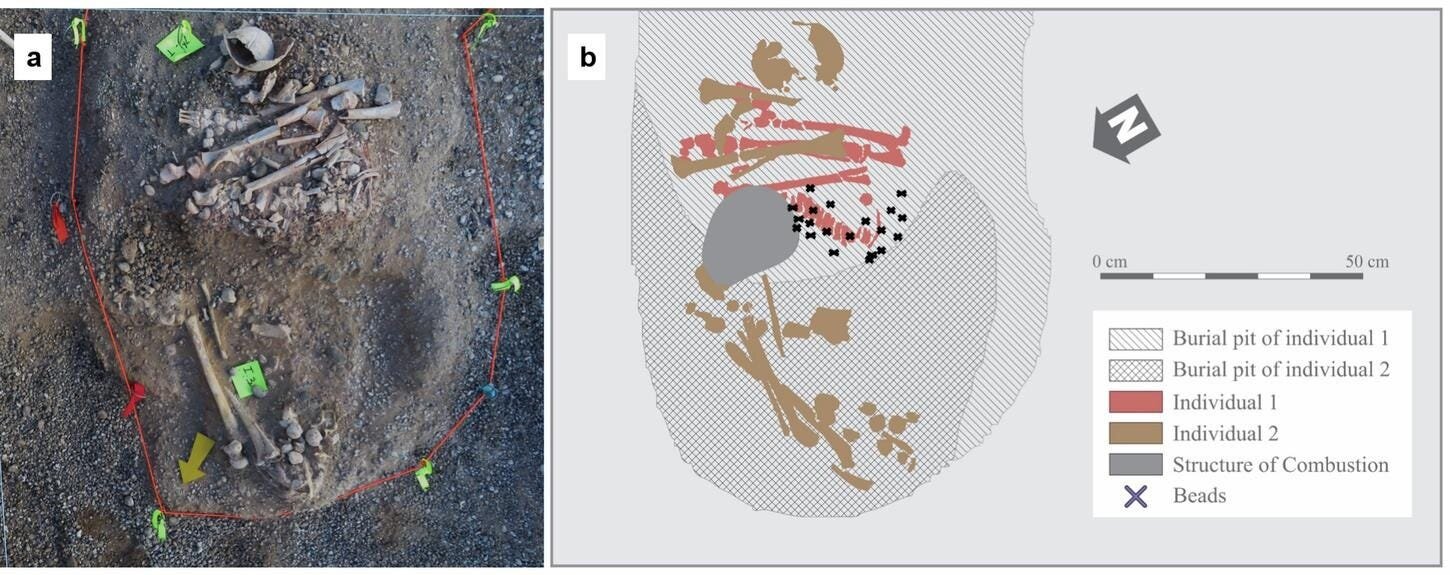
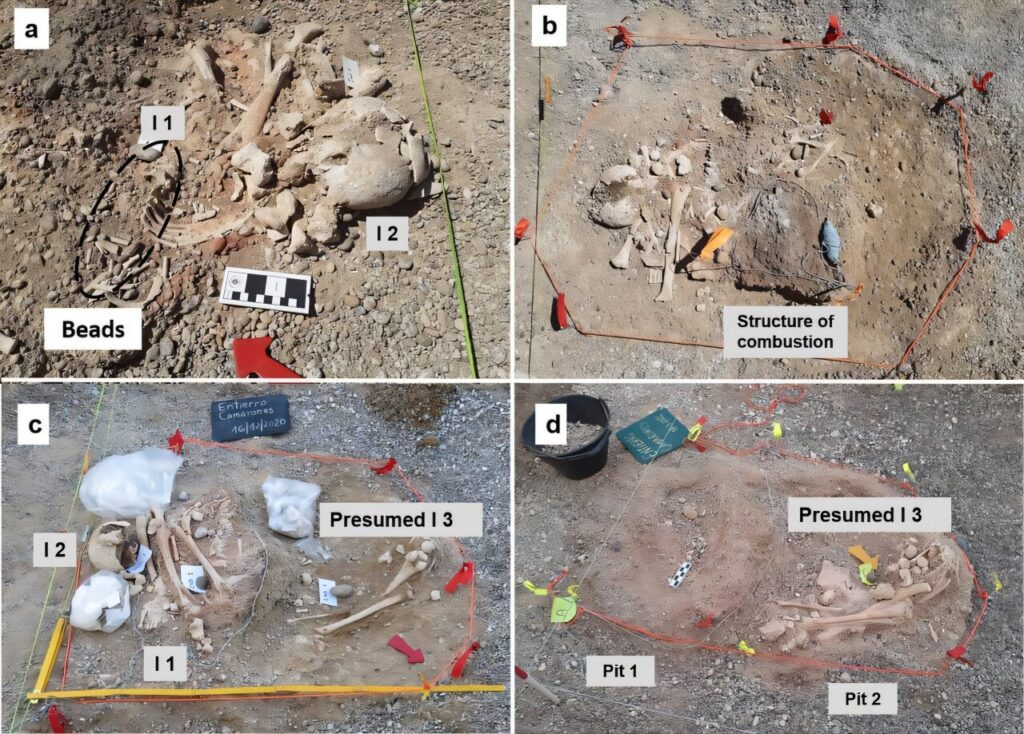
The researchers uncovered what initially appeared to be three separate individuals. Upon closer inspection in the lab, they determined that the second and third sets of remains actually belonged to the same skeleton. This left the team with two distinct individuals: Individual 1, a child who died between the ages of 8 and 9, and Individual 2, an adolescent approximately 14 years old. Despite the antiquity of the remains, the skeletons showed no signs of bone disease, physical trauma, or dental decay. Researchers suggest their deaths may have been the result of acute infectious diseases—such as influenza or smallpox—or perhaps an infected wound, none of which leave permanent marks on the bone.
Ancient Rituals and Unusual Traits
The burial of Individual 1 offered a rare glimpse into the symbolic life of these early inhabitants. The child was interred with red ocher, a natural pigment found in the surrounding area, and 50 beads crafted from bird bones. These beads likely once formed a necklace measuring 1.5 meters in length. This elaborate funerary treatment suggests that even in the earliest stages of coastal occupation, these groups possessed established cultural practices and a deep connection to their young.
Beyond the artifacts, Individual 1 possessed a biological anomaly that has intrigued dental experts. The child’s lower incisors were unusually shaped like triangles, a rare dental feature known as a talon cusp. This characteristic is exceptionally uncommon in modern populations, and the study authors noted that there are currently no other reported cases of this feature appearing in such an early period anywhere in the Americas.
Establishing a Timeline for the Atlantic Route
To place these individuals in the broader context of South American migration, the team utilized radiocarbon dating. The results were staggering. Individual 2 was dated to between 10,798 and 10,302 calibrated years BP, while Individual 1 lived slightly later, between 10,210 and 9878 calibrated years BP. Before this study, the earliest evidence of human activity in this specific region suggested an occupation between 6000 and 600 BP, and the oldest known burial in Patagonia was dated to roughly 5205 uncalibrated years BP.
The Camarones burials push the timeline of human presence in this area back by thousands of years. They prove that hunter-gatherers were successfully navigating the Atlantic coast nearly 10,000 years ago, narrowing the perceived gap between the settlement of the Pacific and Atlantic shores. Because the two individuals were buried in the exact same location roughly 400 years apart, the researchers argue that these populations were not nomadic strangers. Instead, they maintained a persistent knowledge of the landscape and returned to this specific spot across multiple generations.
Diet and Survival on the Coast
The question of how these early pioneers survived was answered through stable carbon and nitrogen isotope analyses. By studying the chemical signatures left in the bones, researchers can reconstruct what a person ate during their lifetime. The analysis revealed that both individuals relied heavily on seafood. Individual 1 showed a particularly high consumption of marine-based foods, confirming that they were directly exploiting the resources of the nearby ocean.
This diet stands in stark contrast to other early burials found in the interior of the continent, where hunter-gatherers relied almost exclusively on terrestrial animals and plants. The reliance on marine resources, combined with the use of local red ocher and bird bones for beads, reinforces the idea that these people were deeply integrated into the coastal ecosystem. They were not merely traveling along the shore to get elsewhere; they had mastered the local environment and its raw materials.
Why This Matters
The discovery at Camarones provides the missing link in the story of South American dispersal. For years, the lack of Atlantic sites led to a “Pacific-centric” view of early migration. These burials prove that the Atlantic coast was a viable and occupied corridor for human movement and settlement much earlier than previously thought.
The study also highlights the archaeological potential of modern urban areas. Because Camarones is a growing village, future construction may lead to even more discoveries that could further refine our understanding of these ancient people. With ongoing genetic analyses and more detailed bioanthropological studies in the works, these 10,000-year-old individuals are finally beginning to tell the story of the first families to call the Atlantic coast home.
Study Details
Julieta Gómez Otero et al, First archaeological evidence of Early Holocene human settlement on the Atlantic coast of South America. The Camarones burial site, Argentine Patagonia, Journal of Archaeological Science: Reports (2026). DOI: 10.1016/j.jasrep.2025.105515