Decades of theoretical work on quantum computers based on electrons floating above superfluid helium have reached an important milestone. Researchers at EeroQ have demonstrated strong coupling between a single trapped electron and a microwave photon, providing a crucial step toward measuring and controlling electron-on-helium qubits for future scalable quantum computing systems.
Quantum computing has long promised to solve specialized problems that remain beyond the reach of conventional computers, but building practical quantum hardware continues to be one of the field’s greatest challenges. Among the many proposed approaches, one idea has persisted for decades: using electrons trapped just above the surface of superfluid helium as the foundation for quantum bits, or qubits.
Now, researchers at Chicago-based EeroQ Corporation have achieved a key experimental milestone that moves this concept closer to reality. Their work, published in Nature Physics, demonstrates strong coupling between a single electron floating above superfluid helium and a single microwave photon—a result that could enable reliable measurement and control of electron-based qubits.
The achievement addresses one of the most persistent technical obstacles that has limited the development of this unconventional quantum computing platform.
Why Electrons on Superfluid Helium Have Drawn Interest
Unlike classical computers, which process information using bits that represent either 0 or 1, quantum computers rely on qubits that can exist in combinations of multiple states. Maintaining these fragile quantum states requires minimizing disturbances from the surrounding environment.
Electrons suspended above superfluid helium have long attracted attention because the system could naturally isolate electrons from many sources of environmental noise. That isolation could help preserve delicate quantum states and reduce computational errors.
Despite this promise, researchers have struggled with a fundamental problem: detecting and measuring the quantum state of individual electrons trapped above the helium surface.
According to senior author Johannes Pollanen, overcoming that limitation was central to the team’s work.
“Ultimately, this trapped electron system can combine the benefits of ultra-high-coherence spin qubits with a CMOS-based scaling architecture needed to create the powerful large-scale quantum computer of the future,” Pollanen told Phys.org. “Despite this tremendous potential, single-electron quantum measurement in this system remained elusive, until now.”
A Device Designed to Strengthen Quantum Interactions
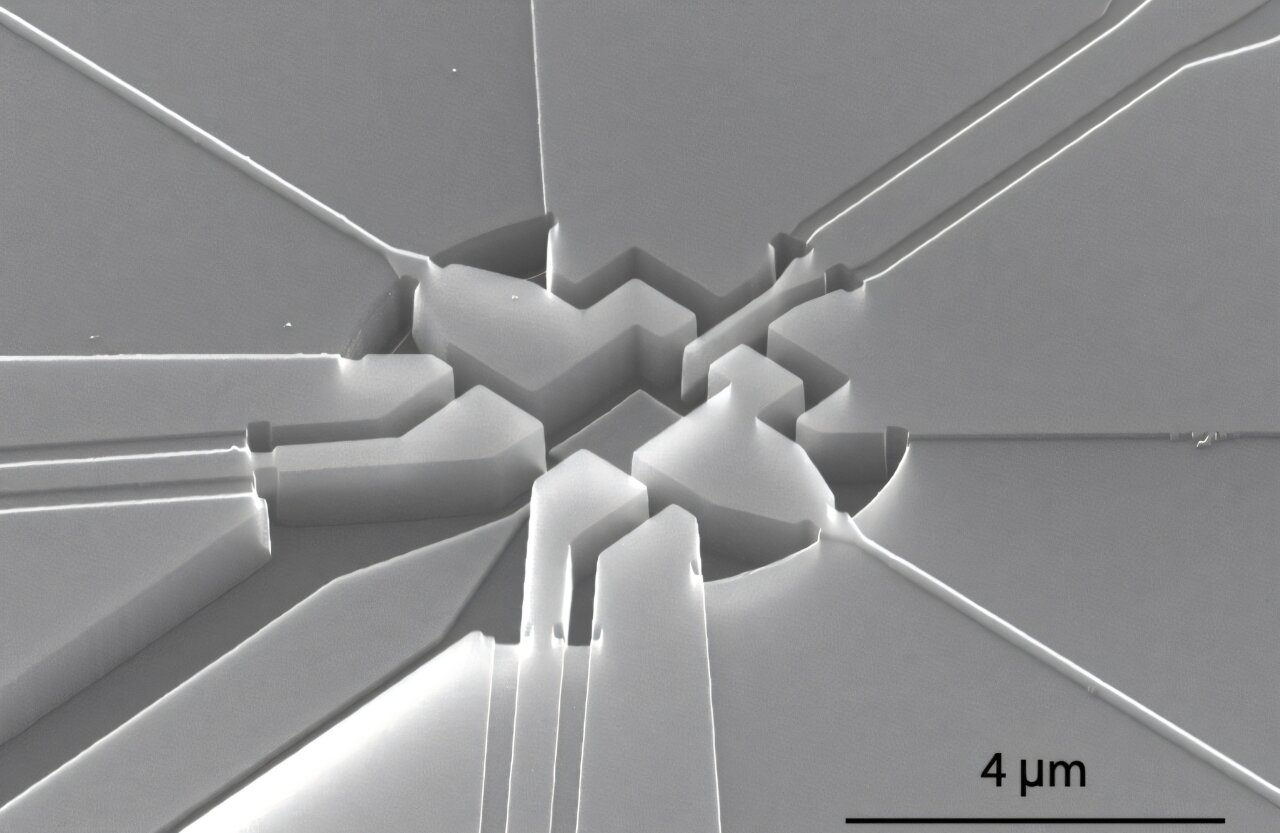
To solve the measurement challenge, the researchers designed a quantum device capable of controlling a single electron above superfluid helium while maximizing its interaction with microwave radiation.
Their platform combines two essential components: a quantum dot, which confines the electron, and a superconducting resonator, which traps microwave photons.
The team focused heavily on increasing the strength of the interaction between the electron and the microwave field. Pollanen explained that achieving this required careful attention to both materials and circuit design.
“To amplify the interaction strength between a microwave photon and an electron’s charge-qubit state, we focused intensely on the resonator’s material choice and dove deeply into the nitty-gritty of microwave engineering,” he said.
A key element was the use of a high-kinetic inductance superconducting material made from titanium and nitrogen. This material allowed the researchers to minimize stray capacitance within the circuit, increasing the microwave electric field experienced by the trapped electron.
Simulations Guided the Device Design
Before fabricating the device, the research team relied extensively on computer simulations to predict how the system would behave.
Using finite element modeling (FEM), they calculated the electric fields produced by the device and how those fields would influence the trapped electron. These simulations helped the researchers tune the electron’s charge qubit so that it would interact as strongly as possible with the microwave field.
Pollanen said this preparation was essential to the experiment’s success.
“This approach allowed us to create the precise charge-qubit state with the right frequency to couple as strongly as possible to the microwave field.”
Building the device itself also proved demanding.
“The nanofabrication of the device was also amazingly challenging and took a lot of iteration and trial and error,” Pollanen said. “Our project really was an amazing team effort, from simulation, to nanofabrication, modeling and measurement.”
Reaching a Long-Sought Experimental Milestone
The finished device successfully demonstrated strong coupling between a single electron floating above superfluid helium and a single microwave photon.
For researchers pursuing electron-on-helium quantum computing, this represents more than an incremental technical improvement. Strong coupling provides a practical way to probe and manipulate the electron’s charge state, an important requirement for building functioning quantum devices.
Pollanen emphasized the broader significance of the result.
“It’s not every day that one can demonstrate coupling to a new type of qubit, so that is certainly the most notable aspect of this work and the one we’re most excited about.”
He also noted that proposals for quantum computers based on electrons on helium have existed for decades, making the demonstration especially meaningful.
Opening the Door to Spin-Qubit Control
While the new study focused on the electron’s charge qubit, the researchers view it primarily as a stepping stone toward controlling spin qubits, which they ultimately hope to use in future quantum computers.
“Ultimately, we want to control and read out the spin-qubit state of the electron for our quantum computers,” Pollanen explained. “Our paper in Nature Physics is a vital step on that path, as it enables getting a handle on the electron charge qubit.”
The researchers say demonstrating that qubit measurement is feasible marks an important transition from theory toward practical implementation.
“People have been talking about qubits, of one kind or another, based on electrons on helium for a long time now,” Pollanen said. “Our work set out to show that one could viably measure these qubit states, and it’s exciting to have accomplished that goal!”
Building Toward Scalable Quantum Computing
The team’s results suggest that electron-on-helium quantum computing may be achievable through a combination of careful engineering, detailed simulations, precision nanofabrication, and established quantum technologies.
Their next objective is to demonstrate rapid, high-fidelity measurement and control of individual electron spin qubits. The researchers plan to accomplish this by hybridizing the electron’s charge and spin using existing techniques.
Pollanen said the project also benefits from lessons learned across the broader quantum computing field.
“We’re really building off the tremendous advances made in other quantum computing systems, namely superconducting qubits and spin qubits in silicon, to leapfrog into the quantum computing race.”
Alongside these efforts, the company is also developing large-scale control chips using CMOS-based manufacturing through commercial semiconductor foundries.
Taken together, the new demonstration provides experimental evidence that a quantum computing architecture once considered primarily theoretical can be realized in hardware. While additional milestones remain before such systems can perform practical quantum computation, the successful coupling of a single electron on superfluid helium to a microwave photon establishes an important foundation for the platform’s continued development.