Imagine pressing rewind on the universe.
In theory, the equations of quantum mechanics allow it. Every interaction, every motion of a particle, every whisper of energy can, on paper, run backward just as neatly as it runs forward. But in reality, something strange happens. The further a quantum system evolves, the harder it becomes to retrace its steps. Tiny imperfections swell. Minute errors grow. What should return to its starting point instead veers into unpredictability.
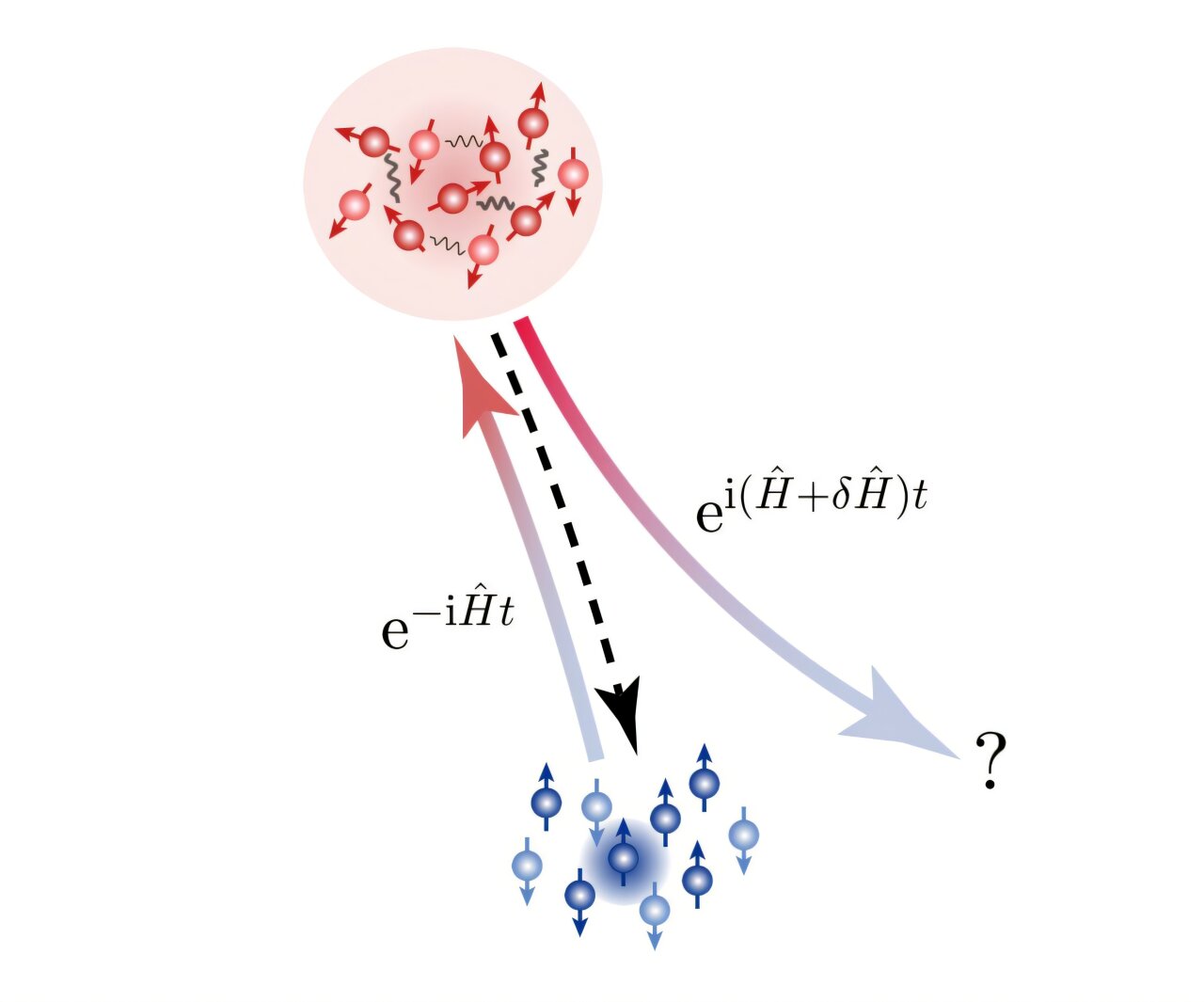
Now, for the first time, researchers in China have measured exactly how that unpredictability—how that chaos—grows in a quantum many-body system when scientists attempt to reverse time.
Led by Yu-Chen Li at the University of Science and Technology of China, the team combined meticulous experiments with theoretical insight to show something remarkable. When they applied time reversal to these systems, the level of chaos didn’t just increase. It grew exponentially. Their findings, published in Physical Review Letters, provide the clearest measurement yet of how fragile time reversal becomes in the quantum world.
The Quantum Butterfly Begins to Flap
The idea at the heart of this story is famously poetic: the butterfly effect.
In chaos theory, the butterfly effect describes how small changes in the starting conditions of a complex system can lead to wildly different outcomes. A minor error, almost invisible at first, can grow until predictions collapse.
Quantum systems take this sensitivity to another level.
In a many-body quantum system, particles do not exist in isolation. They become entangled, forming intricate webs of connection. Through entanglement, the state of one particle intertwines with others, weaving a network that can span the entire system. Even in relatively small collections of particles, this web can become astonishingly complex.
As such a system evolves over time, information about its initial state spreads outward. It doesn’t disappear. Instead, it becomes dispersed—shared across the entire network of entangled particles. Physicists call this process information scrambling.
And this is where chaos quietly takes hold.
Scrambling the Message
Imagine writing a secret message and then breaking it into pieces, scattering each fragment among dozens of people. Reassembling it becomes a monumental task. In quantum systems, something similar happens.
As scrambling progresses, the level of entanglement increases. Information that once belonged clearly to one part of the system becomes hidden in complex correlations among many parts. The system still “remembers” its past, but that memory is encoded in an increasingly tangled way.
Now consider what happens when scientists attempt to reverse this evolution.
In principle, if you could perfectly invert every interaction, you could restore the original state. But in practice, perfection is impossible. Implementing a time-reversed evolution introduces small errors—tiny mismatches in how magnetic fields are applied, slight deviations in control pulses.
And here the butterfly flaps its wings again.
Those tiny imperfections are amplified by the system’s intrinsic sensitivity. The more entangled and scrambled the system becomes, the more violently it responds to even the smallest misstep. Chaos emerges not as a sudden explosion, but as a steady and accelerating divergence from the past.
Until now, physicists have struggled to agree on how best to quantify this growth of chaos during time reversal. The concept was clear. The measurement was not.
Listening to the Spins
To tackle this problem, Li’s team turned to solid-state nuclear magnetic resonance, or NMR.
NMR is a powerful technique that probes the quantum spins of atomic nuclei using carefully controlled magnetic fields and radiofrequency pulses. In the solid material studied by the team, nuclear spins interact randomly with one another. These interactions create a controllable many-body system, complex enough to exhibit scrambling and chaos, yet structured enough to manipulate in the laboratory.
By precisely controlling the magnetic fields, the researchers could let the system evolve forward in time. Then, by adjusting the sequence of pulses, they attempted to reverse that evolution.
The question was simple but profound. How quickly does chaos grow when you try to rewind?
To answer it, they needed a reliable yardstick.
A Mathematical Signal of Chaos
Physicists often use a quantity known as the out-of-time-ordered correlator, or OTOC, to measure the spread of quantum information.
The OTOC captures how much two operations, applied at different times, fail to commute as the system evolves. If its value changes rapidly, it signals strong scrambling. In essence, a rapidly changing OTOC means the system is highly sensitive to perturbations—an indicator of chaotic behavior.
But measuring the OTOC during time reversal is delicate. Imperfections in reversing the system can contaminate the signal. What appears to be chaos might simply be experimental error.
Li’s team approached this challenge with a new theoretical tool. They used a framework based on scramblons, collective excitations involving many entangled particles. Scramblons act as carriers of quantum information, mediating how it spreads through the system.
By incorporating scramblons into their analysis, the researchers could identify which parts of their measurements reflected genuine scrambling and which arose from imperfections in implementing time reversal. In other words, they built a filter to separate true chaos from experimental noise.
Once these corrections were applied, the picture became clear.
Watching Chaos Rise
With errors accounted for, the team observed something striking. As time reversal proceeded, the level of chaos grew exponentially.
This was not a vague trend. It was a precise, quantifiable growth, matching theoretical predictions about the extreme sensitivity of these systems to small errors. The quantum butterfly effect was no longer just an analogy. It was a measured curve.
This marks the first time that the exponential growth of chaos during time reversal has been measured so precisely in a many-body experimental system.
The result confirms a long-suspected truth. While quantum laws are reversible in principle, complex quantum systems resist reversal in practice. The very entanglement that makes them rich and fascinating also makes them fragile when we attempt to turn back the clock.
Why Time Fights Back
At its heart, this research deepens our understanding of a paradox.
The equations governing quantum mechanics are symmetric in time. Yet real systems, especially those involving many interacting particles, behave as though time has a preferred direction. As information scrambles and entanglement grows, returning to the past becomes exponentially harder.
This is not because the laws forbid it. It is because the system’s sensitivity amplifies every imperfection.
The more scrambled the information becomes, the more violently small deviations grow. Time reversal becomes a balancing act on a razor’s edge. A tiny slip, and the system diverges rapidly from its original path.
By quantifying this growth with unprecedented precision, Li’s team has given physicists a clearer map of how chaos unfolds in quantum matter.
Why This Matters
Understanding quantum chaos is not merely an abstract pursuit.
Modern quantum simulations rely on precisely controlled quantum systems to probe physics that would otherwise be intractable. These simulations depend on our ability to manipulate and, at times, effectively reverse quantum evolutions. If chaos grows exponentially during time reversal, researchers must know exactly how and why.
This work provides that knowledge.
By confirming how the OTOC reflects genuine scrambling and by introducing the scramblon-based framework to correct experimental errors, the team has refined the tools available for exploring complex quantum behavior. This improved understanding could lead to more accurate quantum measurements and better control of many-body systems.
In a world racing toward more advanced quantum technologies, clarity about chaos is invaluable.
The study does more than measure a curve. It reveals why reversing a quantum system becomes so difficult as entanglement deepens. It shows that the resistance to time reversal is not mystical, but measurable. Predictable, even in its unpredictability.
And in doing so, it brings us one step closer to mastering the delicate choreography of the quantum world—where even the faintest flutter of a butterfly can echo across an entire universe of entangled spins.
Study Details
Yu-Chen Li et al, Error-Resilient Reversal of Quantum Chaotic Dynamics Enabled by Scramblons, Physical Review Letters (2026). DOI: 10.1103/cg3f-rggs. On arXiv: DOI: 10.48550/arxiv.2506.19915