Researchers have produced the highest-resolution view yet of a pion’s internal structure, revealing how quarks are arranged inside one of nature’s most important subatomic particles. Using the Polaris supercomputer at Argonne National Laboratory, the team uncovered new details about how visible matter emerges from quarks and gluons, while providing a roadmap for future particle physics experiments.
For decades, physicists have known that pions play a crucial role in holding matter together. Yet despite their importance, the particle’s internal structure has remained difficult to study. Now, a new computational breakthrough has provided an unprecedented glimpse inside the pion, offering fresh insights into one of the deepest questions in nuclear physics: how the building blocks of matter combine to create the visible universe.
The research, published in the Journal of High Energy Physics, used advanced simulations and one of the United States’ most powerful supercomputing resources to map the pion in remarkable detail.
Why Pions Matter
Pions are subatomic particles intimately connected to the strong nuclear force, the fundamental force responsible for binding protons and neutrons inside atomic nuclei.
According to Yong Zhao, an Argonne physicist and principal investigator on the project, pions mediate the strong force that binds nucleons—the protons and neutrons that account for an atom’s mass.
Because pions occupy such a central role in nuclear physics, understanding their internal structure can help scientists better explain how matter forms at its most fundamental level.
Researchers have long sought to determine how quarks, the elementary particles inside composite particles such as pions and protons, are distributed and organized. However, experimental information about the pion remains limited, making large-scale computational simulations an essential tool for investigating its properties.
Tackling a Fundamental Mystery
The study addresses a longstanding challenge in physics: understanding how visible matter emerges from elementary particles such as quarks and gluons.
Scientists believe that examining the pion’s multidimensional structure can reveal important clues about how these particles interact and remain confined within larger structures.
By probing the pion’s internal makeup, researchers can gain a deeper understanding of the mechanisms that allow quarks and gluons to form the matter that makes up the observable universe.
Harnessing the Power of Polaris
To carry out the research, scientists from the U.S. Department of Energy’s Argonne National Laboratory collaborated with researchers from DOE’s Brookhaven National Laboratory.
The team relied on the Polaris supercomputer at the Argonne Leadership Computing Facility, combined with advanced theoretical frameworks designed to simulate the behavior of the strong force.
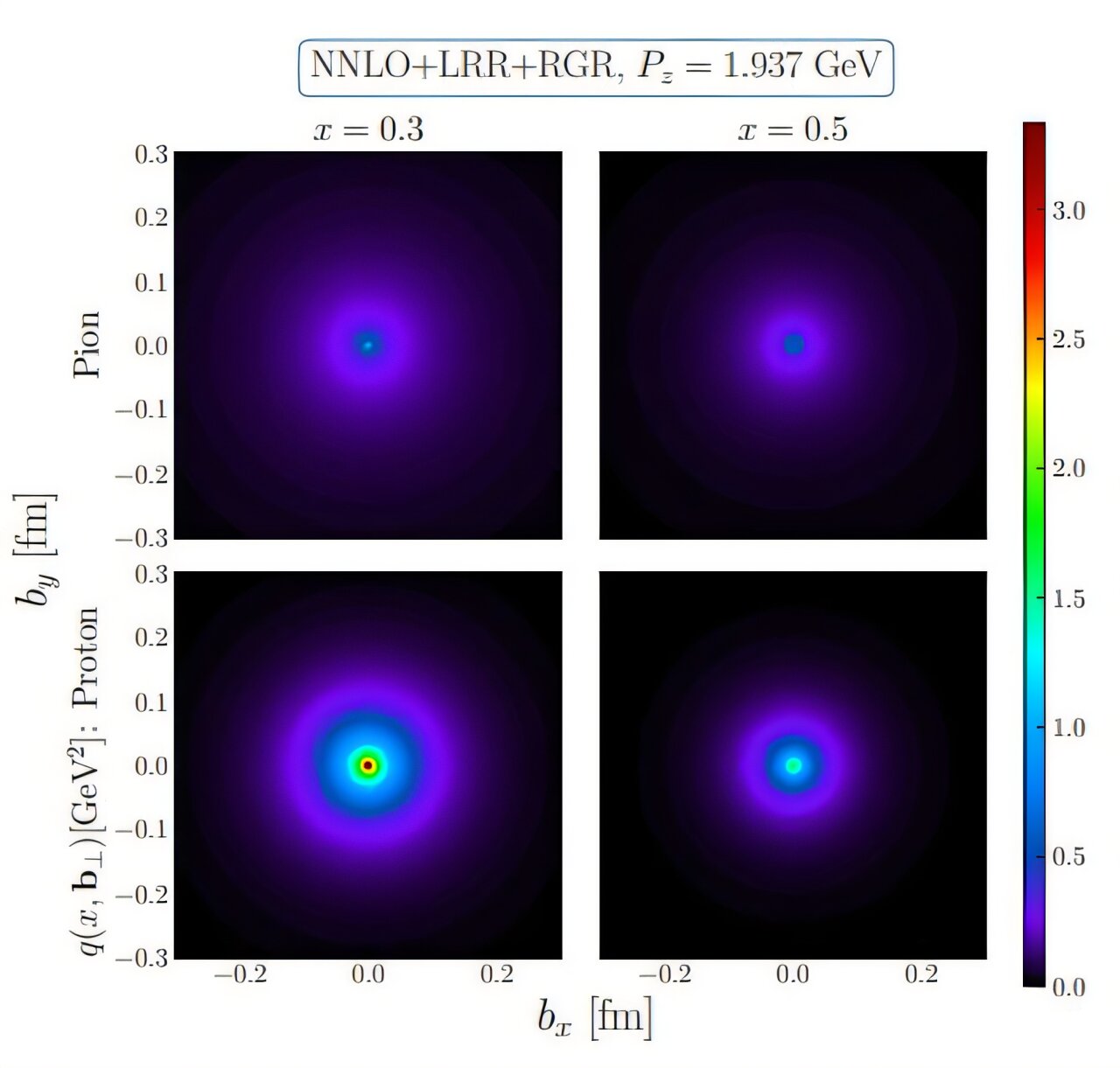
These simulations generated detailed 3D images showing how quarks are arranged inside a moving pion.
According to Zhao, Polaris enabled researchers to model how quarks move and correlate within the particle, both along its direction of motion and across it.
The computational challenge was enormous. The simulation captured hundreds of snapshots of 4D spacetime represented on a lattice containing millions of grid points. Such calculations require large-scale parallel computing resources that are only available through advanced supercomputing systems.
The result was a set of high-resolution images revealing how quarks are distributed inside the pion and how those distributions change depending on how much momentum the quarks carry.
Revealing the Pion’s Inner Landscape
A key outcome of the study was the determination of the pion’s generalized parton distribution (GPD).
The GPD provides a multidimensional description of how quarks are distributed within the particle. Using the Polaris calculations, researchers were able to generate a detailed three-dimensional representation of the pion while maintaining controlled systematic uncertainties across different quark momentum values.
The measurements examined quark momentum both in the direction of the pion’s motion and in directions perpendicular to it. This allowed scientists to build a much richer picture of the particle’s internal structure than had previously been possible.
The resulting images revealed the transverse spatial distributions of quarks carrying different fractions of the pion’s momentum, offering one of the clearest views yet of how the particle is organized internally.
A Surprising Pattern Emerges
One of the most significant findings involved the relationship between momentum and size inside the pion.
The simulations showed that the pion’s transverse size decreases as its momentum increases along its direction of motion.
Researchers noted that this pattern resembles behavior previously observed in the proton. However, the study also found that the pion’s effective size is smaller than that of the proton at moderate values of parallel pion momentum.
These observations provide new information about the dynamics of quarks inside strongly interacting particles and offer important benchmarks for future theoretical and experimental work.
Guiding the Next Generation of Experiments
Currently, there are no experimental measurements of the pion GPD, making theoretical studies especially valuable.
The new results provide a detailed reference that can help guide upcoming investigations at the U.S. Department of Energy’s Thomas Jefferson National Accelerator Facility and the future Electron-Ion Collider at Brookhaven.
By establishing a high-resolution picture of the pion’s internal structure, the study offers researchers a framework against which future experimental observations can be compared.
Looking Beyond the Pion
The team is already planning its next major project.
Researchers intend to use the Aurora supercomputer at the Argonne Leadership Computing Facility to create a three-dimensional map of the proton. Since protons and neutrons make up the atomic nuclei that form visible matter throughout the universe, understanding their structure is another major goal in modern nuclear physics.
The success of the pion study demonstrates how advanced computing can help answer questions that remain beyond the reach of current experiments alone.
Why This Matters
Understanding the pion is about more than learning the properties of a single particle. Pions are deeply connected to the strong nuclear force, one of the fundamental forces that shape the universe and hold atomic nuclei together.
By producing the most detailed picture yet of the pion’s internal structure, researchers have taken an important step toward explaining how quarks and gluons combine to create visible matter. The findings not only deepen our understanding of the fundamental nature of matter but also provide essential guidance for future experiments that aim to uncover the inner workings of the particles that make up our world.