Two enormous streams of gas racing away from a supermassive black hole at up to 30% of the speed of light have been detected in a distant quasar seen during the universe’s peak era of growth. The discovery reveals one of the most powerful ultra-fast outflows ever observed and offers a rare look at how black holes may regulate the evolution of entire galaxies.
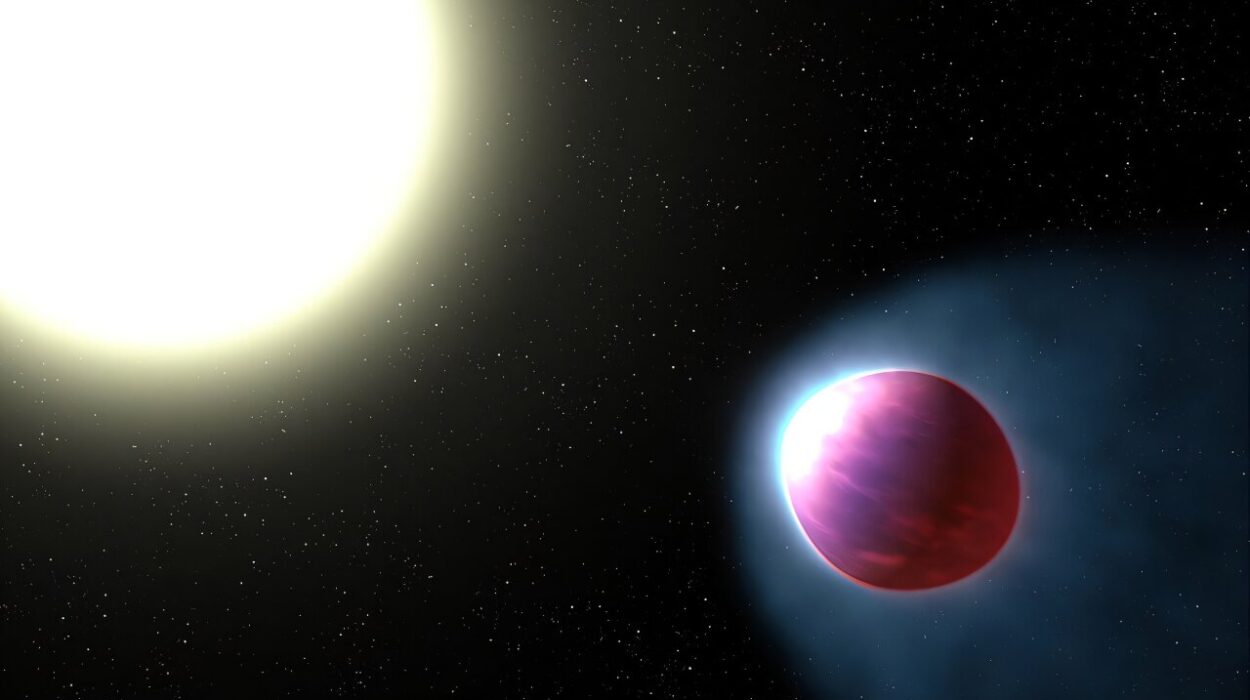
Something extraordinary was happening around a supermassive black hole nearly 2 billion years after the Big Bang. As the black hole voraciously consumed matter, it was also launching colossal winds into space—outflows so powerful that astronomers now rank them among the most extreme ever detected.
Using observations from XMM-Newton and NuSTAR, researchers identified two distinct streams of gas blasting away from the black hole at astonishing speeds. Their findings, which are outlined in a paper submitted to the arXiv preprint server on June 3 and also submitted to Astronomy & Astrophysics (currently under minor revision), provide new evidence that black hole winds can take on a complex, layered structure.
Detecting the Fingerprints of Extreme Black Hole Winds
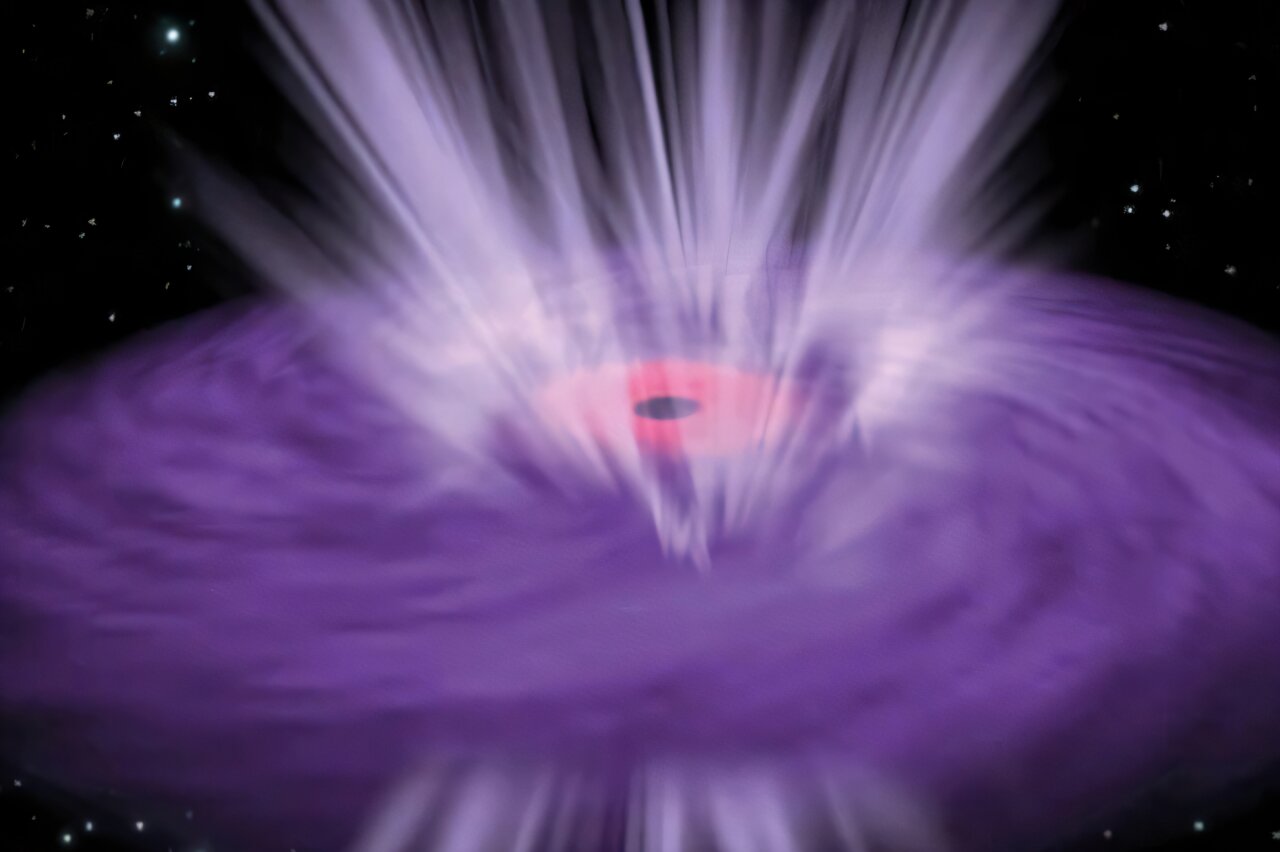
Supermassive black holes do not simply pull material inward. When they feed intensely, they can also drive powerful winds outward from the region surrounding their accretion disks.
These outflows become known as ultra-fast outflows (UFOs) when their speeds exceed 10% of the speed of light. Scientists believe such winds play a major role in shaping galaxies by injecting energy into surrounding gas. This process can heat that gas, reduce star formation, and potentially halt a galaxy’s growth altogether.
Astronomers detect these winds through their signatures in X-ray light. Highly ionized iron within the outflow absorbs specific X-ray energies, leaving characteristic dips in the observed spectrum. Because the gas is moving toward Earth at extremely high velocities, these absorption features appear shifted to higher energies, allowing researchers to measure the wind’s speed.
Looking Beyond Gravitationally Lensed Quasars
Many previous detections of distant UFOs relied on gravitationally lensed quasars. In those systems, a foreground galaxy magnifies the quasar’s light, making it easier to observe.
While that magnification is useful, it can also introduce uncertainties.
To investigate ultra-fast outflows in ordinary, non-lensed quasars, a team led by Giorgio Lanzuisi of INAF Bologna launched the WISSHFUL observing program. The multi-year XMM-Newton project focuses on 15 hyper-luminous quasars located during the era known as cosmic noon, when galaxies and black holes were growing most rapidly.
A Hyper-Luminous Quasar From Cosmic Noon
The first target in the program, known as WISSH13, sits at a redshift of 3.294, meaning astronomers see it as it existed roughly 2 billion years after the Big Bang.
At its center lies a black hole with a mass of approximately 2 billion Suns. The object is consuming matter at an exceptional rate and shines about three times brighter than expected for a black hole of its mass.
To examine the system in detail, researchers combined observations from October 2024 with archival XMM-Newton data collected in 2017. The result was a high-quality X-ray spectrum that revealed two distinct absorption features.
Further modeling showed that both features originated from the same ultra-fast outflow but represented two separate velocity components.
One component was traveling at roughly 10% of the speed of light, while the second reached an extraordinary 30% of the speed of light.
Evidence for a Layered Wind Structure
The two wind components behaved differently over time.
The slower component appeared in both the 2017 and 2024 observations, suggesting it is a persistent feature of the quasar. The faster component, however, was detected only in the more recent observations, indicating that it may be produced in shorter-lived episodes.
According to the researchers, this pattern points to a more complicated outflow than a single uniform wind.
Their observations align with theoretical models that predict a layered structure. In this scenario, a rapidly moving inner region, sometimes described as a “spine,” is launched from the innermost portions of the accretion disk. Surrounding it is a slower “sheath” originating farther from the black hole.
The discovery provides observational support for this stratified arrangement and suggests that multiple wind layers can coexist around actively feeding black holes.
Among the Most Powerful UFOs Ever Found
The scale of these outflows is remarkable.
Together, the two wind components eject approximately 21 and 24 solar masses of material per year, respectively. Those values place them among the most massive and energetic ultra-fast outflows known.
The detection also sets a new benchmark. According to the study, this is the highest-redshift UFO ever detected in a non-lensed quasar.
Despite their immense power, the researchers found that these winds still follow the same scaling relationships seen in active galaxies located much closer to Earth. That consistency suggests that similar physical processes may govern black hole-driven outflows across a wide range of cosmic environments and eras.
Why This Matters
The discovery offers a rare window into how supermassive black holes influenced the universe during one of its most important growth phases.
By identifying a powerful, layered ultra-fast outflow in a distant, non-lensed quasar, astronomers have gained valuable evidence that black hole feedback was already operating at full strength during cosmic noon. These winds are thought to help regulate both black hole growth and galaxy evolution by redistributing enormous amounts of energy into their surroundings.
The findings also demonstrate that current X-ray observatories can uncover these extreme phenomena in the distant universe, while future missions such as the planned NewAthena observatory could reveal many more. Each new detection will help scientists better understand how black holes and galaxies evolved together across cosmic history.