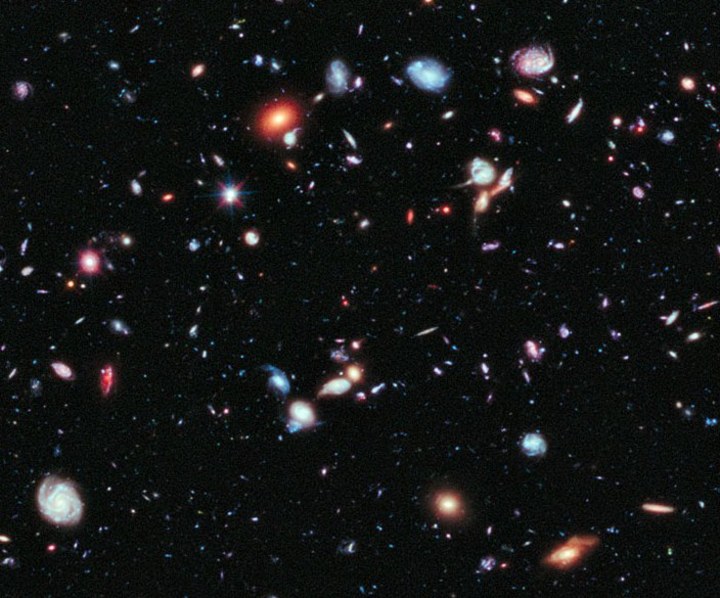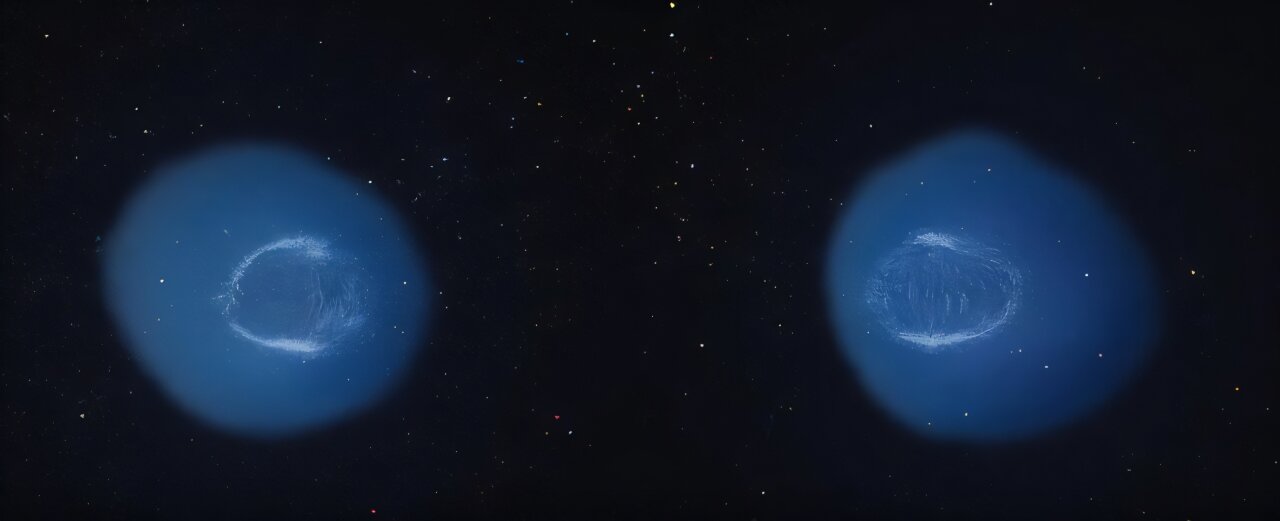
Three galaxies that appear to contain no dark matter have now been found aligned within the same unusual galactic structure, offering some of the strongest evidence yet for a previously unseen galaxy-formation process. The newly identified galaxy, NGC 1052-DF9, sits alongside two other dark matter-free galaxies, creating a formation astronomers say has never been observed before.
Something unusual is unfolding 45 million light-years from Earth. In a region where astronomers expected galaxies to follow familiar rules of cosmic evolution, they have found a third galaxy that appears to be missing one of the universe’s most important ingredients: dark matter.
The discovery, led by researchers at Yale University and published in The Astrophysical Journal, centers on a dwarf galaxy known as NGC 1052-DF9. Its identification not only expands the small group of known galaxies lacking dark matter but also reveals an extraordinary arrangement that could reshape how scientists think about galaxy formation.
A Rare Addition to an Exclusive Group
For years, astronomers have been studying two unusual galaxies, DF2 and DF4, which appeared to contain little or no dark matter. These findings were already challenging because dark matter is widely believed to play a crucial role in the formation and structure of galaxies.
Now, DF9 has joined that exclusive category.
According to the research team, DF9 appears to be part of a straight-line arrangement involving 10 galaxies. Among them are DF2 and DF4, making this the first known example of multiple dark matter-free galaxies connected within the same linear structure.
Michael Keim, a Yale Ph.D. student in astrophysics and lead author of the study, said that a line of galaxies lacking dark matter has never been observed before. He noted that the discovery provides some of the strongest evidence yet for an extreme and previously unseen formation process while offering a rare opportunity to investigate the nature of dark matter itself.
From Misidentified Object to Major Discovery
The path to finding DF9 began during Keim’s doctoral research under Yale astronomer Pieter van Dokkum, who previously led studies of DF2 and DF4 using observations from the Hubble Space Telescope.
During that work, Keim identified DF9 after realizing it had been incorrectly classified as a supermassive black hole. Recognizing its potential importance, he proposed a detailed investigation using the Cosmic Web Imager at Hawaii’s W.M. Keck Observatory.
The instrument is specifically designed to study extremely faint starlight, making it well suited for examining a dim galaxy like DF9.
Measuring a Galaxy’s Missing Mass
To determine whether DF9 contained dark matter, researchers measured the motions of stars inside the galaxy. Those motions allowed them to estimate its total mass.
Their analysis showed that DF9 has a mass equivalent to approximately 100 million Suns. Importantly, that value matches what astronomers would expect from the galaxy’s visible matter alone.
If DF9 possessed the amount of dark matter typically expected for a galaxy of its size, its total mass should exceed 10 billion Suns.
Instead, the measurements revealed no evidence for that enormous hidden component.
The result strongly suggests that DF9 belongs in the same unusual category as DF2 and DF4, reinforcing the idea that all three galaxies share a common origin.
Evidence of a Violent Cosmic Event
The alignment of these galaxies may provide the clue researchers have been searching for.
Keim and his colleagues propose that DF2, DF4, and DF9 likely formed during the same dramatic event, potentially a high-speed collision between galaxies.
In this scenario, the collision would have separated gas from the galaxies’ dark matter. The displaced gas could then have continued moving through space and eventually condensed into new galaxies, creating a linear trail.
That explanation would account not only for the galaxies’ unusual arrangement but also for their apparent lack of dark matter.
The idea represents a significant departure from the standard assumption that galaxies form within dark matter halos, large concentrations of dark matter that are thought to provide the gravitational framework for galaxy growth.
What the Discovery Suggests About Dark Matter
One of the most intriguing implications of the new findings concerns the nature of dark matter itself.
According to the researchers, the system demonstrates that stars and galaxies can form outside traditional dark matter halos under extreme conditions. It also suggests that dark matter behaves as a distinct physical substance capable of separating from ordinary matter and gas during violent interactions.
This interpretation strengthens conclusions from earlier studies of DF2 and DF4, which similarly indicated that dark matter exists as a separate component rather than simply being an effect of gravity.
By identifying a third galaxy with the same unusual characteristics and placing it within the same structure, the new study provides additional support for that picture.
The Search Continues
The researchers are not stopping with DF9.
They are conducting follow-up observations using additional telescopes, including the newly developed Mothra telescope, co-founded by Pieter van Dokkum and University of Toronto astronomer Roberto Abraham.
Their goal is to search for any remaining gas that may have been left behind by the event that created the galaxies. Detecting such material could help reconstruct what happened and provide further evidence for the collision scenario.
Why This Matters
Dark matter remains one of the biggest mysteries in modern astronomy. Although it is thought to make up a substantial portion of the universe, it cannot be observed directly and is known primarily through its gravitational effects.
The discovery of NGC 1052-DF9 adds a crucial new piece to that puzzle. By revealing a third galaxy apparently devoid of dark matter and placing it within a never-before-seen linear arrangement, the finding offers a rare natural laboratory for testing ideas about how galaxies form and how dark matter behaves.
If the researchers’ interpretation is correct, these galaxies could represent direct evidence that dark matter and ordinary matter can separate during violent cosmic events—providing valuable clues about the true nature of one of the universe’s most elusive components.