Single photons are now being produced in the telecom O-band with a level of stability that researchers say could remove a major bottleneck for large-scale quantum networks. The new quantum dot-based emitter delivered over 40 million photons per second while keeping at least 92% of them nearly identical—without the heavy filtering that previously crippled efficiency. Built to match existing fiber-optic infrastructure, the device could accelerate progress toward scalable quantum communication and, eventually, a quantum internet.
Quantum technologies are moving out of theory and into hardware—and one of the biggest challenges is surprisingly simple to describe: making light particles that behave the same way every time.
For quantum communication and quantum computing to work reliably, devices must generate photons that are not just bright, but consistent. If those photons vary too much from one moment to the next, their quantum information becomes unreliable, breaking the very advantage quantum systems are supposed to deliver.
Now, researchers from the University of Copenhagen’s Niels Bohr Institute, Ruhr-University Bochum, the University of Basel, and Sparrow Quantum ApS have developed a new photon emitter designed to solve that problem at a key wavelength used by today’s telecom networks.
Their device, reported in Nature Nanotechnology, operates in the telecommunications O-band around 1,300 nm, meaning it can directly connect with existing communication infrastructure.
Why Telecom-Compatible Quantum Light Has Been So Hard
Quantum emitters are essential building blocks for quantum communication systems and quantum computers because they release individual photons on demand. But for real-world use, those photons must be coherent—meaning their quantum properties remain stable and predictable.
The problem is that many of the best quantum dot emitters historically produced photons at wavelengths that don’t align with telecom standards or silicon photonics systems.
“The motivation was to connect a premier quantum light source with the optical technology we already know how to scale,” said Marcus Albrechtsen, the first author of the paper.
The researchers specifically targeted telecom compatibility without sacrificing the coherence that makes quantum emitters valuable in the first place.
The Material Breakthrough That Protected Coherence
The project emerged from a long-running collaboration across the three universities, aimed at enabling photon emission at telecom wavelengths while avoiding the noise that typically destroys coherence.
According to Albrechtsen, a key step happened at Ruhr University Bochum, where the team developed a method to grow a strain-reduction layer on top of the quantum dots without creating material defects. Those defects would normally degrade photon quality later.
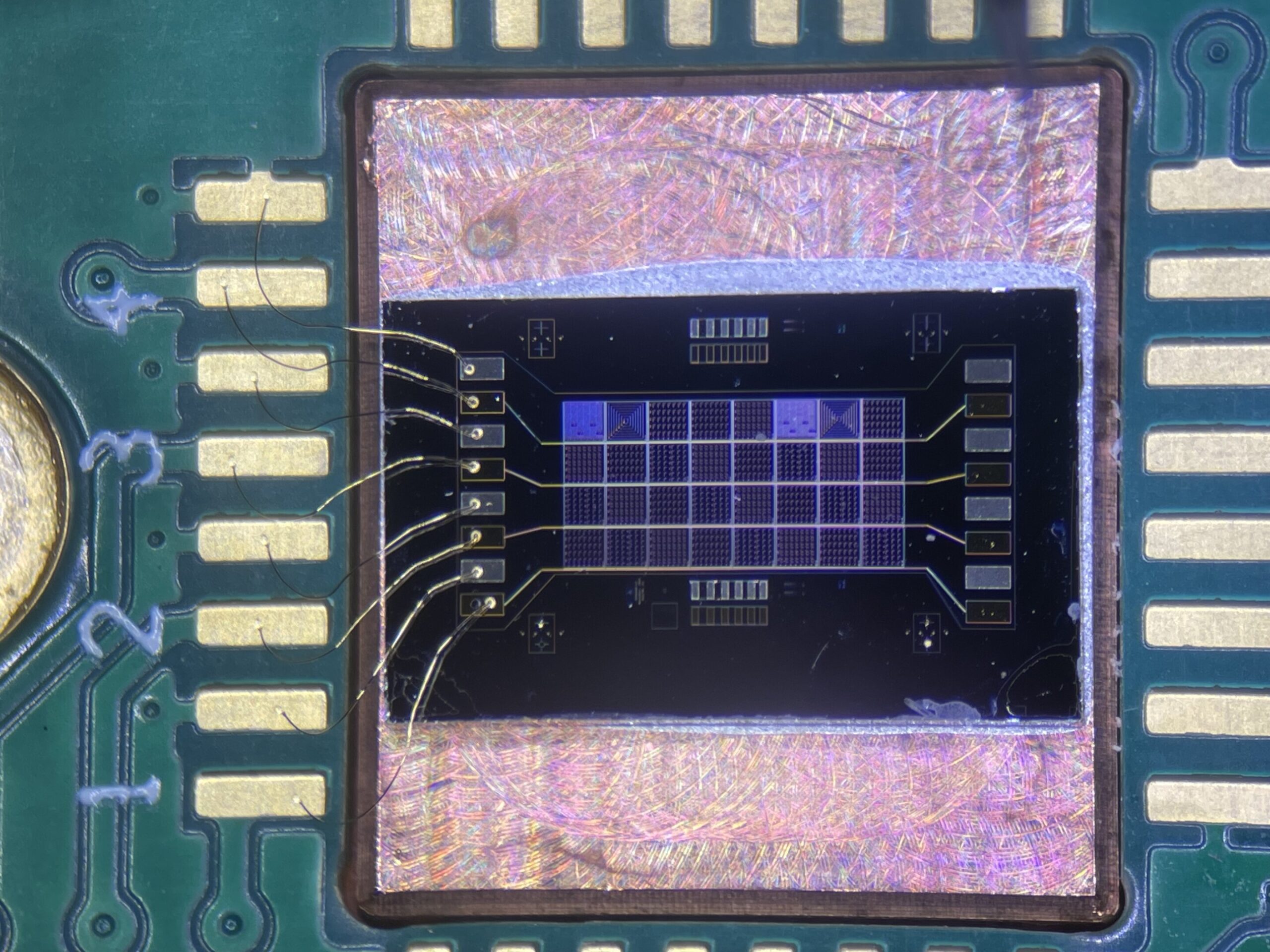
From there, researchers at the Niels Bohr Institute used advanced nanofabrication techniques to machine the samples into quantum photonic circuits with electrical control—while maintaining the high crystal quality needed for reliable quantum performance.
Testing required extreme conditions. The team measured the device in an ultra-cold -269°C environment (4 Kelvin) using a special cryogenic station in Copenhagen.
How the Quantum Dot Emitter Produces Single Photons
Quantum dots are tiny semiconductor structures that act like artificial atoms, with discrete energy states. In the new device, researchers fabricate photonic structures around these dots and excite them using a laser.
After excitation, the dot decays and emits exactly one photon, which is directed into a surrounding nanophotonic waveguide.
The team’s key improvement was not only generating single photons—but generating them in a way that makes consecutive photons nearly identical.
“The electrical control of the devices allows stabilizing the slow noise, such that back-to-back photons become nearly identical,” Albrechtsen explained.
That electrical control comes from embedding each quantum dot in a p-i-n diode, a three-layer structure that stabilizes nearby electrical charges. Without this stabilization, random charge fluctuations can shift photon energy between emissions, reducing coherence.
Purcell Enhancement and Faster, Cleaner Emission
The team also engineered a photonic crystal waveguide around the quantum dots. This boosts photon emission into the waveguide through the Purcell effect, which increases the emission rate and reduces the time window during which noise can disrupt the process.
That combination—electrical stabilization plus photonic crystal engineering—helped the emitter achieve three properties that have been difficult to unite in one system: brightness, coherence, and telecom-wavelength operation.
The Key Result: 92% of Photons Remained the Same
One of the most significant results was how closely the emitter approached the theoretical performance limit.
The researchers reported that the quantum dots produced emission lines only about 8% broader than the fundamental lifetime limit.
In practical terms, that means the photons remained highly consistent over time.
Across several seconds, the device sent more than 40 million single photons per second into the waveguide, and the researchers found that at least 92% of them were nearly identical.
“This is quantum coherence, and it is vital for practical applications of such photon-matter interfaces,” Albrechtsen said.
This level of performance matters because quantum communication protocols often require photons to be indistinguishable in order to create entanglement or reliably transfer quantum information.
Removing the Filtering Bottleneck
Until now, many quantum emitter systems relied on filtering to select only the photons that were identical enough for quantum applications. But filtering comes at a steep cost: it throws away a large fraction of photons, reducing efficiency and limiting scalability.
Principal investigator Leonardo Midolo said this new emitter changes that balance.
“Until now, emitted photons would be filtered to only use the photons that are identical, however, this came with steep efficiency prices that limited the scope and usability,” he explained.
With this telecom-compatible design, the researchers say “the full power of quantum dots is unleashed,” making them compatible with existing telecom infrastructure without requiring frequency conversion.
Midolo emphasized that the advance bridges quantum-coherent emitters with low-loss fibers and silicon photonics, which are already widely used in modern communication technology.
What Comes Next: Multiple Emitters on One Chip
While demonstrating a single high-performing emitter is a major step, the researchers say the next challenge is scaling.
“The next step is to move from one excellent emitter to more complex photonic integrated circuits,” Midolo said.
Their goal is to integrate multiple telecom quantum dots on the same chip, tune them into resonance, and connect them using low-loss optical circuits.
This is where telecom-band operation becomes especially valuable, because it aligns with silicon-on-insulator photonic integrated circuits, a platform that has been heavily developed over the past two decades.
Midolo also noted that the team demonstrated wide-range tuning of emission, which is crucial for matching multiple quantum dots despite natural fabrication differences.
Future development could include integration with silicon photonics using techniques such as micro-transfer printing or wafer bonding.
The researchers also highlighted another potential advantage: the quantum dots are hosted in gallium arsenide, which is itself a strong material for photonic integrated circuits. At telecom wavelengths, gallium arsenide may offer significantly lower loss than at the near-infrared wavelengths used in earlier quantum dot systems.
Why This Matters
Quantum communication systems require single photons that are bright, stable, and indistinguishable—and they must be produced in a way that can scale beyond lab demonstrations. This new telecom O-band quantum dot emitter shows that high coherence and high photon output can coexist directly inside the wavelength range used by today’s fiber-optic infrastructure.
By delivering over 40 million photons per second while keeping at least 92% of them nearly identical, the device could remove a major obstacle to building large-scale quantum networks. That opens a clearer path toward secure quantum communication systems, advanced quantum sensing technologies, and eventually more complex quantum-photonic circuits that could support fault-tolerant quantum computing.
Most importantly, it brings quantum hardware closer to the systems the world already uses—making the idea of a scalable quantum internet feel less like a distant goal and more like an engineering challenge now actively being solved.
Study Details
Marcus Albrechtsen et al, A quantum-coherent photon–emitter interface in the original telecom band, Nature Nanotechnology (2026). DOI: 10.1038/s41565-026-02156-7.