When the James Webb Space Telescope (JWST) peers into the deep universe, it isn’t just looking far away. It’s looking back in time, toward an era when the cosmos was still young and unfinished.
In that ancient darkness, astronomers spotted something unsettling: an object known as QSO1, shining from a time when the universe was only about 700 million years old. It belonged to a puzzling group of sources nicknamed Little Red Dots, strange cosmic specks first revealed by JWST.
Some scientists suspect these objects are early galaxies with newborn supermassive black holes (SMBHs) at their hearts. But these Little Red Dots don’t behave the way astronomers expect. They lack the usual X-ray signatures that often betray a black hole actively feeding.
Still, QSO1 was glowing. Its light, believed to come from its accretion disk, was bright enough to be seen across the unimaginable gulf of time.
And inside that glow, a deeper mystery waited.
The Impossible Giants of the Early Cosmos
Supermassive black holes are not supposed to be easy to explain. They sit in the centers of most galaxies, including the Milky Way, and can carry billions of times the mass of the sun.
The trouble is not that they exist. The trouble is when they exist.
Astronomers have found SMBHs appearing just a few hundred million years after the Big Bang. That is shockingly early. Under traditional models, black holes begin as the remnants of supernova explosions, the final collapse of massive stars. Then, over time, they grow by swallowing gas from an accretion disk.
But even a hungry black hole has limits.
There is a barrier called the Eddington limit, a brightness threshold beyond which radiation pressure pushes material away faster than gravity can pull it in. If a black hole feeds too aggressively, it effectively blasts its own food outward.
So how could a black hole become supermassive so quickly, when physics itself seems to restrict how fast it can grow?
That question has haunted astronomers for years.
A Team Looks Closer, Hoping for a Crack in the Wall
An international team led by Roberto Maiolino at the University of Cambridge decided to push deeper into the mystery. Using JWST data, they performed an in-depth analysis of QSO1, publishing their results in Monthly Notices of the Royal Astronomical Society.
They weren’t just trying to confirm QSO1’s existence. They wanted to read its environment like a fossil record, to see what kind of universe surrounded it when it shone.
Maiolino and his colleagues knew there were several possible explanations for early SMBHs. Perhaps small “seed” black holes grew through short bursts of extreme feeding. Perhaps intermediate-mass black holes formed through runaway mergers in dense star systems. Or perhaps something more dramatic happened.
Maybe some black holes were born large.
These would be “heavy seeds,” black holes that formed already massive, possibly through the direct collapse of huge clouds of material in the extreme conditions of the early universe. Another possibility sometimes discussed is the idea of primordial black holes, dense clumps of matter formed shortly after the Big Bang, a concept once proposed by Stephen Hawking.
But theories are cheap. Evidence is rare.
QSO1 offered a chance to search for it.
A Cosmic Magnifying Glass Brings the Past Into Focus
One reason QSO1 was such an attractive target is that nature had provided a helpful trick.
A foreground galaxy cluster sat between Earth and QSO1, bending and amplifying its light through gravitational lensing. The cluster acted like a cosmic magnifying glass, redirecting more of QSO1’s light into our line of sight and making the distant object easier to study.
With that magnification, the team could attempt something extremely ambitious: resolving the region where the black hole’s gravity dominates everything nearby.
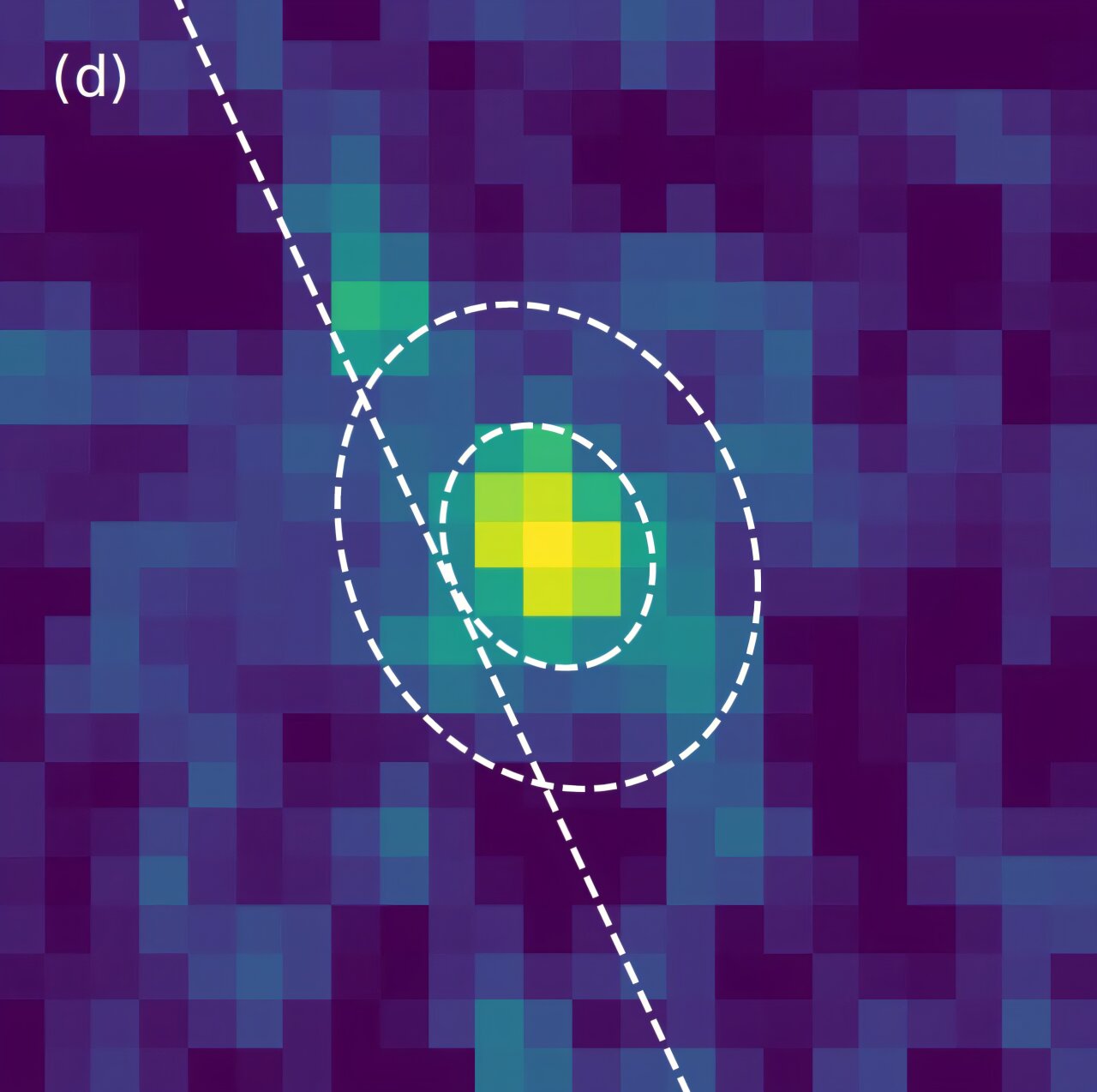
They used an advanced method called integral field observation mode, collecting spectra at every point across a small patch of sky. This wasn’t just an image. It was a map of light broken into its component wavelengths, pixel by pixel, revealing motion and composition across the scene.
Maiolino described how the combination of high spatial and spectral detail allowed the researchers to resolve the black hole’s “sphere of influence,” the region where the motion of gas is controlled primarily by the black hole’s gravity.
This, crucially, made it possible to directly measure the black hole’s mass.
But the story didn’t end with gravity. The same data carried another message, hidden in chemistry.
The Chemical Silence That Spoke Volumes
The team measured emission from ionized hydrogen and oxygen, using those signals to understand the chemical makeup of the gas surrounding QSO1.
This is where the universe’s history becomes almost poetic.
After the Big Bang, the first atoms were simple: hydrogen, helium, and traces of lithium. Everything heavier—oxygen, carbon, iron, and more—had to be forged later inside stars, through nuclear fusion. Those heavy elements spread outward when stars died and exploded as supernovae, enriching their surroundings over time.
So chemical richness is a clue. It tells astronomers whether generations of stars have already lived and died in that region.
And QSO1’s environment, it turned out, was almost chemically empty.
Maiolino explained that QSO1 sits in an environment with extremely low chemical enrichment. Most strikingly, the abundance of oxygen relative to hydrogen was found to be less than 1% of the value measured in the sun.
That is a staggering number. It suggests the gas around QSO1 was nearly pristine, barely touched by star formation.
In other words, very few stars had existed there long enough to build up heavy elements.
Yet the black hole was already there.
And it was already enormous.
When the Black Hole Arrives Before the Galaxy
The chemical evidence created an unsettling picture. If QSO1’s surroundings were still near-pristine, then not many stars had formed nearby. That implies the system around the black hole was still small and undeveloped.
But the black hole itself was massive enough to dominate its environment.
Taken together, the findings suggest something that flips the usual cosmic story on its head: this supermassive black hole formed before the bulk of its host galaxy.
Traditionally, astronomers imagine galaxies forming first, with black holes growing slowly inside them. In that familiar picture, the galaxy is the cradle, and the black hole is the child.
QSO1 hints at the reverse.
Here, the black hole may have come first—an early heavyweight shaping what would eventually become a galaxy around it.
And among the competing theories, this result fits most naturally with the heavy seed scenario, the idea that some black holes in the early universe were born already massive rather than starting small.
Why This Discovery Matters More Than One Black Hole
This isn’t just a strange detail about a distant object. It is a direct challenge to how astronomers understand the early universe.
The existence of SMBHs so soon after the Big Bang has been one of the most stubborn puzzles in modern astronomy. The Eddington limit makes it difficult for black holes to grow fast enough through ordinary feeding. Yet the universe keeps revealing giants that shouldn’t have had time to exist.
QSO1 offers a possible escape from that paradox. Its near-pristine chemical environment and the implication that it outweighs the surrounding system point toward a universe where at least some SMBHs did not grow slowly from stellar remnants. Instead, they may have emerged early as massive “heavy seeds,” forming before galaxies fully assembled.
If this picture is correct, it could reshape the story of cosmic origins. It suggests that supermassive black holes were not merely passengers inside galaxies, but possibly among the first architects of galactic creation—objects that appeared early, heavy, and ready to dominate.
And in that sense, QSO1 is more than a distant dot. It is a clue from the universe’s childhood, whispering that the first giants may have been born before the structures we thought they lived in even existed.
Study Details
Roberto Maiolino et al, A black hole in a near pristine galaxy 700 Myr after the big bang, Monthly Notices of the Royal Astronomical Society (2026). DOI: 10.1093/mnras/staf2109