When astronomers point a telescope toward the deep universe, they are also looking back in time. In this case, that backward glance revealed something quietly remarkable: a small, faint galaxy whose chemical simplicity carries echoes of the universe’s earliest days. Using the James Webb Space Telescope, researchers have identified a previously unknown dwarf galaxy, now designated CAPERS-39810, whose properties place it among the most chemically primitive systems yet observed at this era of cosmic history.
The discovery was not announced with fanfare, but through careful analysis reported in a scientific paper released on January 24 on the arXiv pre-print server. Yet the implications of this finding reach far beyond a single object. CAPERS-39810 offers a rare opportunity to examine how galaxies formed stars and built up chemical elements when the universe was still young and evolving rapidly.
Why Metal-Poor Galaxies Matter
In astronomy, the word “metal” carries a very specific meaning. Any element heavier than hydrogen and helium is considered a metal, and the abundance of these elements inside a galaxy reflects its history of star formation and stellar death. Galaxies with very few metals are thought to resemble the earliest galactic systems, formed before generations of stars had time to enrich their surroundings.
At high redshift, meaning great distances and early cosmic times, metal-poor galaxies become especially valuable. They act as natural laboratories for studying early star formation and chemical enrichment, processes that shaped the structure of the universe we see today. These galaxies may also preserve clues about the properties of massive, low-metallicity stars that contributed to reionization, a transformative period when the universe became transparent to light.
Finding such systems, however, is not easy. They are small, faint, and often hidden among brighter, more evolved galaxies. This is where the extraordinary sensitivity of the James Webb Space Telescope becomes essential.
Searching the Deep Sky with Webb
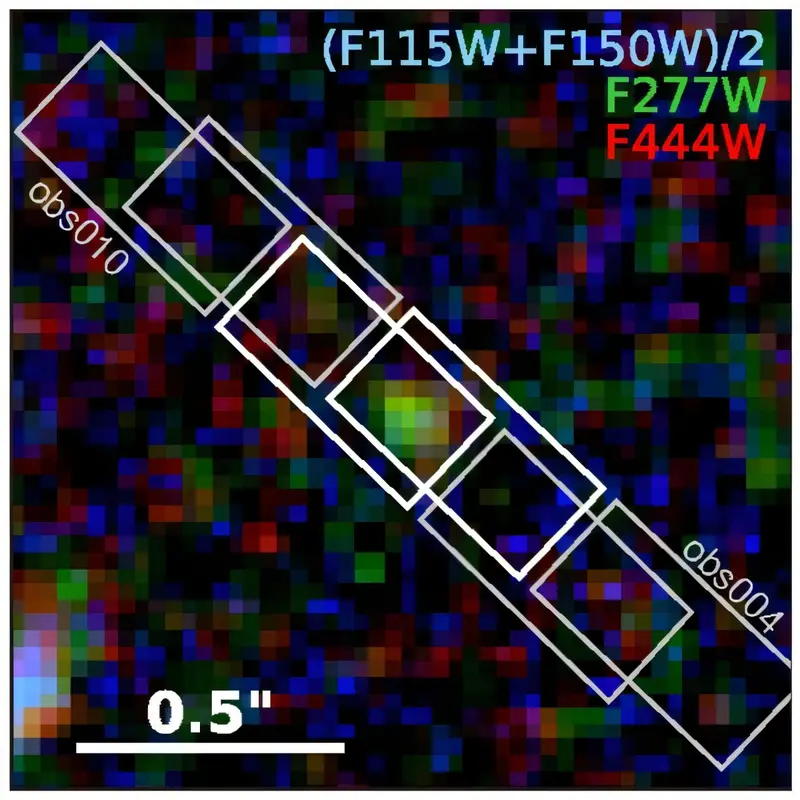
The search for CAPERS-39810 was led by Zijian Yu of the Blair Academy in New Jersey and Sijia Cai of Tsinghua University in Beijing. They focused their investigation on identifying galaxies with exceptionally low metal content at high redshift, using one of Webb’s most powerful instruments, the Near-Infrared Spectrograph, known as NIRSpec.
By analyzing infrared light, NIRSpec can reveal the chemical fingerprints embedded in a galaxy’s spectrum. These spectral signatures allow astronomers to estimate metallicity and probe the physical conditions inside distant stellar systems. To strengthen their analysis, the researchers combined Webb’s observations with existing data from the Hubble Space Telescope, creating a more complete picture of the galaxy’s light across different wavelengths.
This careful observational approach led to the detection of CAPERS-39810, a galaxy located at a redshift of z = 3.654, corresponding to a time when the universe was far younger than it is today.
A Chemically Primitive Dwarf Galaxy
Once CAPERS-39810 had been identified, the researchers turned to the task of understanding what kind of galaxy it is. Their analysis revealed a system that is both small and remarkably metal-poor.
The galaxy has an estimated stellar mass of about 104.7 million solar masses, placing it firmly in the dwarf galaxy category. Its stellar population age, approximately 270 million years, suggests that its stars formed relatively recently in cosmic terms. Despite its modest size, the galaxy is actively forming stars, with a star-formation rate of 0.26 solar masses per year.
What makes CAPERS-39810 especially noteworthy is its chemical composition. The researchers measured its metallicity at −1.96 dex, a value that classifies it as an extremely metal-poor galaxy, or EMPG. Such a low metallicity indicates a chemically primitive system, one that has undergone little enrichment from previous generations of stars.
In many ways, CAPERS-39810 resembles a snapshot of an early stage in galaxy formation, preserved and now revealed through Webb’s sensitive instruments.
Placing CAPERS-39810 in Cosmic Context
CAPERS-39810 does not exist in isolation, at least not scientifically. Its properties place it within a growing population of chemically primitive galaxies that the James Webb Space Telescope has begun to uncover. According to the researchers, this discovery strengthens the evidence that very low-metallicity galaxies were already present during cosmic noon, the period around redshift 3.0 when star formation across the universe reached its peak.
This timing is significant. Cosmic noon represents a crucial era in galaxy evolution, when galaxies rapidly built up their stellar mass and chemical complexity. Finding an extremely metal-poor galaxy at this stage suggests that not all systems followed the same evolutionary path. Some, like CAPERS-39810, appear to have remained chemically simple even as the universe around them grew increasingly enriched.
By studying such galaxies, astronomers can better understand the diversity of galactic evolution and the mechanisms that regulate star formation and chemical growth in young systems.
Filling a Gap in the Metal-Poor Census
One of the most intriguing aspects of this discovery lies in where CAPERS-39810 fits along the cosmic timeline. Extremely metal-poor galaxies are known in the nearby universe as local analogs, and Webb has recently uncovered many such systems at very high redshifts, beyond z = 6.0. However, examples at intermediate redshifts have been scarce.
The detection of CAPERS-39810 helps bridge this gap. It extends the census of EMPGs into a previously underrepresented redshift range, linking local low-metallicity galaxies with their more distant counterparts. This continuity suggests that chemically primitive systems may not be rare anomalies, but rather a persistent population that exists across a wide span of cosmic history.
The researchers note that observational limitations have made these galaxies particularly difficult to identify at intermediate distances. With Webb’s capabilities, those limitations are beginning to ease.
Are Primitive Galaxies More Common Than We Thought?
The discovery naturally raises a broader question. If CAPERS-39810 can be found at this redshift, how many similar galaxies might be waiting to be detected? The authors of the study suggest that extremely metal-poor systems may in fact be common throughout the universe, even if they have remained hidden until now.
Their faintness and small size make them challenging targets, especially without the sensitivity of instruments like NIRSpec. As Webb continues to survey the distant universe, astronomers expect the number of known EMPGs to grow, potentially reshaping our understanding of how widespread chemically primitive galaxies really are.
Why This Discovery Matters
CAPERS-39810 is more than a newly cataloged galaxy. It is a window into a formative period of cosmic history, offering direct evidence that chemically simple galaxies existed and persisted during one of the universe’s most active eras of star formation. By studying such systems, astronomers can refine models of chemical enrichment, explore how stars formed in low-metallicity environments, and better understand the diversity of galactic evolution.
Perhaps most importantly, discoveries like this demonstrate the transformative power of the James Webb Space Telescope. By revealing faint, distant, and chemically primitive galaxies, Webb is allowing scientists to move beyond theoretical speculation and observe the building blocks of cosmic history directly. CAPERS-39810 stands as a quiet but compelling reminder that the universe still holds many ancient stories, waiting patiently to be seen.
Study Details
Zijian Yu et al, Discovery of an Extremely Metal-Poor Galaxy at z=3.654 Using JWST Infrared Spectroscopy, arXiv (2026). DOI: 10.48550/arxiv.2601.17498