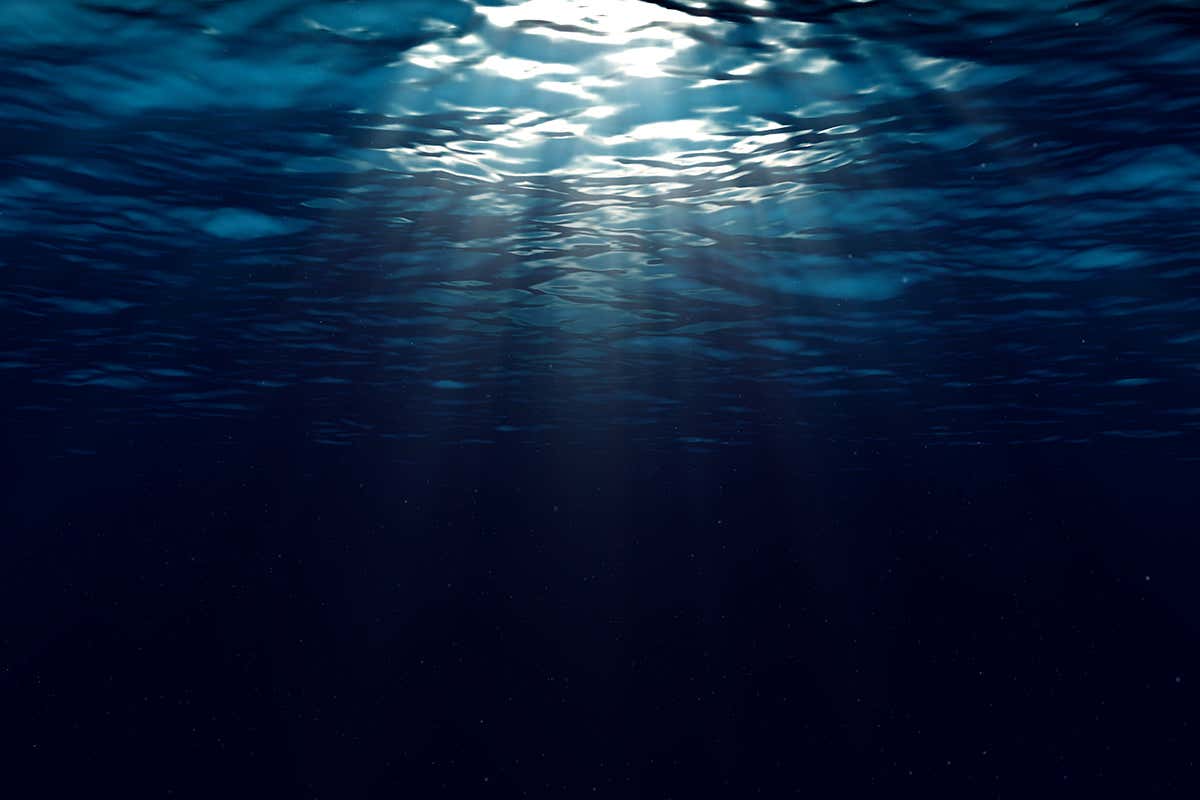
Far beneath the familiar surface of the Pacific Ocean lies a world that feels less like Earth and more like another planet. It is silent, crushingly cold, and darker than the deepest night. The Mariana Trench, the deepest part of the world’s oceans, has become a symbol of mystery—an abyss so remote that even modern science has barely touched it. For decades, it has fueled the imagination of explorers, filmmakers, and conspiracy theorists alike. People speak of monstrous shadows, ancient survivors, and undiscovered predators that might still rule the depths.
It is easy to understand why. When you stand on a beach, the ocean feels endless, but it also feels familiar. You can see waves, smell salt, hear gulls, and watch sunlight dance on the water. Yet the Mariana Trench is nothing like that. It is a realm where sunlight never reaches, where pressure is so extreme it can crush steel, and where life survives under conditions that seem impossible.
So the question rises naturally, almost irresistibly: is there an unknown creature lurking in the Mariana Trench?
The honest answer is both thrilling and sobering. The trench almost certainly contains life we have not discovered. But the kind of unknown creatures it might hide are not likely to match the dramatic sea-monster legends people love to tell. The truth is more complex, more scientific, and in many ways, even more astonishing.
The Mariana Trench: Earth’s Deepest Frontier
The Mariana Trench is located in the western Pacific Ocean, east of the Mariana Islands. It stretches over 2,500 kilometers in length and forms a crescent-shaped scar on the seafloor. Its deepest point is the Challenger Deep, which reaches nearly 11 kilometers below sea level.
To understand what that means, imagine placing Mount Everest at the bottom of the trench. Its peak would still be submerged by more than two kilometers of water. The Mariana Trench is not simply “deep.” It is unimaginably deep, deeper than the altitude at which most commercial airplanes fly.
And yet, this is not an alien planet. It is part of Earth. That fact alone is haunting. Our world has landscapes as extreme as the surface of Mars, but they are hidden under miles of ocean water.
The trench exists because of plate tectonics. One tectonic plate is being forced beneath another in a process called subduction. As the oceanic plate sinks into Earth’s mantle, it creates a long, narrow trench. Over millions of years, the Mariana Trench has deepened into the most extreme ocean environment on the planet.
This is a place where Earth itself seems to fold inward, where geology becomes a kind of slow-motion violence.
A World Without Sunlight
The Mariana Trench is located in what is called the hadal zone, named after Hades, the underworld of Greek mythology. The name is fitting. Below about 6,000 meters, the ocean becomes a permanent night. Sunlight cannot penetrate that far. The trench is not dim. It is completely black.
Without sunlight, photosynthesis cannot occur. That means no plants, no algae, and no food chain built on sunlight. The entire ecological foundation of the surface ocean is absent.
This raises a profound question: how can anything survive there?
The answer is that deep-sea life depends on different energy sources. Some organisms feed on “marine snow,” the constant slow rain of organic debris drifting down from above—dead plankton, fecal matter, decaying fragments of life. It is not abundant, but over time it provides sustenance.
Other organisms rely on chemosynthesis, a process where microbes convert chemicals such as hydrogen sulfide or methane into energy. Instead of sunlight powering life, chemistry powers life. This is one of the most important discoveries in modern biology because it proves that life does not require sunlight, only energy and the right conditions.
In a way, the Mariana Trench is a reminder that life is not fragile. It is adaptable, relentless, and inventive.
Crushing Pressure: The Greatest Barrier to Exploration
If darkness is the trench’s most obvious feature, pressure is its most brutal one.
At sea level, we live under one atmosphere of pressure. At the bottom of the Mariana Trench, pressure reaches over 1,000 atmospheres. That is more than 100 million pascals—enough force to crush most objects instantly. It is like having dozens of jumbo jets stacked on top of every square meter of your body.
Human beings cannot survive there. Even submarines struggle. Specially engineered deep-sea submersibles are required, built with thick pressure-resistant hulls and carefully designed systems to prevent implosion.
This pressure also changes the rules of biology. It affects proteins, cell membranes, and chemical reactions. Creatures that live there have evolved specialized adaptations to survive. Their cells are built differently. Their enzymes function under crushing force. Their bodies are often soft and gelatinous, because rigid structures are harder to maintain under intense pressure.
To creatures of the trench, pressure is not a danger. It is normal. In fact, many hadal species would die if brought to the surface because the sudden loss of pressure would cause their bodies to rupture or malfunction.
This makes studying trench life extremely difficult. Many animals cannot survive long enough in laboratory conditions for scientists to analyze them properly. It is one reason why the deep ocean remains so mysterious.
How Much of the Mariana Trench Have We Actually Explored?
Despite modern technology, we have explored only a tiny fraction of the Mariana Trench. In terms of direct observation, the trench is less studied than the Moon.
There have been only a limited number of manned dives to the Challenger Deep. Robotic probes have gone farther, but even these missions are rare because they are expensive, risky, and technically demanding. The deep ocean is hostile not only because of pressure but also because it is remote, difficult to access, and unpredictable.
Most of what we know about the trench comes from sonar mapping and a handful of scientific expeditions. Sonar can reveal the shape of the seafloor, but it cannot identify animals. A shadow on sonar might be a fish, a rock formation, or a drifting object. The trench is a place where interpretation is always uncertain.
Because exploration is so limited, the possibility of undiscovered species is not speculation—it is a scientific expectation.
The ocean is vast, and the deep ocean is the least known part of it.
The Creatures We Already Know Live There
One of the most surprising truths about the Mariana Trench is that it is not lifeless. In fact, it contains ecosystems full of strange and remarkable organisms.
Scientists have found amphipods, shrimp-like scavengers that thrive in the deep. They have discovered sea cucumbers, some of which look like pale, ghostly creatures crawling across the mud. There are deep-sea worms, microbial mats, and bacteria that survive by consuming chemicals seeping from the Earth.
Even fish have been recorded at extreme depths. One of the most famous is the Mariana snailfish, a translucent, delicate-looking fish that appears almost fragile. Yet it is perfectly designed for its environment, with a body that can withstand crushing pressure. Its tissues contain molecules that stabilize proteins under extreme force.
The existence of such animals is extraordinary because it shows that vertebrate life can survive even in the hadal zone, a place once thought too extreme for fish.
The trench is not empty. It is alive.
But it is alive in ways that challenge our expectations.
Why the Mariana Trench Feels Like a Monster’s Home
The Mariana Trench has become a cultural symbol of hidden terror. People imagine giant squids, ancient sharks, or prehistoric beasts lurking in darkness. It is the perfect setting for a monster story because it contains everything humans fear: the unknown, the unseen, and the unreachable.
There is also a psychological reason. The ocean is already mysterious because it hides what lies beneath. When you cannot see into the water, your imagination fills the space. Now multiply that feeling by 11 kilometers of darkness. The Mariana Trench becomes a canvas for fear.
But fear does not always match reality.
The trench is not a place where massive predators roam freely like in a movie. Food is scarce, energy is limited, and ecosystems are fragile. In nature, environments with little energy tend not to support enormous animals.
That does not mean large animals cannot exist in the deep ocean. Giant squid, for example, live in deep waters. But the deepest parts of the trench are not likely to be the hunting grounds of giant predators because there simply is not enough food to sustain them.
Nature is always bound by energy. Even monsters must eat.
Could There Be a Giant Unknown Predator Down There?
This is the question that excites people most. Could the Mariana Trench hide a massive creature that science has never seen?
From a scientific standpoint, the existence of some undiscovered species is almost certain. The ocean is full of animals that have never been cataloged. New deep-sea species are discovered regularly. Some are entirely new families of organisms.
But could there be something enormous?
A truly giant creature would face major challenges. It would need a stable food supply, a breeding population large enough to sustain itself, and a habitat that supports its lifestyle. The Mariana Trench is not a nutrient-rich environment like coral reefs or coastal waters. It is a desert compared to the surface ocean.
Most deep-sea creatures tend to be small or medium-sized because of limited energy availability. Large animals do exist in the deep ocean, but they typically live at depths where there is more food, such as near continental slopes or midwater zones where prey is more abundant.
At the trench’s deepest points, life survives on scarcity. It is difficult to imagine a massive predator thriving there unseen.
Another problem is detection. Large animals would leave evidence: carcasses, feeding marks, DNA traces, or frequent sonar sightings. While the trench is underexplored, the surrounding ocean is monitored more than people realize. A large unknown species would likely be noticed at some point.
So while the trench could hide unknown creatures, the probability of a giant monster-like predator is low.
The trench is mysterious, but it is not magical.
The More Likely Unknown Creatures: The Small and the Strange
If the Mariana Trench hides unknown life, it is far more likely to be microscopic or small-bodied organisms rather than gigantic beasts. In fact, the most fascinating discoveries may not be dramatic in size but revolutionary in biology.
Scientists have already discovered microbes in the trench that thrive under extreme pressure and low temperatures. These organisms are called extremophiles. Some may have unique metabolic pathways, potentially producing chemicals that could be useful for medicine or biotechnology.
Unknown species of crustaceans, worms, and deep-sea invertebrates are also very likely. Many deep-sea animals look alien because evolution shapes them for darkness. They may have reduced eyes, enhanced sensory organs, transparent bodies, or bizarre feeding mechanisms.
Some may use bioluminescence, producing light through chemical reactions to attract prey or communicate. Bioluminescence is common in the deep sea, though it is less common at the deepest trench floors where organisms are often scavengers rather than hunters.
The trench could also contain new forms of symbiotic life, where bacteria live inside animals and provide them with energy. Such relationships are common near hydrothermal vents, and similar systems may exist in parts of the trench.
The unknown creatures are likely to be strange, subtle, and scientifically priceless.
They may not inspire horror, but they should inspire awe.
Hydrothermal Vents and Chemical Oases
Not every part of the deep ocean is equally barren. Some regions contain hydrothermal vents, cracks in the seafloor where heated water rich in minerals flows out. These vents create localized ecosystems where chemosynthetic bacteria form the foundation of life.
Hydrothermal vent ecosystems can support surprisingly complex life, including tube worms, crabs, and other animals adapted to toxic chemicals and extreme temperatures. In these places, life flourishes in the darkness, not by sunlight but by Earth’s internal heat.
If parts of the Mariana region contain vent systems, they could host unique organisms unlike anything found elsewhere. Some scientists believe that hydrothermal vents may resemble the environments where life first originated on Earth.
This is why the trench is not only a place for monster stories but also a place for origin stories. It might hold clues to the earliest chapters of biology.
Why We Keep Finding New Deep-Sea Species
One reason the idea of unknown creatures is so believable is because it keeps happening. The deep sea has repeatedly surprised scientists.
Even in the last century, humans have discovered creatures that once seemed impossible. Giant squid, once dismissed as sailor mythology, turned out to be real. The coelacanth, a fish thought extinct for 66 million years, was found alive in 1938. Deep-sea anglerfish, with glowing lures on their heads, look like creatures invented by science fiction writers, yet they are real.
These discoveries remind us that the ocean still hides secrets. The deep sea is not fully cataloged. It is not fully understood.
And the Mariana Trench is one of the least explored parts of it.
The question is not whether unknown creatures exist. The question is how many, and what they are like.
The Role of Environmental DNA: Detecting Ghosts Without Seeing Them
One of the most powerful modern tools for discovering unknown life is environmental DNA, often called eDNA. All organisms shed genetic material into their environment through skin cells, waste, mucus, or decaying bodies. By collecting water or sediment samples and analyzing them, scientists can identify species present in the area without physically capturing them.
In the Mariana Trench, eDNA analysis has revealed a wide range of genetic signatures, including organisms not yet fully identified. Sometimes the DNA matches known species, confirming their presence. Other times it does not match any known database, suggesting the existence of unknown organisms.
This is an extraordinary development. It means we can detect life in the trench even if we never directly see it. We can sense the presence of biological “ghosts” in the water.
But eDNA has limitations. It can drift from other areas, making it difficult to pinpoint exactly where an organism lives. It can also degrade over time. Still, it is one of the best methods for exploring environments where direct observation is difficult.
In the future, eDNA may reveal new trench species long before we ever capture them on camera.
The Myth of the “Meg” in the Trench
One of the most popular modern legends is that the Mariana Trench hides prehistoric sharks like Megalodon, a giant predator that went extinct millions of years ago.
This idea does not hold up scientifically.
Megalodon likely lived in warmer, shallower waters where prey was abundant. The trench is cold, dark, and energy-poor. The deep hadal environment is not a suitable habitat for a massive warm-water predator that would require enormous amounts of food.
Additionally, fossil records show no evidence of Megalodon surviving into recent times. If such a massive species still existed, it would leave evidence across the oceans: teeth, carcasses, bite marks, and frequent sightings.
The ocean is large, but it is not infinite. A creature of that size cannot remain hidden indefinitely, especially one that would need to hunt large animals.
The Mariana Trench may hide unknown life, but it is not a time capsule for giant prehistoric monsters.
Reality is stranger than myth, but it is also more disciplined.
What About Giant Squid or Unknown Cephalopods?
The idea of giant squid lurking in the deep is far more plausible than the idea of Megalodon. Giant squid and colossal squid are known to inhabit deep waters, and they can grow to remarkable sizes.
However, even these creatures generally live in the deep ocean’s midwater zones rather than the deepest trench floor. They tend to hunt where prey is more abundant, often between 300 and 1,000 meters deep, sometimes deeper.
Could there be unknown cephalopods in the Mariana region? Possibly. Cephalopods are diverse and intelligent, and deep-sea environments could host species we have never seen.
But again, the deepest parts of the trench are unlikely to support huge predators. Any unknown cephalopod would likely be adapted to scarce food, slow metabolism, and cold temperatures.
It might not be a giant monster. It might be a small, highly specialized survivor, quietly hunting or scavenging in darkness.
In many ways, that is more fascinating.
Why the Deep Ocean Produces “Alien-Looking” Animals
The deep sea is one of the best examples of evolution’s creativity. Animals in the trench look strange not because they are unnatural, but because the environment is extreme.
Many deep-sea animals have reduced pigmentation, appearing pale or translucent. Color becomes meaningless where there is no sunlight. Many have reduced eyesight or no eyes at all, because vision is useless in complete darkness. Instead, they rely on touch, vibration detection, chemical sensing, and pressure sensitivity.
Some have enormous mouths and expandable stomachs, because food is rare and any meal could be the last for weeks. Others have slow metabolisms and long lifespans, conserving energy in a harsh environment.
Some deep-sea animals even show gigantism at certain depths, though this is more common in some zones than in the trench floor itself. The rules of size in the deep sea are complex and influenced by temperature, oxygen availability, and food supply.
The Mariana Trench is not just deep water. It is a separate world with its own evolutionary pressures.
And evolution, given enough time, will create forms that feel almost unreal.
Human Pollution Has Already Reached the Trench
One of the most unsettling discoveries about the Mariana Trench is not about unknown creatures, but about humanity’s footprint.
Scientists have found plastic waste, chemical pollutants, and even persistent industrial compounds in trench sediments. Microplastics have been detected in deep-sea organisms. This means that even the most remote place on Earth is not untouched.
This has major implications for the trench ecosystem. Deep-sea creatures often live long lives and reproduce slowly. This makes them vulnerable to pollution because toxins can accumulate in their bodies over time. The trench is also a sink, a place where debris eventually settles.
The idea that the Mariana Trench is a pristine alien world is no longer entirely true. It is connected to the rest of Earth’s environment, and it is absorbing the consequences of surface civilization.
This adds urgency to exploration. We are altering ecosystems we barely understand.
Could the Trench Hide a Completely New Type of Animal?
This is perhaps the most thrilling possibility. Could the Mariana Trench contain life that is not just a new species, but something fundamentally different?
Within Earth’s biology, all known life shares a common origin. All organisms use DNA or RNA, rely on similar genetic codes, and share basic cellular structures. It is extremely unlikely that the trench contains a completely separate form of life unrelated to the rest of Earth.
However, it could contain organisms with unusual biochemistry, rare adaptations, or metabolic pathways unknown to science. It could host microbes that survive in ways we did not think possible. It could contain animals with unique proteins that resist pressure or enzymes that function under conditions that destroy most biology.
Such discoveries would not be “alien” in origin, but they could feel alien in their implications. They could reshape medicine, biotechnology, and even our understanding of what life might look like on other worlds, such as Europa or Enceladus, moons that likely have subsurface oceans.
The trench is one of the best natural laboratories for studying life at the edge of possibility.
The Deepest Truth: The Mariana Trench Is Not a Single Place
Many people imagine the Mariana Trench as one enormous pit. In reality, it is a complex environment with ridges, slopes, valleys, sediment basins, and microhabitats.
Different parts of the trench may host different species. Some areas may have more organic debris falling from above. Some may have chemical seepage from the Earth. Some may have stronger currents or unique sediment types.
This means biodiversity may be greater than expected. Even small changes in the environment can create niches for specialized organisms.
The trench is not one ecosystem. It is a network of ecosystems stacked in the dark.
And that complexity increases the likelihood of undiscovered life.
Why We Haven’t Found Everything Yet
The main reason the trench remains mysterious is simple: it is incredibly difficult to explore.
Sending a submersible to the Challenger Deep is not like sending a rover to the desert. The equipment must survive enormous pressure. Communication is difficult because radio waves do not travel well through seawater. Even light is limited, and cameras must operate under extreme conditions.
Every expedition requires specialized ships, careful planning, and enormous cost. A single dive may last only a few hours on the seafloor. That is barely enough time to glimpse a fraction of what is there.
In addition, many deep-sea animals are rare, elusive, and adapted to stillness. They may not move much. They may not react to lights. Some may bury themselves in sediment. Others may live in tiny pockets of habitat that a submersible could easily miss.
It is not surprising that we have not found everything.
The surprising part is that we have found anything at all.
So, Is There an Unknown Creature Lurking There?
Yes—almost certainly.
But the unknown creatures of the Mariana Trench are not likely to be gigantic sea monsters waiting to rise from the abyss. The trench does not provide enough food to support enormous populations of massive predators. Its ecosystem is built on scarcity, slow metabolism, and survival in harsh conditions.
The real unknown creatures are likely to be small, strange, and scientifically profound. They may be new species of amphipods, worms, mollusks, crustaceans, or fish. They may be microbes with unique chemistry. They may be organisms that redefine what we thought possible for life under pressure.
The Mariana Trench is not a hiding place for fantasy monsters.
It is something far more interesting: a frontier of real biology.
The Wonder of the Unknown
Perhaps the greatest reason the Mariana Trench fascinates us is because it reminds us that Earth is not fully explored. In an age where satellites map continents and drones fly across mountains, it is comforting and unsettling to know that vast regions of our own planet remain largely unseen.
The trench is proof that mystery is still real. Not imaginary mystery, but scientific mystery. The kind that exists because the world is vast and our reach is still limited.
Somewhere in that black water, there may be a creature no human has ever witnessed. It might be crawling slowly across the sediment, sensing chemical traces with delicate antennae. It might be floating in darkness, nearly invisible, waiting for a rare meal. It might be a microbe feeding on minerals seeping from Earth’s crust, performing chemistry that could inspire future technology.
And it might never know we exist.
The Mariana Trench is not just a place. It is a reminder of humility. It shows us that we live on a planet where discovery is not finished, where the unknown still breathes quietly beneath the waves.
If there is an unknown creature lurking in the Mariana Trench, it is not lurking with malice. It is simply living, as life always does—adapting, surviving, evolving, and quietly proving that nature’s imagination is greater than ours.
The greatest monster in the trench is not a giant beast with teeth.
The greatest monster is our assumption that we already know everything.