Inside a tomb in Luxor, archaeologists have reconstructed how generations of burials gradually changed from relatively separate, coffin-contained arrangements into a dense vertical system in which newer bodies were placed directly over older ones and the chamber itself became the main organizing structure.
The evidence comes from Side Chamber 3 of Theban Tomb 209, or TT 209, in the South Asasif area of Luxor. The chamber contains a stratified funerary assemblage spanning the Twenty-Fifth Dynasty through the Ptolemaic period.
Researchers documented 17 mummified bodies in primary or partially primary positions, along with a separate secondary deposit containing bone fragments from at least four additional individuals. The chamber also contained coffins, funerary objects, ceramics, fabrics and other materials from different stages of its use.
The key finding is not simply that the tomb was reused. The arrangement of the remains shows that the way the chamber was used changed over time.
The earliest burials were relatively individualized. Bodies were placed in coffins and occupied distinct areas of the chamber. Later burials increasingly entered spaces that had already been used, coming into direct contact with earlier bodies and coffins.
By the Persian and Ptolemaic phases, the pattern had become much denser. Bodies were repeatedly placed above earlier burials, creating a vertically structured accumulation.
The researchers interpret this as a change in funerary organization rather than a breakdown of order. The chamber developed a different system in which each new burial was increasingly shaped by what was already there.
The earliest burials were more clearly separated
The earliest deposits, identified as FD1 and FD2 and probably associated with the Twenty-Fifth Dynasty, occupied different sectors of the chamber.
FD1 contained two individuals in the eastern sector, while FD2 contained two individuals in the southwestern sector. The bodies were associated with separate coffins and funerary objects. One coffin contained a small clay ushebti and a fragmented amphora, while others were accompanied by objects including scarabs, Sons of Horus amulets and tubular faience beads.
These early arrangements provided clearer boundaries around individual burials. Coffins helped define where each body was located and helped organize the objects associated with it.
A third deposit, FD3, contained another individual and still showed evidence of this earlier system. But it also marked the beginning of a more complicated arrangement.
The transition became clearer from FD4 onward.
Later burials were placed directly over earlier ones
In the southeastern part of the chamber, researchers found several direct vertical relationships between burials.
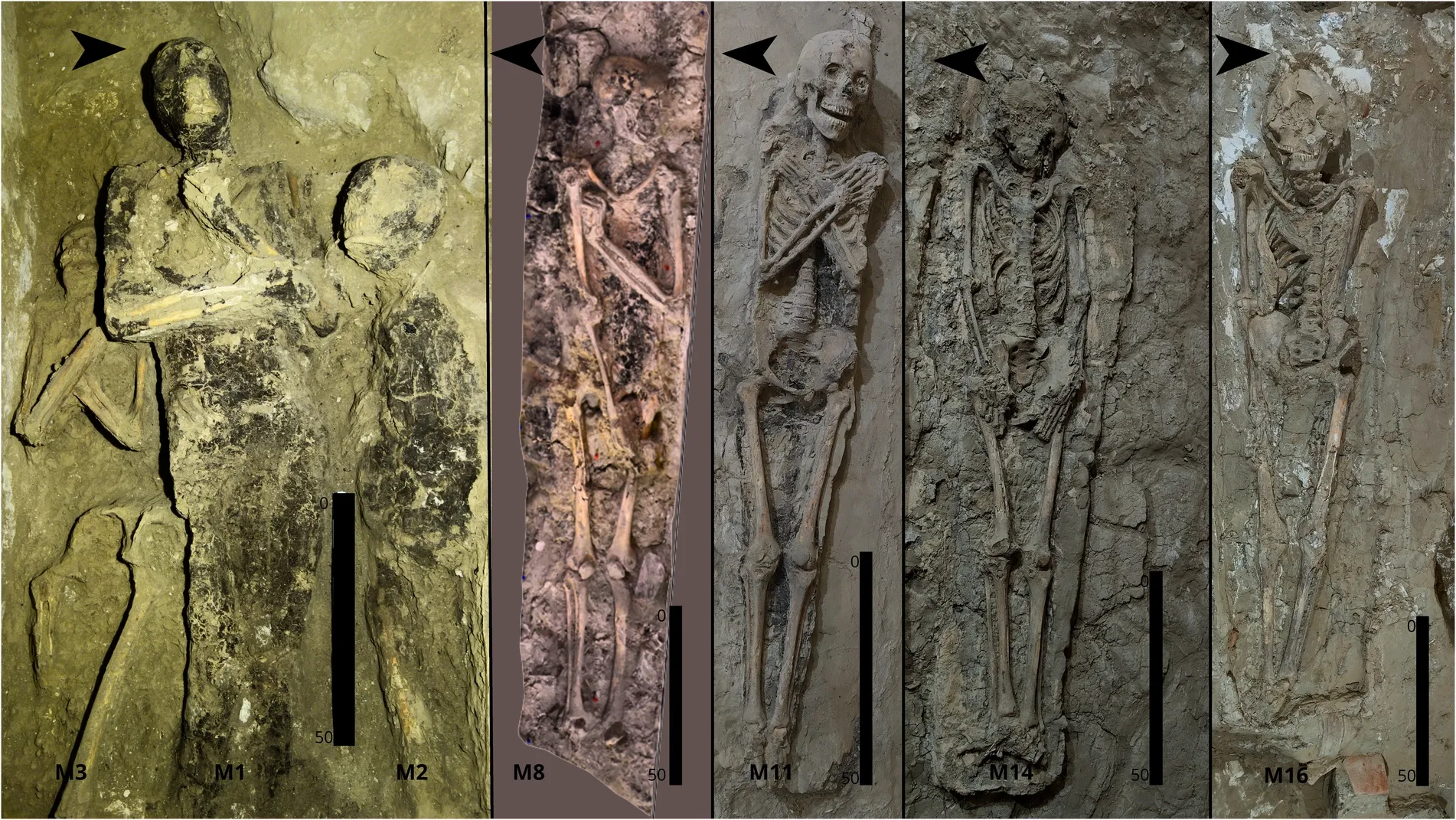
One individual, M11, was placed directly over M15. M6 and M7 formed a tightly superimposed group, with a mummified canid, M9, positioned over their lower limbs. Later, M5 was placed over M6, M3 over M8, and M1 over M3.
At least six of the nine funerary deposits showed clear vertical superposition.
This repeated stacking is important because it shows that later burials were not simply placed in any remaining open space without regard to what had come before. Earlier remains and structures could directly affect the position of later bodies.
The researchers caution, however, that the present height of the bodies does not necessarily represent their original height when they were buried. Coffins, wrappings, soft tissues and sediment could decay, collapse and compress over time, lowering bodies within the accumulated deposits.
That means some earlier bodies and coffins may originally have been more visible or prominent when later people were buried than they appear today.
Coffins gradually lost their organizing role
The changing role of the coffin is one of the clearest parts of the sequence.
In the earliest deposits, coffins were closely tied to individual burials. They physically enclosed or delimited bodies, helped maintain their arrangement and concentrated associated funerary objects around them.
At least seven of the nine funerary deposits had direct or indirect evidence of coffins, but the strongest concentration occurred in the earliest phases.
In FD1, M16 and M17 were placed in Coffins 7 and 12. FD2 included M13 and M14 in Coffins 9 and 10, while M15 in FD3 was associated with Coffin 8.
Later, coffins became part of larger and more complicated arrangements rather than defining independent burial units.
For example, M12 was placed inside Coffin 6, which itself lay above Coffin 7 containing M16. M10 was deposited directly over Coffin 5.
In the upper deposits, there was no clear evidence of coffins. Instead, bodies were positioned according to the structures and surfaces already present. M11 lay directly over M15, M5 had its skull resting on a ceramic fragment, and M2 was wedged between limestone blocks.
The coffin therefore did not simply disappear. Its role changed. Earlier in the sequence, it helped define the burial space. Later, the immediate surroundings of the chamber became more important in determining where another body could be placed.
The researchers describe this as a progressive dissolution of the one-to-one relationship between a body, its coffin and its associated objects.
The bodies themselves remained largely intact
Despite the complicated history of the chamber, many of the mummified bodies retained substantial anatomical organization.
At least 14 of the 17 documented individuals, or 82.4%, preserved partial or complete anatomical connections. This included individuals from both the earlier and later deposits.
Most bodies were lying on their backs. Their orientations varied within the east-west alignment of the chamber. Across the documented individuals, about 61.5% had their feet oriented east and about 38.5% west.
Arm positions also changed through the sequence. Hands placed on the pelvis were more common in earlier deposits, while crossed arms over the chest became more common in later ones. Eight of 14 individuals with recorded upper-limb positions had crossed arms over the thorax.
The researchers do not interpret these changes as evidence of a single religious transformation. Instead, arm position is considered one part of broader changes involving body preparation, wrapping, embalming and the surrounding depositional context.
The difference between the earlier and later deposits is therefore more strongly expressed in how bodies were positioned in relation to one another and to the chamber than in a complete change in basic body arrangement.
Water and sediment also changed the deposits
The chamber’s history was not shaped only by human activity.
TT 209 lies directly within an active drainage channel of the Wadi Hatasun and was repeatedly exposed to episodes of flooding and sediment transport. Side Chamber 3 was not disturbed by early 20th-century excavations or later modern intrusions, making it particularly useful for examining the interaction between funerary activity and sedimentation.
The sediment sequence records several different deposits. One upper unit, SU 367, contains silts, sands, gravels, limestone blocks, plaster, ceramics and displaced funerary materials. The researchers interpret it as the result of mixed processes including waterborne sediment, internal reworking, debris transport and anthropogenic or anthropically mediated redeposition.
These processes affected the bodies and the materials around them. Researchers documented skeletal fragmentation, displaced skulls, sediment entering body cavities, degradation of fabrics, compression from blocks or overlying bodies, and partial loss of textiles. High humidity and episodic flooding also contributed to the deterioration of coffins and stuccoed wooden elements.
This means the present arrangement cannot be read as a perfectly preserved record of every burial event. Later changes altered some of the original relationships.
A separate deposit records burned remains
The chamber also contains a secondary deposit, designated FD6, that differs sharply from the anatomically coherent mummies.
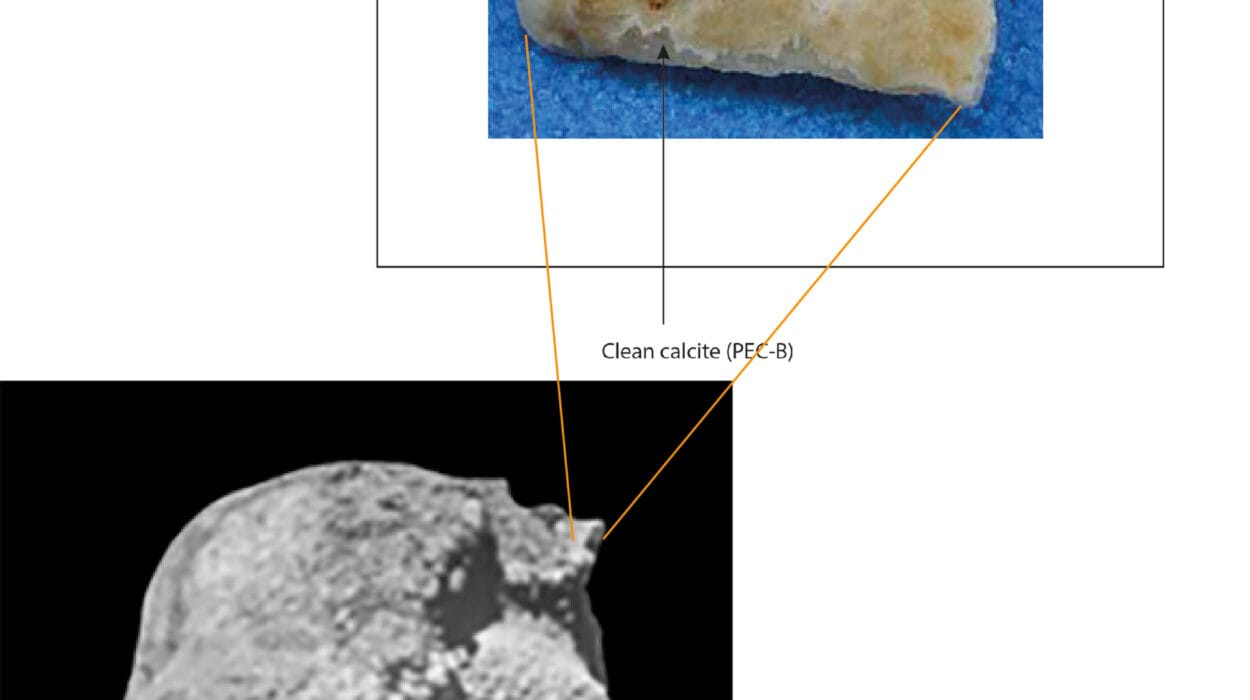
Researchers examined 1,775 bone fragments from this deposit and identified a minimum of four individuals, including three adults and one subadult. The fragments had been heavily fragmented and thermally altered.
Overall, 88.6% showed evidence of thermal alteration, while about 36% approached calcination. The strongest fire-related alteration occurred in cranial elements and lower limbs, while the vertebral column and upper limbs generally showed less severe alteration.
The original source of these burned remains cannot be established with certainty. They may have come from an earlier deposit within Side Chamber 3 or from funerary deposits displaced from another part of the tomb.
Some of the thermally altered fragments were later incorporated into SU 367, showing that the burned material itself became part of the chamber’s later accumulation.
The researchers therefore treat FD6 as an intermediate disturbed funerary deposit rather than as part of the final Ptolemaic accumulation.
The chamber became the main organizing structure
Taken together, the evidence points to a gradual change in how the burial space functioned.
In the earliest phases, a body could be understood as part of a relatively discrete unit consisting of the individual, a coffin and associated objects. As the chamber was reused, those relationships became less separate.
New individuals were inserted into areas already occupied by earlier burials. Coffins became incorporated into larger arrangements. Bodies came into direct contact with earlier remains. Sedimentary surfaces, existing structures and the positions of previous burials increasingly influenced where the next body could be placed.
The researchers therefore interpret Side Chamber 3 as a dynamic funerary environment rather than a static collection of separate graves.
This does not mean that the later users necessarily intended to engage with earlier burials in a symbolic or commemorative way. The study specifically cautions against assuming such an intention. Instead, the earlier bodies, objects, sediments and architectural features remained physically present and could constrain later activity.
The vertical accumulation also cannot be explained simply as the result of a chamber running out of space. The repeated contacts between earlier and later burials, together with the lack of complete sediment infilling between some depositional events, indicate continued use of the same funerary sector.
At the same time, the sequence was not perfectly continuous or orderly in a simple linear sense. Re-entry, disturbance, burning, flooding, sediment movement and later redistribution repeatedly altered the deposits.
Reconstructing the sequence from bodies, objects and sediment
The researchers used an archaeothanatological approach to reconstruct these changes.
Rather than looking only at the number of individuals, they combined anatomical relationships, body positions, stratigraphy, coffin use, associated objects and taphonomic alterations. Excavation followed a microstratigraphic protocol in which small changes in sediment, interfaces, body position and relationships between remains were recorded as the deposit was exposed. Photography, planimetry, photogrammetry and total-station measurements were used to document the remains at successive levels.
That approach allowed the deposits to be treated as a sequence of related events rather than simply as a collection of mummies.
The resulting reconstruction shows a clear transition. Early Twenty-Fifth Dynasty deposits were relatively individualized and spatially separated. From the late Twenty-Fifth Dynasty onward, the arrangement became more flexible. During the Persian period and later, bodies were increasingly inserted into existing depositional spaces. By the Ptolemaic phase, the chamber had developed a dense, vertically structured accumulation.
The change was therefore not from order to disorder. It was a change in the rules by which the burial space was organized.
Earlier in the sequence, the coffin could define the boundaries of an individual burial. Later, the bodies, sediments and structures already occupying the chamber increasingly defined the conditions for the next burial.
That shift is the central pattern revealed by the archaeological evidence from Side Chamber 3 of TT 209.
The study was published in Frontiers in Environmental Archaeology.