Unlike conventional boron, which is typically brittle and conducts electricity poorly, Imma-B60 can withstand substantial deformation while carrying electrical current far more effectively. Its unusual behavior comes from an open boron framework that can shift under stress without breaking apart.
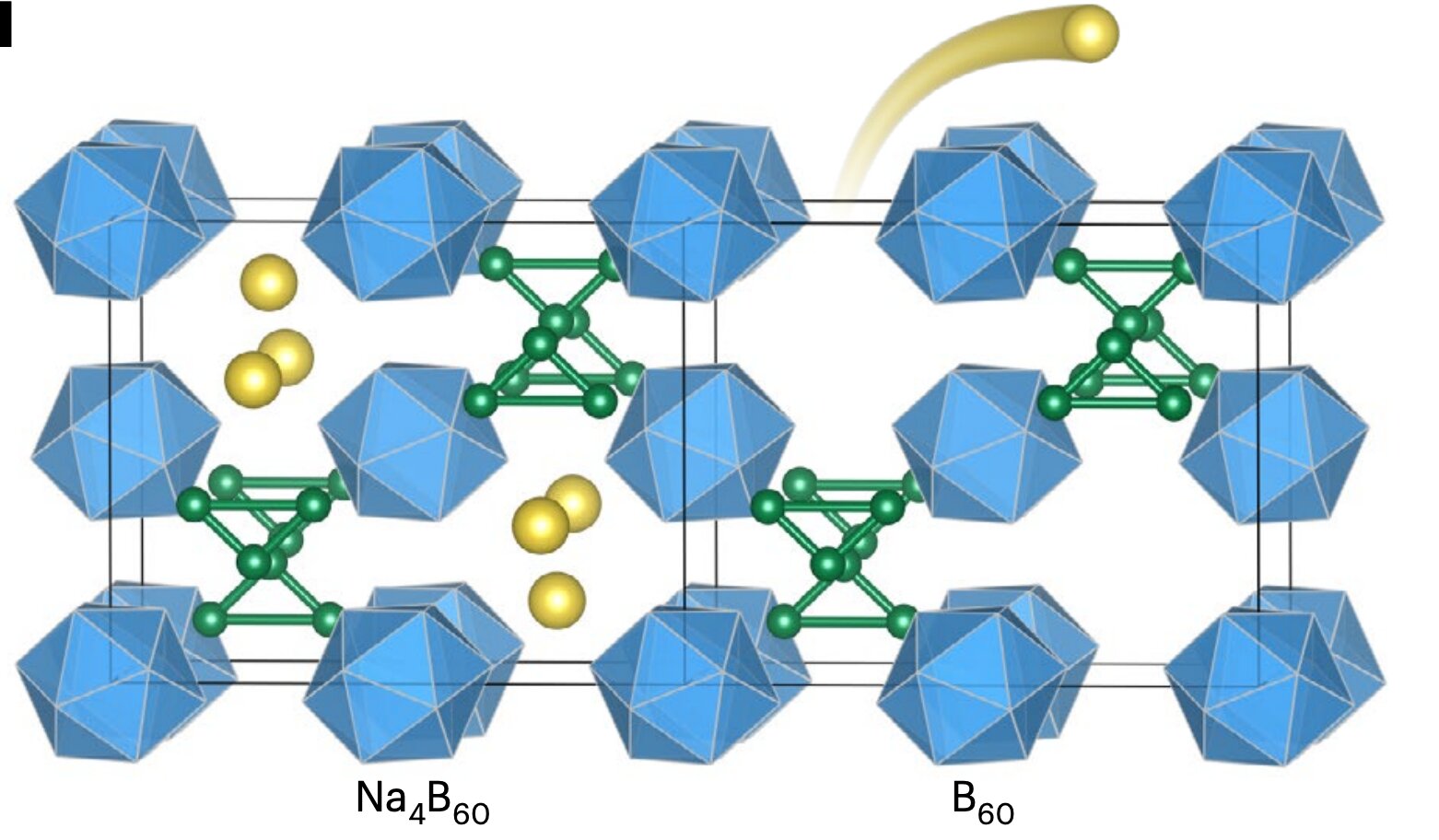
The new material, called Imma-B60, has a structure unlike the dense atomic arrangements found in more familiar forms of elemental boron. Instead of packing tightly together, its atoms form a porous framework made from 12-atom boron cages connected by three-atom triangular units.
That open structure was created by first making a sodium boride compound, Na4B60, and then removing the sodium from it. The resulting framework remained intact and became a pure form of elemental boron.
The approach matters because conventional methods for making boron allotropes generally use high pressure and high temperature. Those conditions tend to produce dense crystals, making it difficult to create the kind of open framework that had been proposed for a more flexible and electrically conductive form of boron.
Removing sodium without destroying the framework
The researchers first needed to produce sufficiently large, high-quality sodium boride crystals. Earlier attempts had produced only tiny, low-quality crystals, making it difficult to remove the sodium atoms effectively.
To overcome that problem, they introduced zinc interlayers while forming the sodium boride. This allowed larger crystals to grow, with sodium atoms occupying open channels within a framework of interconnected boron cages.
The crystals were then placed in a vacuum furnace and heated to 900°C for two days. Under vacuum, the sodium atoms were pulled out through the open channels.
What remained was the boron framework itself.
This two-step process provided a way to create an open boron structure without requiring the framework to be built directly under the extreme conditions normally used to synthesize boron allotropes.
The material conducts much more electricity
The resulting Imma-B60 has electronic properties that differ sharply from those of standard rhombohedral boron.
Imma-B60 behaves as a narrow-bandgap semiconductor, with a bandgap below 0.2 electron volts. At room temperature, it conducts electricity at roughly 9×10² S m⁻¹, about 10 million times better than the common form of boron described in the study.
Conventional elemental boron has wide bandgaps above 1.5 electron volts and is a poor electrical conductor. Imma-B60 therefore combines an electronic structure that allows much greater conductivity with a framework that is also mechanically deformable.
Its atomic planes can slide under stress
The material’s mechanical behavior was also unusual.
Compression tests on Imma-B60 nanopillars showed that they could reach about 32% strain without fracturing. The material was also described as capable of deforming by about 23% without shattering.
High-resolution imaging provided evidence for how this deformation occurs. Under stress, atomic planes can slide smoothly past one another through a dislocation-mediated slip mechanism.
Rather than simply breaking when mechanical stress is applied, the open framework can therefore accommodate substantial structural movement.
That behavior contrasts with the brittleness normally associated with conventional forms of elemental boron.
A different route for making boron allotropes
The researchers’ approach uses a temporary metal-containing scaffold to create a structure that would be difficult to obtain through conventional direct synthesis.
The sodium occupies the framework while the boron structure forms. Once the sodium is removed through the framework’s open channels, the boron atoms retain the overall structure and produce Imma-B60.
The result is an elemental boron material with both much higher electrical conductivity and substantial mechanical plasticity. The researchers propose that this two-step scaffolding strategy could provide a basis for designing other mechanically resilient, functional inorganic materials.
The study was published in Nature Chemistry.