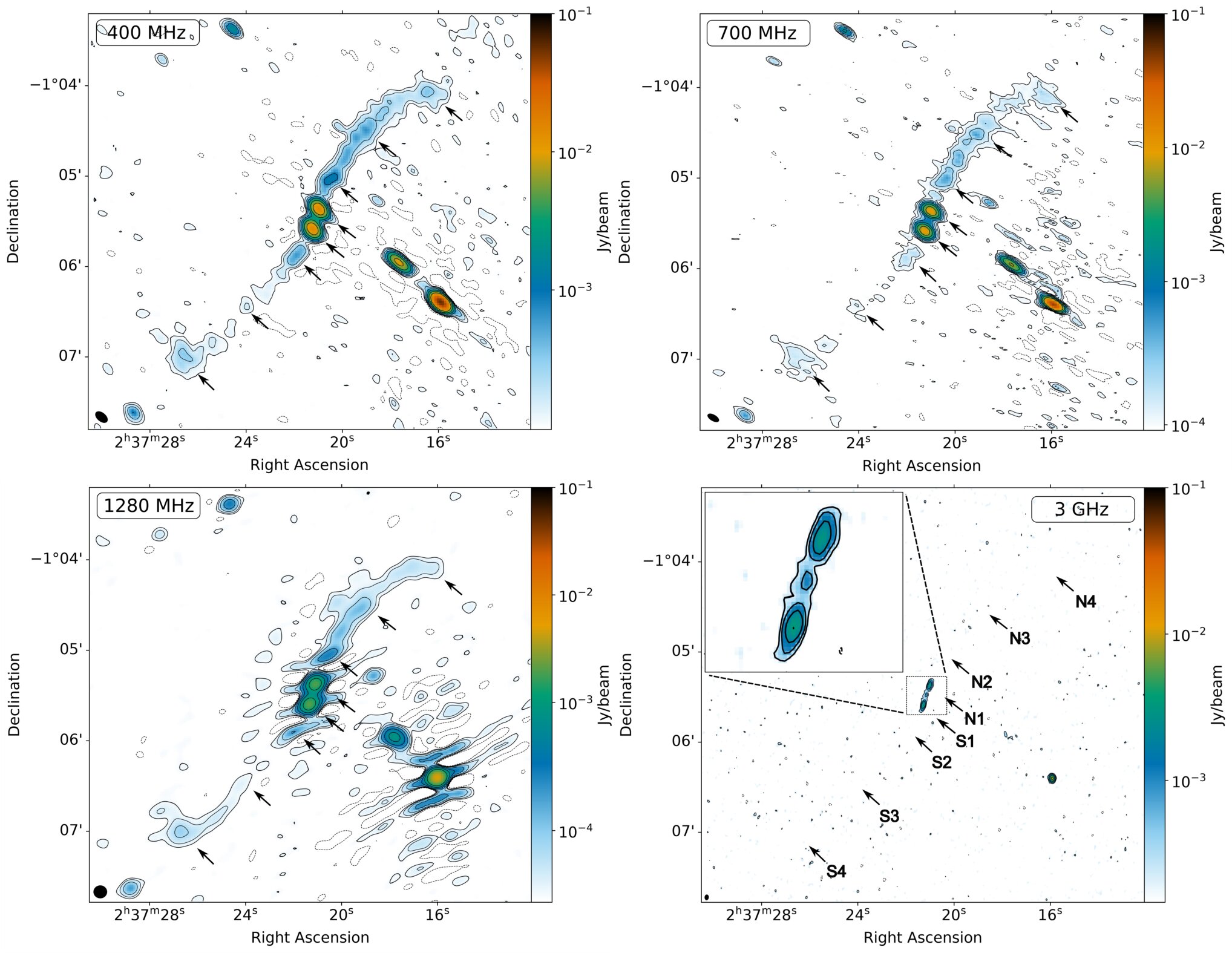
Nearly 1.2 million light-years across, the radio galaxy J023721.13−010528.5 carries four pairs of compact radio features arranged around its central galaxy. Their locations, symmetry, radio spectra, and estimated ages point to a history in which the galaxy’s central engine launched jets on at least four separate occasions, with each episode sending plasma farther into space before a later episode began.
J023721.13−010528.5 lies at a redshift of about 0.372, at the center of the galaxy cluster WHL J023721.1−010528. Radio observations show a giant structure extending roughly 1.2 megaparsecs between its outermost hotspots, with a largest projected linear size of about 1.3 megaparsecs.
Its radio emission does not form a simple straight pair of lobes. Instead, the structure bends into an S shape. Along that curved structure are four distinct pairs of compact, relatively bright radio components. The researchers label them N1 and S1 for the innermost pair, followed outward by N2 and S2, N3 and S3, and finally N4 and S4 at the outer edge.
The components appear on opposite sides of the galaxy in approximately paired positions. In the 400-megahertz radio image, the researchers divided the source into 71 regions along its ridge line and measured the peak surface brightness in each. Four distinct peaks appeared on each side of the central radio core. The locations of those peaks also broadly coincide with enhancements in the estimated magnetic field and equipartition pressure.
That combination is important because a bright compact feature inside a radio jet does not automatically mean that the central engine switched off and later restarted. Such features can also arise when a jet encounters dense clouds of material along its path.
The researchers therefore set out to determine whether the four pairs represented four generations of jet activity or were simply knots produced within a continuously operating jet.
The central galaxy and its radio jets
The radio core coincides with an elliptical host galaxy, SDSS J023721.13−010528.52, whose measured redshift is 0.37183 ± 0.00005. Its optical spectrum lacks strong emission lines such as Hα and [O III], leading the researchers to classify the galaxy as a low-excitation radio galaxy, or LERG.
The measured stellar velocity dispersion is 317.26 ± 16.88 kilometers per second. Using established black-hole scaling relations, the researchers estimate a central black-hole mass of 2.28 ± 0.71 billion solar masses.
The radio source itself was observed at several frequencies. The main new observations came from the upgraded Giant Metrewave Radio Telescope, or uGMRT, at frequencies centered around 400 and 700 megahertz. The researchers also used MeerKAT observations at 1,280 megahertz and a Very Large Array Sky Survey image at 3 gigahertz.
The different frequencies provide more than different views of the same object. They allow the researchers to examine how the radio spectrum changes across the structure, which in turn provides information about the history of the relativistic electrons producing the emission.
The highest-frequency image also reveals the central radio core clearly. The innermost pair, N1 and S1, is detected at all four observing frequencies, while the three outer pairs are not detected at 3 gigahertz.
The four pairs are not identical. N1 and S1 are the brightest and most symmetrical in flux density. N2 is about 2.5 times brighter than S2, while N3 is nearly five times brighter than S3. The outermost N4 and S4 have more comparable flux densities, although the two outer pairs appear increasingly diffuse.
The radio spectrum gets older farther from the center
One of the clearest clues comes from the radio spectra.
The researchers constructed spectral-index maps using the 400- and 700-megahertz images at a common resolution. Across the source, the radio spectrum generally becomes steeper with increasing distance from the radio core, with localized flattening around the compact component pairs.
The integrated measurements show the same broad pattern. For the northwestern side of the source, the high-frequency spectral index progressively steepens from N1 through N4. The trend is less clear on the southeastern side because that emission is fainter and therefore has larger measurement uncertainties.
The spectral curvature also becomes more pronounced toward the outer components, particularly along the brighter northwestern jet.
This behavior is consistent with the outer radio-emitting plasma containing older electron populations. As relativistic electrons lose energy, their radio spectrum changes, allowing the researchers to estimate a radiative age for the emitting plasma.
To estimate the physical conditions inside the radio components, the researchers also calculated equipartition magnetic fields, minimum energy densities, and pressures. These calculations assume that the energy stored in relativistic particles and the magnetic field are approximately balanced.
The estimated magnetic field decreases from the inner pair toward the outer pair. The same general decline occurs in the equipartition pressure. The compact features themselves coincide with local enhancements in these quantities, strengthening their identification as distinct components rather than arbitrary fluctuations in the diffuse radio emission.
For the eight hotspots, the estimated equipartition magnetic fields range from about 0.6 to 1.3 microgauss.
The four pairs have different radiative ages
The researchers modeled the radio spectra using several standard models of synchrotron aging and found that the different models were broadly consistent. They report the ages from the Jaffe-Perola model.
The estimated radiative ages range from about 4.5 million years for S1 to about 20.5 million years for N4.
The age estimates are not identical within each pair, as would be expected for perfectly simultaneous and perfectly measured hotspots. Differences between the northern and southern members of the four pairs range from −2.3 to +6 million years, with a standard deviation of 4.5 million years. The largest discrepancy occurs for the faint S3 component.
Despite those uncertainties, the overall pattern is clear. The farther components tend to be older.
The northwestern jet shows this especially clearly. N1 has an estimated age of about 7.5 million years, N2 about 11.2 million years, N3 about 17.5 million years, and N4 about 20.5 million years.
The corresponding southeastern components are estimated at about 4.5, 13.5, 11.5, and 17.5 million years for S1 through S4, respectively. Their larger uncertainties make the progression less clean than on the northwestern side.
When the researchers plot radiative age against projected distance from the central core, both sides show a general increase in age with distance. The trend is particularly strong on the brighter northwestern side.
The result is difficult to reconcile with the idea that all four pairs are simply knots produced by one continuously active jet.
Why the features are unlikely to be ordinary jet knots
A continuously active relativistic jet can produce compact features when it encounters dense clouds of plasma. The researchers therefore considered this possibility directly.
If the eight components were ordinary knots inside one continuously active jet, their synchrotron-emitting plasma should have broadly similar radiative ages. The researchers argue that the time required for the relativistic jet to travel from the first to the fourth component would be less than about 2 million years, much shorter than the range of radiative ages measured across the components.
A sequence of independently energized hotspots provides a different explanation. In that scenario, the currently active inner pair would contain the youngest plasma, while older pairs farther out would have been energized during earlier episodes and then left to age after their respective jets shut down.
The locations of the components provide another test.
If random clouds along the jet produced the compact features, there would be no particular reason for the same number of components to appear on opposite sides of the central galaxy, nor would the corresponding components necessarily lie at similar distances from the core.
Hotspots produced by a pair of opposing jets, however, should naturally appear in approximately symmetric pairs.
The researchers compared the observed arm-length ratios with two distributions. One came from measurements of 399 previously studied radio galaxies. The other came from 107 Monte Carlo simulations in which six components were randomly positioned between the core and the two outermost hotspots.
About 70.5 percent of the simulations failed even to produce three components on each side of the core. The observed source instead has three inner pairs arranged symmetrically around the nucleus, in addition to the outermost pair.
From the resulting distributions, the researchers estimate that the multi-epoch hotspot interpretation is about 3 million times more probable than the random-knot model for these three inner pairs.
Together with the spectral-age evidence, this supports the interpretation that the compact features represent successive generations of jet activity rather than random knots in one continuously active jet.
The jet axis moved between episodes
The four generations of hotspots do more than mark different distances from the center. They also trace a changing direction.
Using the innermost N1-S1 pair as a reference, the researchers find that the position angle of the successive hotspot pairs rotates progressively in a counterclockwise direction. The offsets are about −7 degrees for N2-S2, −16 degrees for N3-S3, and −24 degrees for N4-S4.
That gradual change in orientation produces the large-scale S shape.
The paper describes S-shaped radio sources as systems in which the direction of the jets changes more regularly over time, potentially through precession of the central black hole. For this particular galaxy, however, the observations establish the changing orientation of the successive jet axes rather than identifying a confirmed physical mechanism that caused the central engine to precess.
The source is also sufficiently large that the changing jet directions have separated the different generations of hotspots across a substantial area of the surrounding environment.
The outer hotspots preserve a longer history
The projected separations of the four hotspot pairs are approximately 70, 286, 711, and 1,198 kiloparsecs from the innermost to the outermost pair.
Using an assumed hotspot advance speed of 0.1 times the speed of light, the researchers estimate kinematic ages of roughly 1.1, 4.7, 11.6, and 19.5 million years for the four episodes.
These kinematic ages should not be confused with the radiative ages. The researchers use them to estimate the duration of jet activity associated with each episode under the assumed advance speed. They specifically note that these values do not establish the temporal sequence in which the episodes were triggered.
The radiative ages provide the more direct evidence for aging of the plasma between episodes. The outer components are generally older than the inner ones, while the kinematic estimates indicate that the more distant pairs correspond to substantially longer jet structures under the assumed speed.
The researchers therefore interpret the source as a record of repeated activity from the central engine, with the four pairs representing four separate episodes. They designate it a quadruple-double radio galaxy, or QDRG.
The later episodes may have been weaker or shorter
The observations also reveal a possible change in the behavior of the central engine over time.
The equipartition magnetic field and pressure decline from the inner pair toward the outer pair. The spectral-age measurements also show that the hotspot age increases with distance.
In their discussion, the researchers suggest that the pattern could mean either that the jet power decreases with successive episodes, that the duration of the active phase becomes shorter, or that both effects occur.
They do not treat that explanation as established. The paper emphasizes that only a very small number of radio galaxies currently provide enough information to test whether this pattern is common.
Among the previously known double-double and triple-double systems, the relationship between hotspot flux and distance from the core does not show one consistent trend. Some triple-double sources have stronger outer hotspots, while others do not. Symmetry also varies substantially between different systems.
The QDRG described here is therefore unusual not only because it contains four apparent episodes, but also because the successive pairs trace a relatively coherent S-shaped pattern.
Its enormous size may help reveal repeated activity
J023721.13−010528.5 is a giant radio galaxy, with an outer-hotspot separation of about 1.2 megaparsecs. The researchers compare its size with those of other episodic radio galaxies and with a sample of S-shaped radio sources.
They find that the source is the second-largest known S-shaped radio source in their comparison, while the median projected size of the 280 S-shaped sources in their compiled sample is about 180 kiloparsecs. The median size of the combined sample of 198 multi-epoch radio sources is about 908.9 kiloparsecs.
The researchers caution that this difference may partly reflect selection effects. In a small radio source, successive hotspots from different episodes can lie close together and become difficult to distinguish, especially at larger distances where limited angular resolution makes the separation even harder.
A large source provides more physical space for successive generations of hotspots to separate. An S-shaped source may make the distinction easier still because changes in jet direction spread the different generations across two dimensions rather than placing them directly on top of one another.
The researchers therefore propose that large S-shaped radio galaxies could be useful targets for finding additional systems with repeated jet activity.
A four-stage record of a changing central engine
The evidence assembled for J023721.13−010528.5 comes from several independent properties of the radio structure. Four paired compact features appear as local peaks in surface brightness and equipartition quantities. The pairs are arranged approximately symmetrically around the central galaxy. Their radio spectra generally become older with increasing distance from the core. Their locations are difficult to reproduce with randomly distributed jet knots, and their axes rotate progressively outward to produce the S-shaped structure.
Taken together, these observations lead the researchers to conclude that the source contains four distinct episodes of radio-jet activity. The authors describe it as the first radio galaxy known to them with four such episodes.
The observations also leave open how many episodes the central engine may ultimately be capable of producing. The researchers state that there is no reason to regard four as an upper limit for recurrent activity in a radio galaxy. They emphasize that a larger sample of triple- and quadruple-episode systems will be needed to determine whether the apparent decline in jet power or active-phase duration is a general feature of repeated radio-jet activity.
For J023721.13−010528.5, the four generations of radio emission remain separated across more than a million light-years, preserving a record of activity that occurred at different stages in the history of the galaxy’s central engine.
The study was posted to the arXiv preprint server.