On December 6, 2020, a radio telescope watching the millisecond pulsar PSR J1227−4853 recorded 114 unusually intense pulses in a single hour. The burst of activity was part of a much larger search that identified 235 giant pulses from the system, including signals lasting only 1.28 microseconds. Their arrival times were strongly clustered rather than occurring randomly, adding an unusual pattern to the first detection of giant-pulse emission from a transitional millisecond pulsar.
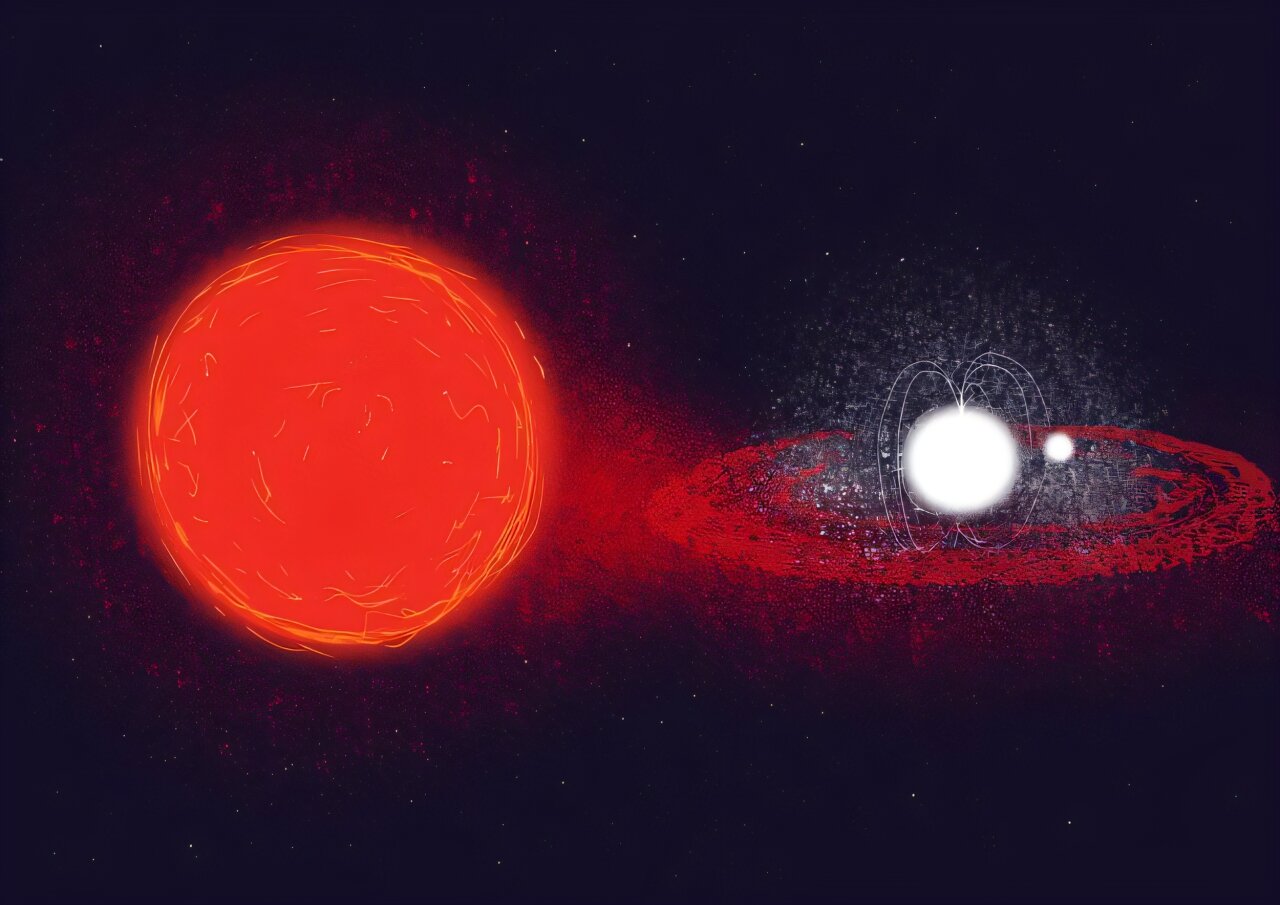
PSR J1227−4853 is a transitional millisecond pulsar, a system that can move between an accretion-powered state associated with a low-mass X-ray binary and a rotation-powered millisecond-pulsar state. It has a spin period of 1.69 milliseconds and is an eclipsing redback millisecond pulsar. The system was discovered as a radio pulsar with the Giant Metrewave Radio Telescope in 2014.
The new observations were motivated in part by the pulsar’s unusually high light-cylinder magnetic field strength and spin-down luminosity compared with other millisecond pulsars. The study notes that all previously known recycled millisecond pulsars producing giant pulses have light-cylinder magnetic fields above 10⁵ G. Before this work, only five giant-pulse-emitting millisecond pulsars had been reported.
Giant pulses are extremely short, unusually intense radio pulses. The study searched for them in 174 hours of observations made with the upgraded Giant Metrewave Radio Telescope, or uGMRT, at frequencies between 550 and 750 MHz. The observations came from two datasets. One contained 165 hours collected during 185 observing epochs between January 2019 and August 2024, sampled every 10.24 microseconds. The second contained 9 hours from 10 epochs between September 2024 and February 2025, with much finer 1.28-microsecond sampling so that exceptionally narrow pulses would be less likely to be missed.
The search began with thousands of single-pulse candidates. In the 10.24-microsecond data, the analysis produced 1,510 candidates, of which 1,287, about 85%, were rejected after visual inspection because they showed characteristics of radio-frequency interference. In the higher-time-resolution dataset, 124 candidates were produced and 112, about 90%, were identified as interference.
The researchers then concentrated on pulses narrower than 150 microseconds, approximately the width of a main-pulse component in the pulsar’s average profile. Together with the signal-to-noise threshold used in the search, this corresponded to a flux-density detection threshold of 0.4 Jy. The finest-resolution observations had a fluence detection threshold of 3.8 Jy μs.
That process produced the 235 giant pulses. Their properties varied substantially. Examples shown in the study range from a pulse 143.36 microseconds wide to one only 1.28 microseconds wide. The brightest detected pulse had a signal-to-noise ratio of 54.98, a width of 10.24 microseconds, and a calculated flux density of 11.82 Jy.
The intensity of some pulses was far above the pulsar’s ordinary emission. Across the detected sample, flux densities reached approximately 10⁴ times the pulsar’s mean flux density. The study therefore places PSR J1227−4853 among the small group of pulsars known to produce such extreme individual radio pulses.
The pulses came from specific parts of the pulse profile
The giant pulses were not spread uniformly across the pulsar’s rotational phase. They were concentrated mainly in the second and third main-pulse components, labeled MP2 and MP3 in the average pulse profile. No giant pulses were detected in the interpulse region.
The two main-pulse regions also produced noticeably different kinds of giant pulses. Every MP3-associated pulse had a width of 20.48 microseconds or less, and the narrowest signals in the entire sample, down to 1.28 microseconds, came exclusively from that phase region. The highest signal-to-noise events were also concentrated there.
The fluence distributions provided another characteristic of giant-pulse emission. Above the completeness threshold, the cumulative fluence distributions were described by power laws. For the combined sample, the cumulative power-law index was −5.92. The index was −6.26 for MP2 pulses and −2.61 for MP3 pulses.
The difference between MP2 and MP3 was particularly notable in the distribution of pulse widths and signal-to-noise ratios. The study interprets the separation as evidence that the two phase regions may represent distinct giant-pulse emission regimes. It also notes that the MP3 pulses resemble the short, high-intensity giant pulses seen in other pulsars, while the broader MP2 pulses could represent the high-fluence end of a broader single-pulse distribution. These remain interpretations of the observed properties rather than demonstrated differences in the underlying emission mechanism.
The researchers also looked for an ordering between the two populations. Although consecutive pulses often came from the same phase region, the study found no preferred direction in transitions between MP2 and MP3. The numbers of MP2-to-MP3 and MP3-to-MP2 transitions were identical within the sample.
The concentration in pulse phase did not have a corresponding dependence on the binary orbit. The observations showed no significant dependence of giant-pulse occurrence on orbital phase. The study argues that this lack of orbital dependence weighs against propagation effects or plasma lensing in the binary environment being the primary driver of the observed giant-pulse properties.
The strongest change appeared in time
The most striking variation emerged not from where the pulses appeared within the rotation cycle, but from when they appeared during the long observing campaign.
On December 6, 2020, 114 giant pulses were detected during a single one-hour observation. The event accounted for a large fraction of the detected pulses despite representing only one observing epoch. Across all epochs, the mean giant-pulse rate inferred from the statistical analysis was 1.44⁺⁰·¹⁹₋₀·²⁵ per hour. During the December 6 observation, the inferred rate rose to 124⁺²⁰₋₃₀ per hour.
That change matters because the pulses did not simply appear at a higher average rate. Their arrival times also showed evidence of clustering.
If individual pulses arrived independently at a constant rate, their waiting times would follow an exponential distribution. Instead, the waiting times for the combined observations were better described by a Weibull distribution. Its shape parameter was k = 0.303 ± 0.012. Because k = 1 corresponds to a Poisson process and values below 1 indicate temporal clustering, the measured value indicates strong clustering in the giant-pulse arrival times.
The December 6 episode was less strongly clustered than the combined dataset but still departed from Poisson behavior. Its Weibull shape parameter was k = 0.472 ± 0.033, while its giant-pulse rate reached 124⁺²⁰₋₃₀ per hour.
The authors caution that this statistical description has limitations. The Weibull model provides a phenomenological, single-scale description of clustering and assumes a stationary process. It does not naturally capture more complicated possibilities such as changing activity states or multiple kinds of clustering. Finite observing windows and incomplete sampling can also bias the inferred clustering parameter toward stronger apparent clustering.
For that reason, the measured clustering does not by itself identify the physical process responsible for the giant pulses. The study notes that other statistical approaches, including models designed for changing activity states or correlated triggering, could provide a more detailed description, but investigating those models was outside the scope of the work.
A possible connection to repeating fast radio bursts
The temporal behavior becomes particularly interesting when compared with one other result discussed in the study. The k value measured during the December 6 giant-pulse episode is statistically consistent with the value previously measured for a burst storm from the repeating fast radio burst FRB 20200120E.
The study gives k = 0.50⁺⁰·⁰⁵₋₀·⁰⁴ for that fast radio burst activity, compared with k = 0.472 ± 0.033 for the December 6 giant-pulse episode. The authors emphasize that this statistical similarity alone does not establish a physical connection. Instead, they describe it as a possible phenomenological parallel between giant pulses from compact binary systems and repeating fast radio bursts.
That possibility is part of a broader unresolved issue raised by the observations: why this is the first transitional millisecond pulsar from which giant pulses have been detected. The authors do not conclude that giant-pulse emission is unique to transitional systems.
Only three systems are confirmed as transitional millisecond pulsars in the study’s discussion. PSR J1023+0038 has remained in an accretion-like state since 2013, during which radio pulsations are not observed, preventing an equivalent giant-pulse search. PSR J1824−2452I has not been the subject of a dedicated giant-pulse study. PSR J1227−4853 is therefore currently the only transitional millisecond pulsar that is observable as a radio pulsar and has also been extensively searched for giant pulses.
The source was also selected because of its high light-cylinder magnetic field, a property already associated with giant-pulse emission among recycled pulsars. The authors therefore say the discovery can be explained without requiring a mechanism unique to transitional millisecond pulsars.
What remains is whether the unusual pulse behavior belongs specifically to PSR J1227−4853 or is shared more broadly among transitional systems. The study does not resolve that question. Its authors say further single-pulse observations of other transitional millisecond pulsars will be needed to distinguish between those possibilities.
For PSR J1227−4853 itself, the observations establish a distinctive combination of properties: giant pulses concentrated in particular parts of the rotational phase, exceptionally narrow signals reaching 1.28 microseconds, power-law fluence distributions above the completeness threshold, no significant dependence on orbital phase, and arrival times that are strongly clustered. The December 6, 2020 episode stands out as the clearest example, with 114 giant pulses detected in one hour and a rate of 124⁺²⁰₋₃₀ per hour.
The discovery adds PSR J1227−4853 to the rare population of giant-pulse-emitting pulsars while leaving the physical origin of its unusually concentrated and clustered emission unresolved. The study concludes that systematic single-pulse observations of additional transitional systems will be needed to determine whether this activity is common among them or instead reflects the particular magnetospheric conditions of this one pulsar.
The study was published in The Astrophysical Journal.