Every time a cat launches itself into a cardboard box and the moment reaches your screen seconds later, something quietly miraculous has happened. That tiny video has likely traveled thousands of kilometers, not as electricity crawling through copper, but as pulses of pure light racing through strands of glass thinner than a human hair. Fiber optics is the invisible infrastructure that makes modern digital life feel effortless. It is the reason video calls feel natural, streaming feels instant, and the internet feels alive.
Fiber optics is not just a technology; it is a story of human ingenuity, patience, and obsession with speed and clarity. It is a story about learning to tame light itself, to bend it, trap it, guide it, and use it as a messenger carrying the emotions, jokes, arguments, and everyday moments of billions of people. To understand fiber optics is to understand how modern civilization learned to speak in flashes of light.
Light as a Messenger Before Fiber Optics
Long before glass fibers crisscrossed oceans, humans tried to communicate using light. Signal fires burned on hilltops. Mirrors flashed coded messages across battlefields. Lighthouses warned ships with rotating beams. Light was fast, visible, and powerful, but it was stubbornly hard to control. It spread outward, weakened with distance, and vanished with fog, darkness, or daylight glare.
The invention of the telegraph and later the telephone shifted communication toward electricity. Copper wires carried electrical signals that could be amplified, switched, and routed. This electrical age built the first global communication networks, but it had limits. Electrical signals weaken over distance, suffer interference, and generate heat. As data demands exploded in the late twentieth century, engineers began to realize that electricity was struggling to keep up with humanity’s hunger for information.
The answer, paradoxically, was to return to light, not as a free beam in the air, but as a prisoner inside glass.
What Fiber Optics Really Is
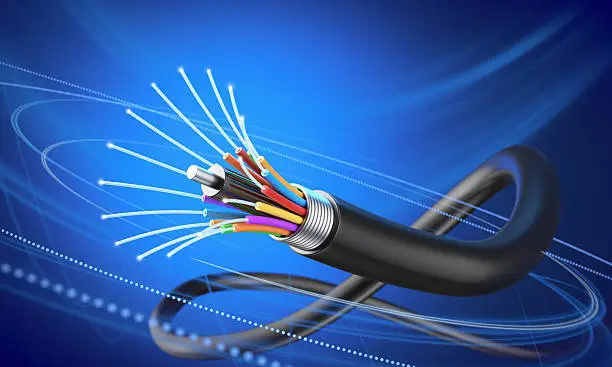
Fiber optics is the technology of transmitting information using light through long, thin strands of transparent material, usually glass or plastic. These fibers act as waveguides, confining light and directing it along precise paths with astonishing efficiency. Instead of electrons drifting through metal, fiber optics sends photons racing at near-light speed.
At first glance, the idea sounds impossible. Light naturally travels in straight lines and spreads out. How can it be forced to follow a curving cable, bending around corners, across continents, and under oceans? The answer lies in one of the most elegant phenomena in physics: total internal reflection.
Total Internal Reflection and the Art of Trapping Light
When light passes from one medium to another, such as from air into glass, it bends. This bending, known as refraction, depends on the properties of the materials involved. Under certain conditions, when light tries to move from a denser medium to a less dense one at a shallow angle, it does not escape. Instead, it reflects entirely back into the original medium.
Fiber optic cables exploit this phenomenon. Each fiber has a core surrounded by a cladding with a slightly lower refractive index. When light enters the core at the right angle, it strikes the boundary with the cladding and reflects inward instead of escaping. The light becomes trapped, bouncing down the fiber like a pinball, but with astonishing efficiency.
This is not a crude or chaotic process. The reflections are smooth, predictable, and preserve the integrity of the signal. Light can travel tens or even hundreds of kilometers with minimal loss, carrying vast amounts of information encoded in its pulses.
Encoding Information Into Light
Light itself is not information. It becomes information when it is controlled. In fiber optics, data is encoded by rapidly turning a light source on and off or by subtly changing its properties. Each flash represents a bit of data, a binary choice between presence and absence, one and zero.
Modern systems go far beyond simple on-off signaling. They use multiple wavelengths of light, different polarization states, and complex modulation schemes to pack enormous amounts of data into a single fiber. A single strand can carry terabits of data per second, enough to stream millions of high-definition videos simultaneously.
When you watch a cat video online, the image is broken into digital data, converted into optical signals, transmitted as light pulses, and then converted back into electrical signals and images on your screen. This entire journey happens so quickly that it feels instantaneous, collapsing distance and making the global feel local.
The Materials That Make Fiber Optics Possible
The heart of fiber optics is glass, but not ordinary window glass. Fiber optic glass must be extraordinarily pure, free of impurities that would scatter or absorb light. Even tiny amounts of contamination can dramatically reduce performance.
The development of ultra-pure silica glass was a turning point in fiber optics. Early attempts suffered from high signal loss, making long-distance transmission impractical. Over decades of refinement, scientists learned how to remove impurities down to parts per billion, creating fibers through which light can travel vast distances with minimal attenuation.
Plastic fibers also exist and are used for short-distance applications. They are cheaper and more flexible but cannot match the performance of glass for long-haul communication. For the global internet, glass reigns supreme.
Lasers: The Engines of Optical Communication
To send light through fibers efficiently, engineers needed light sources that were powerful, precise, and controllable. The invention of the laser provided exactly that. Lasers produce coherent light, meaning the waves are synchronized in frequency and phase. This coherence allows for tight control and efficient transmission.
In fiber optic systems, semiconductor lasers generate light at specific wavelengths chosen to minimize loss in the fiber. These lasers can be modulated at incredible speeds, turning data into streams of photons that race through the network.
The marriage of lasers and fibers transformed communication. It allowed signals to travel farther, faster, and with greater clarity than ever before, laying the foundation for the modern internet.
Optical Amplifiers and Long-Distance Communication
Even the best fibers are not perfect. Over long distances, some light is inevitably lost. Early systems relied on electrical repeaters that converted optical signals back into electrical ones, amplified them, and then converted them back into light. This process was complex and limited performance.
The development of optical amplifiers changed everything. These devices amplify light directly, without converting it to electricity. By boosting the optical signal itself, they allow data to travel thousands of kilometers with minimal degradation.
Optical amplifiers made undersea fiber optic cables practical, enabling continents to be connected by strands of glass laid on the ocean floor. Today, the vast majority of international internet traffic flows through these silent, submerged highways of light.
Fiber Optics Beneath the Oceans
It is easy to imagine the internet as something abstract and virtual, but it has a physical backbone that is both fragile and resilient. Undersea fiber optic cables stretch across oceans, following carefully planned routes that avoid geological hazards and human activity.
These cables are engineering marvels. They must withstand immense pressure, corrosive saltwater, and the occasional curious shark. Layers of protective materials shield the fibers, while repeaters spaced along the cable maintain signal strength.
When a video is uploaded in one country and viewed in another, it often travels through these undersea cables, crossing entire oceans in fractions of a second. The global flow of information depends on these hidden arteries, quietly pulsing with light.
Why Fiber Optics Is Faster Than Copper
Electrical signals in copper wires face fundamental limitations. Resistance causes heat, which wastes energy. Electromagnetic interference introduces noise. As data rates increase, these problems become harder to manage.
Light in fiber optics avoids many of these issues. Photons do not carry electric charge, so they do not generate heat in the same way. Fibers are immune to electromagnetic interference, allowing signals to remain clean even in noisy environments.
The result is higher bandwidth, lower loss, and greater reliability. Fiber optics is not just faster; it is fundamentally better suited to the demands of modern communication.
Latency and the Feeling of Instant Connection
Speed in communication is not just about bandwidth; it is also about latency, the time it takes for data to travel from one point to another. Fiber optics minimizes latency by allowing signals to travel at a significant fraction of the speed of light.
This low latency is why video calls feel natural, online games feel responsive, and remote collaboration feels possible. It shrinks the world, making distant interactions feel immediate and personal.
The emotional impact of this cannot be overstated. Fiber optics enables real-time human connection across vast distances, changing how relationships, work, and culture function.
Fiber Optics in Homes and Cities
Fiber optics is no longer confined to long-distance backbones. Increasingly, it is being brought directly into homes and businesses. Fiber-to-the-home networks replace copper lines with glass fibers, delivering faster and more reliable internet connections.
In cities, fiber optics supports everything from traffic management to emergency services. It enables smart infrastructure, real-time monitoring, and data-driven decision-making. Urban life increasingly depends on the silent flow of light beneath streets and buildings.
As more devices connect to the internet, from phones to appliances, fiber optics provides the capacity needed to support this digital ecosystem.
Beyond the Internet: Other Uses of Fiber Optics
While internet communication is the most visible application, fiber optics plays crucial roles in many other fields. In medicine, fiber optic cables allow doctors to see inside the human body through minimally invasive procedures. Light guides instruments through narrow spaces, reducing risk and recovery time.
In science, fiber optics is used to transmit signals from telescopes, sensors, and experiments where electrical interference would be problematic. In industry, fibers monitor temperature, pressure, and strain in harsh environments, providing data where electronics would fail.
Fiber optics is also used in art, lighting, and design, creating visual effects that blend technology and aesthetics. Light, once merely a natural phenomenon, has become a versatile tool shaped by human creativity.
The Physics That Makes It All Work
At its core, fiber optics is an application of fundamental physics. It relies on the wave nature of light, the principles of refraction and reflection, and the quantum properties of photons. Understanding fiber optics requires knowledge of electromagnetism, materials science, and quantum mechanics.
Yet the beauty of fiber optics lies in how these complex principles come together in a practical, reliable system. It is physics made tangible, physics woven into the fabric of daily life.
Every data packet is a small triumph of understanding, a reminder that abstract scientific ideas can reshape how humanity communicates and connects.
Challenges and Limitations of Fiber Optics
Despite its advantages, fiber optics is not without challenges. Installing fiber networks is expensive and labor-intensive. Fibers are fragile compared to copper and require careful handling. Repairs, especially undersea, can be complex and costly.
There are also fundamental limits imposed by physics. As data rates increase, effects such as dispersion and nonlinear interactions between light waves become significant. Engineers continuously develop new techniques to manage these issues, pushing the boundaries of what fibers can carry.
These challenges ensure that fiber optics remains an active field of research and innovation, rather than a solved problem.
The Future of Light-Based Communication
The future of fiber optics is closely tied to humanity’s appetite for data. Emerging technologies such as virtual reality, remote surgery, and global scientific collaboration demand ever greater bandwidth and reliability.
Researchers are exploring new types of fibers, new modulation schemes, and even quantum communication using individual photons. The goal is not just faster internet, but more secure, more flexible, and more resilient networks.
As artificial intelligence, automation, and global connectivity expand, fiber optics will remain a foundational technology, quietly enabling progress.
The Human Side of Fiber Optics
It is easy to think of fiber optics as cold infrastructure, but it carries deeply human content. It transmits laughter, grief, creativity, and curiosity. It carries messages between loved ones, knowledge between scholars, and stories between cultures.
When light pulses through a fiber, it is not just data that travels. It is human presence, encoded and preserved across distance. Fiber optics turns light into a bridge between minds.
The cat video that makes someone smile on a difficult day is not trivial. It is a small reminder of connection, made possible by decades of scientific effort and engineering skill.
Light, Glass, and the Shape of Modern Life
Fiber optics represents one of humanity’s most elegant technological achievements. By learning to guide light through glass, we transformed communication, collapsed distance, and reshaped society. What once required days or weeks now takes milliseconds.
The technology is invisible by design, hidden beneath oceans and streets, but its impact is everywhere. It is in our conversations, our entertainment, our work, and our understanding of the world.
Fiber optics shows what happens when fundamental physics meets human imagination. It proves that even something as intangible as light can be shaped into a reliable messenger, carrying the everyday moments and extraordinary ideas that define modern life.
The next time a cat leaps onto your screen from across the world, it is worth pausing to appreciate the quiet miracle beneath it all: a flash of light, racing through glass, connecting human lives one photon at a time.