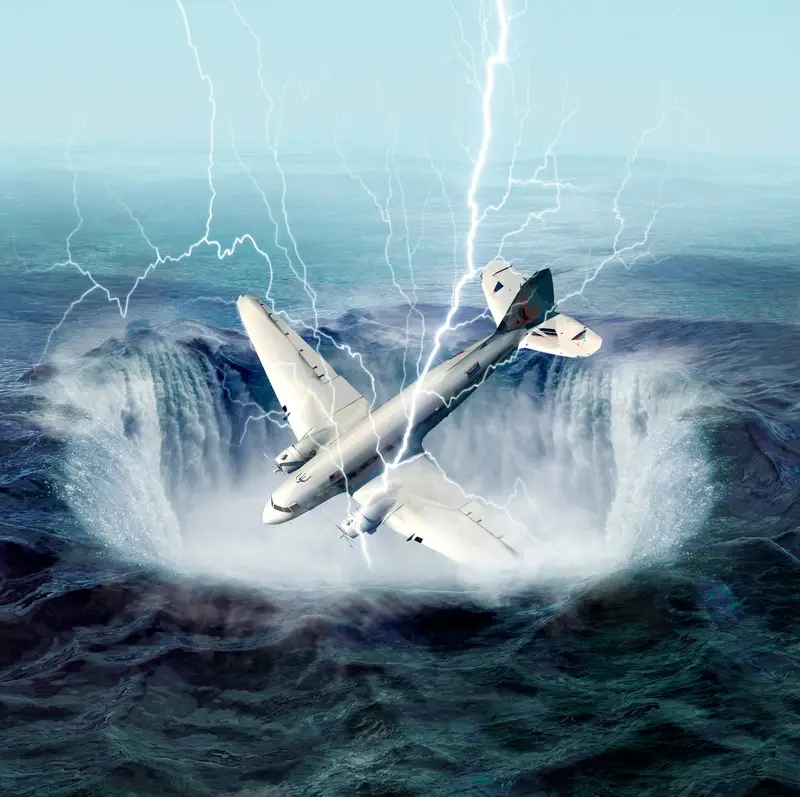
For decades, the Bermuda Triangle has occupied a unique place in human imagination. Mention its name, and images of ghost ships, vanished airplanes, strange lights, mysterious fogs, and unexplained disappearances instantly come to mind. It is one of the world’s most famous mysteries—a region of the Atlantic Ocean where, according to popular stories, ships and aircraft have disappeared without a trace.
Some people believe the Bermuda Triangle hides supernatural forces. Others blame extraterrestrials, underwater civilizations, magnetic anomalies, or even portals to another dimension. Books, documentaries, movies, and television shows have transformed it into a symbol of the unknown, where ordinary rules no longer seem to apply.
But behind the legends lies a more fascinating story—one built from real history, scientific investigation, human error, powerful storms, and the remarkable ability of myths to grow larger with every retelling.
The truth about the Bermuda Triangle is not simply a battle between believers and skeptics. It is a story about how mystery captures the human imagination, how nature can be both beautiful and dangerous, and how careful scientific investigation often reveals explanations that are every bit as interesting as fiction.
What Is the Bermuda Triangle?
The Bermuda Triangle is a loosely defined region in the western North Atlantic Ocean.
Although there is no officially recognized boundary, the area is commonly described as forming a triangle between Miami in Florida, Bermuda in the North Atlantic, and San Juan in Puerto Rico.
Together, these three points enclose an enormous stretch of ocean covering roughly 500,000 square miles (about 1.3 million square kilometers), though estimates vary because the boundaries are not fixed.
Unlike countries or protected marine areas, the Bermuda Triangle has no legal borders. Ships crossing the area do not encounter signs announcing they have entered it. Airplanes flying overhead do not receive special warnings simply because they are passing through the so-called triangle.
It is, in many ways, a cultural creation rather than a geographical one.
Yet it overlaps one of the busiest transportation corridors on Earth.
Thousands of ships travel these waters every year.
Commercial airlines cross the region daily.
Cruise ships regularly sail through it.
Millions of people pass safely through the area without even realizing they have entered the famous triangle.
A Region of Extraordinary Beauty
One reason the Bermuda Triangle captures the imagination is that it lies in one of the most beautiful parts of the Atlantic Ocean.
The waters range from brilliant turquoise near tropical islands to deep sapphire blue over the open ocean.
Coral reefs flourish in many areas.
Flying fish leap above the waves.
Sea turtles, dolphins, whales, sharks, and countless other marine creatures inhabit these waters.
Warm ocean currents help create rich ecosystems while also influencing global climate.
Tourists flock to Bermuda, the Bahamas, Puerto Rico, and Florida every year to enjoy beaches, diving, sailing, and fishing.
Nothing about the region looks mysterious from above.
On a calm day, it can appear almost impossibly peaceful.
Yet beneath that beauty lies an ocean capable of changing dramatically within hours.
How the Legend Began
Contrary to popular belief, the Bermuda Triangle has not been feared since ancient times.
The modern legend is surprisingly young.
Although disappearances at sea have always occurred throughout history, the phrase “Bermuda Triangle” did not become widely known until the twentieth century.
In 1950, newspaper writer Edward Van Winkle Jones published an article discussing mysterious disappearances in the region.
A few years later, writer George X. Sand expanded the idea in a magazine article.
The name “Bermuda Triangle” itself became popular after writer Vincent Gaddis used it in a 1964 magazine article.
From there, the mystery grew rapidly.
Books began collecting stories of disappearances.
Television documentaries presented dramatic accounts.
Movies added supernatural twists.
Over time, the legend became larger than the actual historical record.
Why People Love Mysteries
Humans are naturally drawn to mysteries.
Throughout history, unexplained events have inspired stories, legends, and myths.
Our brains constantly search for patterns.
When information is incomplete, imagination fills the gaps.
A missing airplane is tragic.
A missing airplane with no immediately obvious explanation becomes unforgettable.
When several mysterious events appear connected, even if they occurred decades apart under completely different circumstances, they create a powerful narrative.
The Bermuda Triangle became exactly that—a collection of separate tragedies woven together into one enduring mystery.
The Famous Case of Flight 19
No event contributed more to the Bermuda Triangle legend than the disappearance of Flight 19.
On December 5, 1945, five U.S. Navy TBM Avenger torpedo bombers departed from Fort Lauderdale, Florida, for a routine training mission.
The weather initially appeared favorable.
The exercise was expected to last only a few hours.
During the flight, something went wrong.
The squadron leader, Lieutenant Charles Taylor, apparently became uncertain of his exact location.
Radio communications suggested growing confusion.
Pilots disagreed about where they were.
As fuel supplies decreased, the situation became increasingly desperate.
Eventually, radio contact was lost.
The aircraft never returned.
A rescue plane sent to search for Flight 19 also disappeared after takeoff.
Altogether, twenty-seven people were lost.
The tragedy shocked the nation.
Because no wreckage was immediately found, speculation flourished.
Over time, Flight 19 became central to Bermuda Triangle mythology.
However, historians studying surviving radio transcripts believe navigational confusion, deteriorating weather, and fuel exhaustion likely explain the disaster.
The missing rescue aircraft may have exploded shortly after takeoff, a known hazard for that model due to fuel vapor issues.
Although heartbreaking, the available evidence does not require supernatural explanations.
The Mystery of the USS Cyclops
Another famous disappearance involved the USS Cyclops.
This massive U.S. Navy cargo ship vanished in March 1918 while carrying manganese ore from Brazil toward Baltimore.
More than 300 people were aboard.
No distress signal was received.
No confirmed wreckage has ever been found.
Its disappearance remains one of the largest losses of life in U.S. Naval history unrelated to combat.
Numerous theories have been proposed.
Some suggest structural failure caused by the extremely heavy cargo.
Others point toward rough seas or mechanical problems.
German submarines were initially suspected during World War I, but no convincing evidence has ever supported that idea.
Although the ship disappeared within the region associated with the Bermuda Triangle, historians generally view the event as an unsolved maritime tragedy rather than evidence of mysterious forces.
Other Famous Stories
Many books about the Bermuda Triangle mention ships apparently found drifting without crews.
Others describe airplanes that vanished from radar.
Some accounts tell of captains reporting strange lights or unusual compass readings before disappearing.
However, careful historical investigation has shown that many popular stories became exaggerated over time.
In some cases, ships believed lost in the Bermuda Triangle actually sank elsewhere.
Some vessels later turned up safely in port.
Others were reported missing because communication delays were common before modern satellite technology.
Several dramatic stories simply grew through repeated retelling.
Like many legends, each new version often became slightly more mysterious than the last.
Does the Bermuda Triangle Really Have More Disappearances?
This question lies at the heart of the entire mystery.
Scientists, insurance companies, and maritime organizations have studied accident records extensively.
The available evidence suggests the Bermuda Triangle does not experience an unusually high number of disappearances compared with other heavily traveled regions of the world’s oceans.
Because the area sees enormous volumes of ship and aircraft traffic, accidents inevitably occur.
When millions of people travel through a region every year, even rare accidents produce noticeable numbers.
Organizations that monitor marine safety have not identified the Bermuda Triangle as uniquely dangerous.
The legend largely arises from selective attention.
People remember unusual disappearances while overlooking the countless safe journeys occurring every day.
The Power of Weather
One of the strongest scientific explanations involves weather.
The Bermuda Triangle lies within a region famous for rapidly changing atmospheric conditions.
Warm tropical waters provide enormous energy for storms.
Thunderstorms can develop quickly.
Strong winds may appear with little warning.
Visibility can decrease dramatically during heavy rain.
Lightning frequently accompanies severe weather.
Powerful downdrafts and turbulence create dangerous conditions for aircraft.
Even experienced pilots and sailors must treat these conditions with respect.
Before modern forecasting, crews often encountered severe weather with little advance warning.
Hurricane Alley
The region also lies within one of the world’s major hurricane zones.
Every year, Atlantic hurricane season brings the possibility of powerful tropical cyclones.
These storms generate enormous waves, destructive winds, torrential rain, and dangerous storm surges.
Even modern ships equipped with advanced navigation avoid direct encounters whenever possible.
Before satellites and sophisticated weather models existed, hurricanes frequently caught ships by surprise.
Many historical disappearances likely occurred during severe storms that were poorly documented at the time.
The Gulf Stream
Another important natural factor is the Gulf Stream.
This powerful ocean current flows rapidly through portions of the Bermuda Triangle.
Moving at speeds that can exceed several miles per hour, it transports warm water from the Gulf of Mexico toward Europe.
The Gulf Stream influences weather, climate, and marine ecosystems.
It also complicates search-and-rescue operations.
If a ship sinks or an airplane crashes into the ocean, the current can quickly carry floating debris far from the accident site.
This makes locating wreckage much more difficult.
In some cases, debris may never be found.
The absence of wreckage does not necessarily imply mysterious forces.
Ocean currents provide a perfectly natural explanation.
Navigation Before GPS
Modern travelers enjoy remarkable navigation technology.
GPS satellites provide accurate positioning almost anywhere on Earth.
Digital maps constantly update locations.
Aircraft carry sophisticated navigation systems.
Ships use radar, satellite communications, and electronic charts.
Earlier generations had none of these tools.
Navigators relied upon compasses, celestial observations, dead reckoning, and experience.
Errors accumulated easily.
Poor visibility increased uncertainty.
Clouds could hide stars.
Mechanical failures sometimes disabled instruments.
A small navigational mistake could eventually place a ship or aircraft far from its intended route.
Many historical disappearances occurred long before satellite navigation existed.
Compass Confusion
One of the most persistent Bermuda Triangle claims involves compasses.
According to popular stories, compasses spin wildly or point in impossible directions.
Scientific investigation paints a more ordinary picture.
Earth’s magnetic field naturally varies across the planet.
Compasses point toward magnetic north rather than geographic north.
The difference between these directions is called magnetic declination.
In certain locations, the two directions nearly coincide.
Elsewhere they differ significantly.
Navigators must account for these variations.
The Bermuda Triangle does not possess unique magnetic properties unknown elsewhere.
Although local magnetic variations occur throughout Earth’s surface, they are well understood and mapped.
There is no scientific evidence that mysterious magnetic forces regularly disable navigation within the region.
Rogue Waves
The ocean occasionally produces enormous waves known as rogue waves.
Unlike ordinary waves, rogue waves can appear suddenly and reach exceptional heights.
Some exceed 20 meters, or more than 65 feet.
Such waves may overwhelm ships unexpectedly.
Researchers now know rogue waves occur naturally in many oceans.
The interaction of currents, wind, and wave systems can produce these rare giants.
Because the Bermuda Triangle includes active shipping lanes and complex ocean conditions, rogue waves may have contributed to some maritime accidents.
Methane Hydrate Theory
One popular scientific hypothesis once suggested underwater methane gas might explain disappearances.
Large deposits of methane hydrate exist beneath portions of the ocean floor.
If enormous quantities of methane suddenly escaped into seawater, they could reduce water density.
A ship passing through such an area might lose buoyancy more rapidly than expected.
Gas entering the atmosphere might also affect aircraft engines.
Although laboratory experiments showed such effects are theoretically possible, researchers have found no convincing evidence that massive methane eruptions occur frequently enough in the Bermuda Triangle to explain its legendary reputation.
Today, most scientists consider this an unlikely primary explanation.
Human Error
Perhaps the least mysterious explanation is also one of the most common.
People make mistakes.
Pilots misjudge weather.
Captains miscalculate positions.
Mechanical problems are overlooked.
Communication errors occur.
Fatigue affects judgment.
Stress leads to poor decisions.
Accident investigations around the world consistently identify human error as a major contributing factor.
The Bermuda Triangle is no exception.
Recognizing human fallibility does not diminish the tragedy of accidents.
Instead, it helps improve safety for future travelers.
Mechanical Failure
Machines are remarkable but imperfect.
Aircraft engines fail.
Electrical systems malfunction.
Ships experience leaks.
Navigation equipment breaks.
Fuel contamination occurs.
Structural fatigue weakens materials over time.
Before modern engineering standards and maintenance practices, mechanical failures were even more common.
Many disappearances likely resulted from combinations of equipment failure and severe environmental conditions.
Why Wreckage Is Often Never Found
Many people assume that if a ship sinks, debris should always float.
Reality is more complicated.
Heavy cargo often sinks immediately.
Aircraft break apart underwater.
Ocean currents scatter debris over enormous distances.
Marine life gradually consumes organic materials.
Saltwater corrodes metals.
Storms bury wreckage beneath sediment.
The Atlantic Ocean also contains immense depths.
Some portions exceed 20,000 feet.
Locating wreckage in such environments remains extraordinarily difficult even with today’s technology.
Many accidents worldwide remain unsolved simply because the ocean is vast.
The Ocean Is Still Largely Unexplored
Ironically, one reason Bermuda Triangle mysteries endure is that humanity knows surprisingly little about the deep ocean.
Scientists estimate much of the seafloor has never been explored in detail.
New underwater mountains, ecosystems, and geological features continue to be discovered.
Searching immense underwater areas requires expensive ships, remotely operated vehicles, sonar mapping, and specialized equipment.
Even modern search missions may cover only tiny portions of the ocean floor.
This leaves many historical mysteries unresolved.
Could Aliens Be Responsible?
One of the most popular fictional explanations involves extraterrestrials.
According to these stories, alien spacecraft abduct ships and airplanes.
No credible scientific evidence supports this idea.
Despite decades of investigation, no verified observations connect extraterrestrial activity with Bermuda Triangle disappearances.
The theory remains part of popular culture rather than science.
The Legend of Atlantis
Another imaginative explanation involves the lost city of Atlantis.
Some writers suggest advanced technology left behind by Atlantis creates mysterious energy fields.
Again, no archaeological evidence supports this claim.
Atlantis itself remains a legendary story originating in the writings of the ancient Greek philosopher Plato.
Although underwater archaeology has uncovered remarkable ancient settlements around the world, none confirm Atlantis beneath the Bermuda Triangle.
Time Portals and Other Extraordinary Claims
Television programs and internet videos sometimes describe time warps, portals, dimensional gateways, and mysterious energy vortices.
These ideas capture attention because they are exciting.
However, no reliable scientific observations support such phenomena.
Extraordinary claims require extraordinary evidence.
To date, such evidence has not appeared.
The Role of Media
The Bermuda Triangle became famous largely because of media.
Books highlighted mysterious stories.
Movies emphasized suspense.
Television documentaries often focused on unanswered questions while giving less attention to ordinary explanations.
The internet accelerated this process.
Dramatic stories spread rapidly through social media.
Videos accumulate millions of views.
Each generation discovers the mystery anew.
Entertainment does not necessarily require factual accuracy.
As a result, myths often become more widely known than historical evidence.
Scientific Investigations
Oceanographers, meteorologists, aviation experts, historians, geologists, and marine engineers have all examined Bermuda Triangle claims.
Most conclude that no single mysterious force operates within the region.
Instead, accidents result from combinations of familiar factors.
Rapidly changing weather.
Strong ocean currents.
Human error.
Mechanical failures.
Heavy traffic.
Limited historical records.
These explanations may sound less dramatic than supernatural stories, but together they provide a convincing understanding of most known incidents.
Why the Mystery Refuses to Disappear
If science offers reasonable explanations, why does the legend continue?
Part of the answer lies in human psychology.
People naturally remember extraordinary stories.
Ordinary events fade from memory.
A million successful flights rarely become headlines.
One unexplained disappearance does.
Mysteries also invite imagination.
They allow every listener to invent possibilities.
The Bermuda Triangle occupies a perfect balance between reality and legend.
Real accidents occurred.
Some remain unsolved.
The gaps invite speculation.
Lessons from the Bermuda Triangle
Perhaps the greatest lesson of the Bermuda Triangle is not about supernatural forces but about nature itself.
The ocean commands respect.
It is beautiful, powerful, unpredictable, and sometimes unforgiving.
Modern technology has greatly improved safety, yet storms still sink ships.
Mechanical failures still occur.
Search-and-rescue teams still face enormous challenges.
The Bermuda Triangle reminds us that despite remarkable scientific progress, nature remains capable of surprising us.
It also teaches another important lesson.
Curiosity should always be paired with evidence.
Asking questions drives science forward.
Accepting extraordinary claims without proof does not.
The most satisfying mysteries are those investigated carefully, honestly, and patiently.
Does the Bermuda Triangle Still Deserve Its Reputation?
Today, millions of travelers safely cross the Bermuda Triangle every year.
Commercial airliners follow regular routes.
Cruise ships carry thousands of passengers.
Cargo vessels transport goods between continents.
Most journeys pass without incident.
This does not mean accidents never happen.
They do.
But accidents occur throughout the world’s oceans and skies.
Current evidence does not indicate that the Bermuda Triangle is uniquely dangerous compared with other heavily traveled regions.
Its reputation owes more to storytelling than to statistics.
Yet that reputation continues inspiring books, films, documentaries, and scientific curiosity alike.
Conclusion
The Bermuda Triangle stands at the fascinating intersection of fear, imagination, history, and science. For more than half a century, it has inspired stories of vanished ships, missing aircraft, ghostly encounters, and mysterious forces beyond human understanding. These tales have become deeply woven into popular culture, transforming an ordinary stretch of the Atlantic Ocean into one of the world’s most famous mysteries.
Careful investigation, however, tells a different story. Most disappearances associated with the Bermuda Triangle can be explained through well-understood natural causes such as severe weather, hurricanes, powerful ocean currents, navigational mistakes, mechanical failures, and the immense challenges of searching the deep sea. Some historical cases remain unsolved—not because they defy science, but because the ocean often leaves little evidence behind.
In many ways, the Bermuda Triangle is a reminder of two equally important truths. The first is that nature is extraordinarily powerful, capable of creating conditions that challenge even modern technology. The second is that humans are natural storytellers. We are drawn to mysteries, especially those that leave room for wonder.
Perhaps that is why the Bermuda Triangle continues to fascinate generation after generation. It is not merely a place on a map. It is a symbol of our endless curiosity about the unknown. Even as science explains more of its legends, the mystery endures—not because the answers are missing, but because our desire to explore, question, and imagine will always remain part of what makes us human.