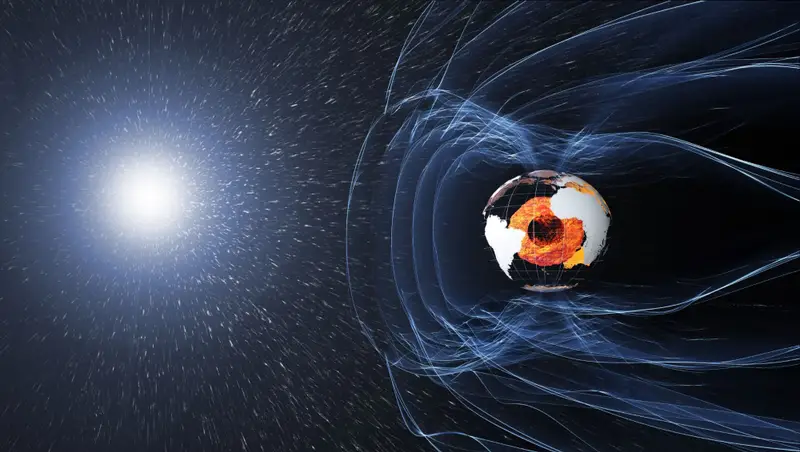
The Earth feels solid beneath our feet, dependable and permanent. Mountains rise, oceans spread, and continents drift so slowly that a human lifetime barely notices. Yet hidden far below the surface, our planet is restless. It stirs, churns, and rewrites its own internal story. One of the most dramatic expressions of this hidden restlessness is something both unsettling and magnificent: the flipping of Earth’s magnetic poles.
At first glance, the idea sounds like science fiction. North becomes south. Compass needles reverse direction. Invisible forces reorganize themselves on a planetary scale. But this is not speculation or myth. It is a real, well-documented phenomenon that has occurred many times throughout Earth’s history. The magnetic poles have flipped again and again, sometimes after millions of years of stability, sometimes more frequently, with no fixed schedule and no simple trigger.
Understanding why Earth’s magnetic poles flip requires us to travel deep into the planet, into realms we can never visit directly. It also requires us to let go of comforting ideas about permanence and accept that even the most fundamental features of our world are dynamic. This story is not only about magnetism. It is about how Earth works as a living system, about time scales far beyond human experience, and about how fragile yet resilient life on this planet truly is.
The Magnetic Field That Protects the Planet
Earth’s magnetic field is not something we can see, but its effects are everywhere. It shapes the movement of charged particles from the Sun, guides migratory animals, and allows compasses to point reliably toward north. Without it, life on the surface of Earth would be exposed to far harsher conditions.
The magnetic field acts like an invisible shield, deflecting much of the solar wind, a stream of charged particles constantly flowing outward from the Sun. When these particles collide with Earth’s magnetic field, they are guided toward the poles, where they create the shimmering auroras. More importantly, this magnetic protection prevents large amounts of radiation from stripping away the atmosphere over time.
This field behaves roughly like the field of a giant bar magnet, with a north magnetic pole and a south magnetic pole. But this similarity is deceptive. There is no massive bar magnet buried inside Earth. The real source of the magnetic field is far more complex, dynamic, and fascinating.
Deep Inside the Earth: The Engine of Magnetism
To understand why the magnetic poles flip, we must look deep beneath Earth’s crust, far beyond where humans can drill or observe directly. Beneath the solid mantle lies the core, divided into two main parts: a solid inner core and a liquid outer core. The outer core, composed mostly of molten iron and nickel, is where Earth’s magnetic field is born.
This liquid metal is not still. It moves in complex, turbulent patterns driven by heat escaping from the inner core and by Earth’s rotation. As the molten iron flows, it carries electric charges with it. Moving electric charges create magnetic fields. This self-sustaining process is known as the geodynamo.
The geodynamo is one of the most extraordinary natural engines in the universe. It converts thermal and kinetic energy into magnetic energy on a planetary scale. It is powerful enough to generate a magnetic field that extends tens of thousands of kilometers into space, yet delicate enough that small changes in flow patterns can alter the field’s structure.
The key to understanding magnetic pole flips lies in the chaotic nature of this dynamo. The flows in the outer core are not smooth or orderly. They twist, break, merge, and reorganize. Over time, these changes can weaken the existing magnetic field and allow a new configuration to emerge, one in which the magnetic poles are reversed.
What a Magnetic Pole Flip Really Means
When people hear that Earth’s magnetic poles flip, they often imagine the planet physically turning upside down or spinning wildly in space. This is not what happens. The flip is not a rotation of Earth itself, nor is it a sudden event.
A magnetic pole reversal refers to a change in the orientation of Earth’s magnetic field. The magnetic north pole becomes magnetic south, and vice versa. The process unfolds over thousands to tens of thousands of years. During this time, the magnetic field does not simply fade out and reappear reversed. Instead, it becomes weaker, more complex, and more chaotic.
Multiple magnetic poles can appear across the planet during a reversal. The field may look fragmented, with regions of north and south scattered unpredictably. Eventually, a new dominant configuration emerges, stabilizing into a reversed field.
From a human perspective, this process is incredibly slow. No civilization has ever directly observed a complete reversal from start to finish. Yet in geological terms, it happens relatively quickly, like a blink of an eye in Earth’s long history.
Evidence Written in Stone and Fire
How do we know that magnetic pole reversals have happened in the past? The answer lies in rocks, especially those formed from molten lava.
When lava erupts and cools, tiny magnetic minerals within it align themselves with Earth’s magnetic field at that moment. As the rock solidifies, this magnetic orientation is locked in place. These rocks become time capsules, preserving a record of the direction of the magnetic field when they formed.
Geologists have studied lava flows and found that some are magnetized in the opposite direction from today’s field. Even more striking, when layers of rock are dated and analyzed, they reveal a pattern of repeated reversals over millions of years.
One of the most powerful pieces of evidence comes from the ocean floor. As molten rock rises at mid-ocean ridges and spreads outward, it records the magnetic field at the time of its formation. This creates symmetrical полос of normal and reversed magnetism on either side of the ridges, like a barcode written across the seafloor. These patterns provide a clear and beautiful record of magnetic reversals and have helped scientists reconstruct the history of Earth’s magnetic field.
The Irregular Rhythm of Reversals
One of the most unsettling aspects of magnetic pole flips is their unpredictability. There is no fixed schedule. Sometimes millions of years pass without a reversal. At other times, reversals occur more frequently.
On average, Earth’s magnetic field flips every few hundred thousand years, but this average hides enormous variation. There have been long periods, lasting tens of millions of years, with no reversals at all. There have also been periods of frequent flipping.
The most recent complete reversal occurred about 780,000 years ago. Since then, the magnetic field has remained in its current orientation, though it has weakened and shifted. This has led to speculation about whether another reversal might be approaching.
The truth is that scientists cannot predict when the next flip will occur. The processes inside Earth’s core are too complex and too inaccessible for precise forecasting. What we can say is that reversals are a natural part of Earth’s behavior, not a sign that something has gone wrong.
What Happens During a Flip
The idea of a magnetic pole reversal can sound terrifying, as if it signals an impending catastrophe. In reality, while reversals are dramatic in a geological sense, they are not known to cause mass extinctions or global collapse.
During a reversal, the magnetic field weakens, sometimes to a fraction of its usual strength. This reduced shielding allows more solar and cosmic radiation to reach Earth’s upper atmosphere. Satellites and communication systems could be affected, and modern technology would likely face challenges if a reversal were happening today.
However, Earth’s atmosphere itself provides significant protection, even without a strong magnetic field. Life has survived many reversals in the past, including complex life forms. There is no clear evidence that reversals are directly responsible for major biological crises.
For animals that rely on Earth’s magnetic field for navigation, such as birds and marine species, a reversal could be confusing. Yet these species have persisted through many past reversals, suggesting they can adapt or use additional cues.
The most profound changes during a reversal occur not on the surface but deep within Earth’s core, where the magnetic field is being reshaped.
The Role of Chaos in Earth’s Core
At the heart of the mystery of magnetic pole flips is chaos. The flow of molten iron in the outer core is governed by complex physical laws involving heat transfer, fluid dynamics, and electromagnetism. These laws allow for stable patterns, but they also allow for sudden shifts.
Small changes in temperature or flow can grow over time, altering the balance of forces that sustain the magnetic field. Eventually, the system may reach a tipping point where the existing magnetic configuration collapses and a new one forms.
This behavior is similar to other chaotic systems in nature, such as weather patterns. While the underlying physics is well understood, the exact outcomes are unpredictable. Earth’s magnetic field is stable enough to persist for long periods, yet flexible enough to reorganize itself completely.
This balance between stability and change is one of the defining features of Earth as a dynamic planet.
Magnetic Excursions: Near Misses and False Starts
Not all disturbances in the magnetic field lead to full reversals. Sometimes the field weakens and the poles wander far from their usual positions, only to return to their original orientation. These events are known as magnetic excursions.
Excursions can last thousands of years and may involve significant weakening of the field, but they stop short of a complete flip. They are like rehearsals for a reversal that never quite happens.
Studying excursions helps scientists understand the conditions that lead to full reversals and the factors that stabilize the magnetic field. They also remind us that Earth’s magnetism is constantly in motion, even when it appears stable on human timescales.
The South Atlantic Anomaly and Modern Concerns
In recent decades, scientists have observed a region of unusually weak magnetic field over parts of the South Atlantic. Known as the South Atlantic Anomaly, this area allows more radiation to reach satellites in low Earth orbit, causing increased risks for electronics and astronauts.
Some have wondered whether this anomaly is a sign that a magnetic reversal is imminent. While it is true that the magnetic field has been weakening overall, this alone does not mean a reversal is about to occur. Similar weakening and regional anomalies have likely happened many times in the past without leading to immediate flips.
The South Atlantic Anomaly is best understood as a surface expression of complex processes deep in the core. It is a reminder that Earth’s magnetic field is not uniform or static, but it is not a reliable predictor of an impending reversal.
Magnetic Poles Versus Geographic Poles
It is important to distinguish between Earth’s magnetic poles and its geographic poles. The geographic poles are defined by Earth’s axis of rotation. They are fixed relative to the planet’s rotation and do not flip.
Magnetic poles, by contrast, are defined by the magnetic field and can wander over time. Even outside of reversals, the magnetic north pole moves, sometimes by tens of kilometers per year. This movement reflects changes in the flow of molten iron in the outer core.
A magnetic pole reversal does not affect Earth’s rotation or tilt. The planet does not physically flip upside down. Only the magnetic field changes orientation.
Why Reversals Do Not Destroy Life
One of the most common fears surrounding magnetic pole flips is that they might trigger mass extinctions or render Earth uninhabitable. The geological record does not support this fear.
Life has persisted through hundreds of magnetic reversals. Many of these occurred during periods when life was already complex and widespread. There is no consistent correlation between reversals and major extinction events.
This resilience highlights the strength of Earth’s protective systems. The atmosphere absorbs much of the harmful radiation that could reach the surface. Life itself is adaptable, capable of adjusting to changing conditions over long timescales.
This does not mean a reversal would be completely harmless in the modern world. Our technological infrastructure is far more sensitive to radiation and magnetic disturbances than ancient life forms were. Satellites, power grids, and communication systems could face serious challenges. But these are problems of engineering and preparedness, not signs of planetary doom.
The Long Memory of the Planet
Magnetic pole flips remind us that Earth has a long memory, written into its rocks and fields. The planet we inhabit today is the product of countless changes, many of which unfolded long before humans existed.
Understanding reversals requires patience and humility. We cannot run experiments on Earth’s core. We cannot speed up geological time. Instead, we must piece together clues from rocks, models, and observations, building a picture that is always incomplete but steadily improving.
This process mirrors the way science itself advances. It is slow, careful, and often uncertain, yet capable of revealing profound truths about the natural world.
Are We Due for Another Flip?
The question of whether Earth’s magnetic poles are about to flip is one of the most frequently asked and most difficult to answer. The weakening of the magnetic field and the movement of the poles have fueled speculation, but there is no clear evidence that a reversal is imminent.
Given the irregular timing of past reversals, it is entirely possible that Earth could go another million years without flipping. It is also possible, though less likely, that a reversal could begin in the relatively near future. The uncertainty is part of the nature of the system.
What scientists can say with confidence is that reversals are normal. They are not a failure of the magnetic field, but a feature of how it operates over long timescales.
The Deeper Meaning of Magnetic Pole Flips
Beyond the science, magnetic pole flips carry a deeper emotional and philosophical weight. They challenge our sense of permanence and control. They remind us that Earth is not a static stage built for human comfort, but a dynamic, evolving system with its own rhythms.
There is something humbling about knowing that the invisible forces guiding our compasses today have been reversed many times before and will be reversed again. It places human history within a much larger context, one in which our concerns are brief and our assumptions temporary.
At the same time, there is something reassuring in the planet’s resilience. Earth has endured these changes before, and life has flourished nonetheless. The magnetic field bends and flips, but the planet continues its long journey through space.
A Planet Alive with Motion
The flipping of Earth’s magnetic poles is not an anomaly or a malfunction. It is a sign that our planet is alive with motion, from the slow drift of continents to the turbulent flow of molten metal deep below the surface.
This motion is the source of both stability and change. It powers the magnetic field that protects us, even as it occasionally reorganizes that field in dramatic ways. It reminds us that Earth is not a finished product, but an ongoing process.
To ask why Earth’s magnetic poles flip is to ask how a planet works at its deepest level. The answer is not a single cause or event, but a complex interplay of heat, motion, and magnetism unfolding over immense spans of time.
Living on a Restless World
In the end, Earth’s magnetic pole flips teach us something profound about our place in the universe. We live on a world that is dynamic and unpredictable, yet governed by laws that we can understand, at least in part. The same physics that drives the geodynamo also governs stars, galaxies, and the fabric of space itself.
There is beauty in this connection. The invisible field that guides a compass needle is linked to processes that began when Earth first formed. Each reversal is a reminder of that deep history, a quiet echo of the planet’s fiery beginnings.
Earth’s magnetic poles will flip again someday. When they do, it will not be the end of the world, but another chapter in a long, unfolding story. A story of a planet that never truly stands still, and of a universe that is always in motion.