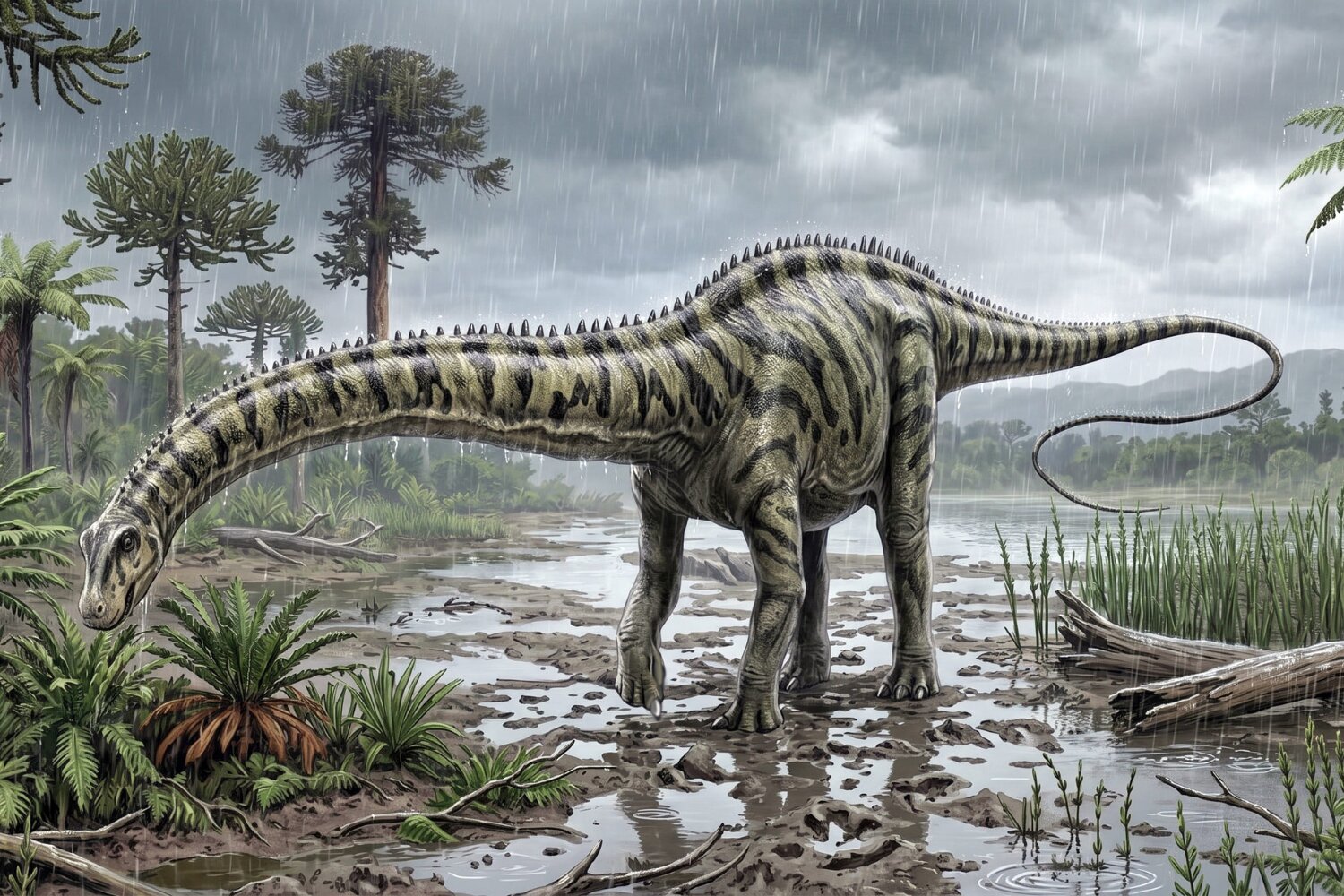
Fourteen tail vertebrae and a collection of forked bones found in northeastern Spain belong to Diplodocus, extending the known range of one of the most recognizable Jurassic dinosaurs beyond North America for the first time. The fossils come from the La Tejería site near El Castellar in Teruel and date to the Late Jurassic, when the region formed part of a coastal and alluvial landscape. Their anatomy and repeated placement in different evolutionary analyses point to Diplodocus, although the researchers leave the specimen unnamed at the species level because the preserved bones do not include enough diagnostic anatomy.
The specimen, designated CT-30, was discovered at La Tejería in 2008, in the municipality of El Castellar in the province of Teruel. The fossil-bearing area covered about 10 square meters. Five tail vertebrae were collected outside the sediment during the initial discovery, followed by nine more vertebrae and several chevrons during excavations in 2014 and 2015. All of the material studied is housed at the Museo Aragonés de Paleontología in Teruel.
The 14 vertebrae represent the 22nd through 35th positions in the tail, based on their features and dimensions and comparison with other diplodocine tails. Five of them retain nearly complete neural arches, the structures that rise from the vertebral bodies. The series was found partly articulated and partly associated.
The fossils came from the upper part of the Villar del Arzobispo Formation, a mixed siliciclastic-carbonate unit. In the El Castellar area, that upper portion was deposited on a coastal and alluvial plain. The formation is assigned to the Kimmeridgian-Tithonian interval of the Late Jurassic based on its geological and paleontological evidence.
That setting is important because Diplodocus had previously been confidently documented only in the Morrison Formation of the United States. The recognized Diplodocus specimens listed by the authors came from Colorado, New Mexico, Utah and Wyoming.
Europe had yielded other diplodocid fossils, but its record was sparse and fragmentary. Before CT-30, the only relatively complete European diplodocid skeleton described was Supersaurus lourinhanensis from the Late Jurassic of Portugal. Other European finds consisted largely of isolated or fragmentary bones.
The tail carries the key anatomical evidence
The CT-30 vertebrae have several features characteristic of diplodocine sauropods. Their vertebral bodies are elongated, with length-to-height ratios ranging from 1.7 to 2.5. They are also wider than tall, and their articular surfaces are generally quadrangular to trapezoidal. The vertebrae become proportionally longer toward the rear of the preserved series.
One vertebra preserves a large pneumatic fossa, a hollowed area in the side of the bone. The vertebrae lack longitudinal ridges along their lateral surfaces. Their lower margins are straight when viewed from the side, while both ends expand downward and a longitudinal groove runs along the underside. That groove is deeper than 1 centimeter in most of the vertebrae and becomes shallower toward the rear.
The more complete vertebrae also preserve several distinctive features. Their neural arches sit over the front halves of the vertebral bodies. The prezygapophyses, projections that helped neighboring vertebrae articulate, extend slightly beyond the front articular surfaces. In several vertebrae, those projections are connected by a transverse bony lamina. The neural spines point strongly backward and extend over the rear articular surfaces.
The chevrons add another part of the anatomical picture. These bones were attached beneath the tail vertebrae. The CT-30 material includes two fused mid-tail chevrons, several pairs of unfused mid- and posterior chevrons, and four fragments. They are V-shaped when viewed from the front and forked in side view. The researchers found that the chevrons become progressively different toward the rear of the tail, with their projections changing in shape and orientation.
The chevrons are also elongated. Their lengths are similar to those of the corresponding vertebral bodies, a condition resembling that seen in Diplodocus carnegii and Diplodocus hallorum. Some of the middle chevrons have distinct depressions on their inner surfaces, another feature previously reported in D. hallorum.
Taken together, the anatomy gave the researchers a recognizable combination of features. The specimen has elongated mid- and posterior tail vertebrae, large pneumatic fossae, no lateral ridges, straight lower margins, deep ventral grooves and long forked chevrons. Some of these characteristics occur in several diplodocids, but others are particularly similar to features documented in Diplodocus.
Several evolutionary analyses converged on Diplodocus
The anatomical comparison was followed by phylogenetic analysis, using the specimen’s morphology to test where it fits within the diplodocids.
The researchers added 23 characters from the CT-30 tail vertebrae and chevrons to an existing character matrix containing 489 characters and 36 taxa. They analyzed the resulting matrix using maximum parsimony under equal weighting and two forms of implied weighting. They also performed a separate Bayesian analysis.
The exact relationships among many diplodocids changed depending on the analytical method. The maximum-parsimony analyses produced different arrangements of several groups, and relationships within Diplodocinae remained variable. That instability means the analysis does not provide a completely fixed evolutionary tree for the broader group.
But one placement remained stable.
In every maximum-parsimony analysis, CT-30 fell inside the Diplodocus clade alongside D. carnegii and D. hallorum. In each case it was recovered as the sister operational taxonomic unit of D. hallorum. The Bayesian analysis produced the same basic result.
The Bayesian analysis recovered 8,986 trees. The researchers report that the runs had apparently reached convergence, with an average standard deviation of split frequencies of 0.0065 and effective sample sizes above 10,447 for all parameters. The resulting majority-rule consensus tree again placed CT-30 within Diplodocus as the sister operational taxonomic unit of D. hallorum.
The Diplodocus clade itself received Bremer support of 4 and a standard bootstrap value of 83 in the relevant maximum-parsimony analysis. The CT-30 plus D. hallorum relationship was also recovered consistently. In the Bayesian analysis, posterior probabilities reached 91% for the Barosaurus plus Diplodocus grouping and 86% for the CT-30 plus D. hallorum grouping.
The researchers also tested an alternative possibility: that CT-30 belonged with the contemporary Iberian diplodocid Supersaurus lourinhanensis. They forced CT-30 into that position and compared the resulting tree with the unconstrained result. The Templeton test produced a statistically significant difference, with p < 0.05, indicating that the constrained arrangement was significantly less parsimonious. The authors therefore conclude that it is highly unlikely that CT-30 belongs to S. lourinhanensis.
That result is especially relevant because the researchers cannot directly compare CT-30 with S. lourinhanensis across the same tail elements. The Portuguese species does not preserve overlapping material that would allow a direct comparison. The authors instead compare CT-30 with the tail vertebrae of S. vivianae and infer that S. lourinhanensis might have shared similar tail characteristics. They explicitly note that this expectation cannot be confirmed until additional S. lourinhanensis material containing middle and posterior tail vertebrae is found.
The researchers stop short of naming a species
Despite the strong placement within Diplodocus, CT-30 is not assigned to D. carnegii, D. hallorum or another named species.
The reason is straightforward. Only the middle and rear portions of the tail are preserved, and the researchers state that the specimen lacks unambiguous autapomorphies, or unique characteristics that would establish a species-level identity. They therefore use the conservative designation Diplodocus sp.
Some of the features are particularly close to D. hallorum. The CT-30 neural arches occupy the front half of the vertebral bodies, and its middle chevrons have fossae on their inner surfaces. Both traits had previously been treated as autapomorphies of D. hallorum. Yet the researchers do not use those similarities alone to assign CT-30 to that species.
The authors also caution that some anatomical characters used in identifying Diplodocus can vary within individuals and among specimens. In particular, they note variation in the shape of vertebral articular facets and say that trapezoidal facets should therefore be treated with caution when used as a diagnostic feature.
The CT-30 specimen is nevertheless comparable in size with several diplodocine specimens from the Morrison Formation. The researchers estimate a body length of about 25 meters.
Spain adds Diplodocus to an already diverse sauropod community
The discovery also changes the picture of sauropod diversity in eastern Iberia during the Late Jurassic.
The Villar del Arzobispo Formation already contains several kinds of sauropods. The authors list early-diverging eusauropods such as Turiasaurus riodevensis and Losillasaurus giganteus, as well as several neosauropods, including the newly described Diplodocus specimen, the macronarian Galveosaurus herrei and indeterminate brachiosaurids. Aragosaurus ischiaticus has also been recovered from the formation, although the authors note that it has been dated as Berriasian rather than Late Jurassic.
The researchers place CT-30 among the most complete diplodocid specimens described from Europe. They note that the Supersaurus lourinhanensis type specimen and CT-30 are the only European diplodocid specimens complete enough to resolve their phylogenetic relationships with what they regard as an adequate degree of accuracy. Earlier diplodocid evidence from the Villar del Arzobispo Formation consisted of isolated material, including a tooth, part of an ilium and part of an anterior tail vertebra.
The new specimen also joins a longer list of similarities between Late Jurassic faunas in North America and Europe. The authors cite other dinosaur genera reported from both regions, including Supersaurus, Ceratosaurus, Allosaurus, Torvosaurus and Stegosaurus, along with likely Camptosaurus. They also note that some non-dinosaur vertebrates, including the choristoderan Cteniogenys and mammal Dryolestes, have been reported from both continents.
The presence of Diplodocus in Spain makes the comparison more direct because CT-30 represents the first evidence of the genus outside North America. The researchers describe it as one of the strongest pieces of evidence supporting faunal exchange between North America and Europe during the Late Jurassic.
The proposed route across the proto-North Atlantic
The fossils themselves establish the occurrence of Diplodocus in eastern Iberia. The broader explanation for how related dinosaur faunas could have been exchanged between North America and Europe comes from the study’s paleobiogeographic interpretation.
The researchers point to geotectonic evidence suggesting a regressive trend in the proto-North Atlantic during the late Kimmeridgian to early Tithonian. They propose that this could have favored episodic emergence of landmasses along a Newfoundland-Iberia corridor, providing opportunities for continental animals to move between North America and Europe.
In this interpretation, the progressive opening of the Atlantic would eventually have promoted geographic isolation. Yet the authors argue that terrestrial faunas on the two sides still showed relatively limited morphological differentiation in some groups during the Kimmeridgian-Tithonian interval. The new Diplodocus occurrence is presented as evidence consistent with that pattern, rather than as a direct reconstruction of an individual animal’s route or journey.
The authors also compare the finding with sauropod trackways. Narrow-gauge tracks assigned to the ichnotaxon Parabrontopodus, which are typically attributed to diplodocids, have been reported from the Morrison Formation and several Upper Jurassic European formations. Some tracks from the Villar del Arzobispo Formation have been attributed to this lineage, while others in the region could also have been produced by diplodocids based on their morphology and the size and position of the hand and foot impressions.
The paper does not treat those tracks as proof that Diplodocus specifically made them. Instead, they provide additional evidence for the presence of diplodocid-type sauropods in the European Late Jurassic record.
For the CT-30 specimen itself, the final taxonomic conclusion remains deliberately conservative. The anatomical comparisons and both major phylogenetic approaches consistently place it within Diplodocus, while the available tail material is insufficient to establish a species. The specimen therefore remains Diplodocus sp. until more diagnostic material becomes available.
The study was published in Journal of Vertebrate Paleontology.