For hundreds of thousands of years, woolly rhinoceroses moved through a changing Eurasian landscape, and their genetic history appears to have been shaped less by the far north than by regions farther south. Ancient DNA from specimens across Eurasia, combined with habitat modeling covering the past 500,000 years, points to temperate Eurasia as an important center of their genetic diversity, with East Asia contributing ancestry to later populations and the Altai region repeatedly providing suitable habitat as climates shifted.
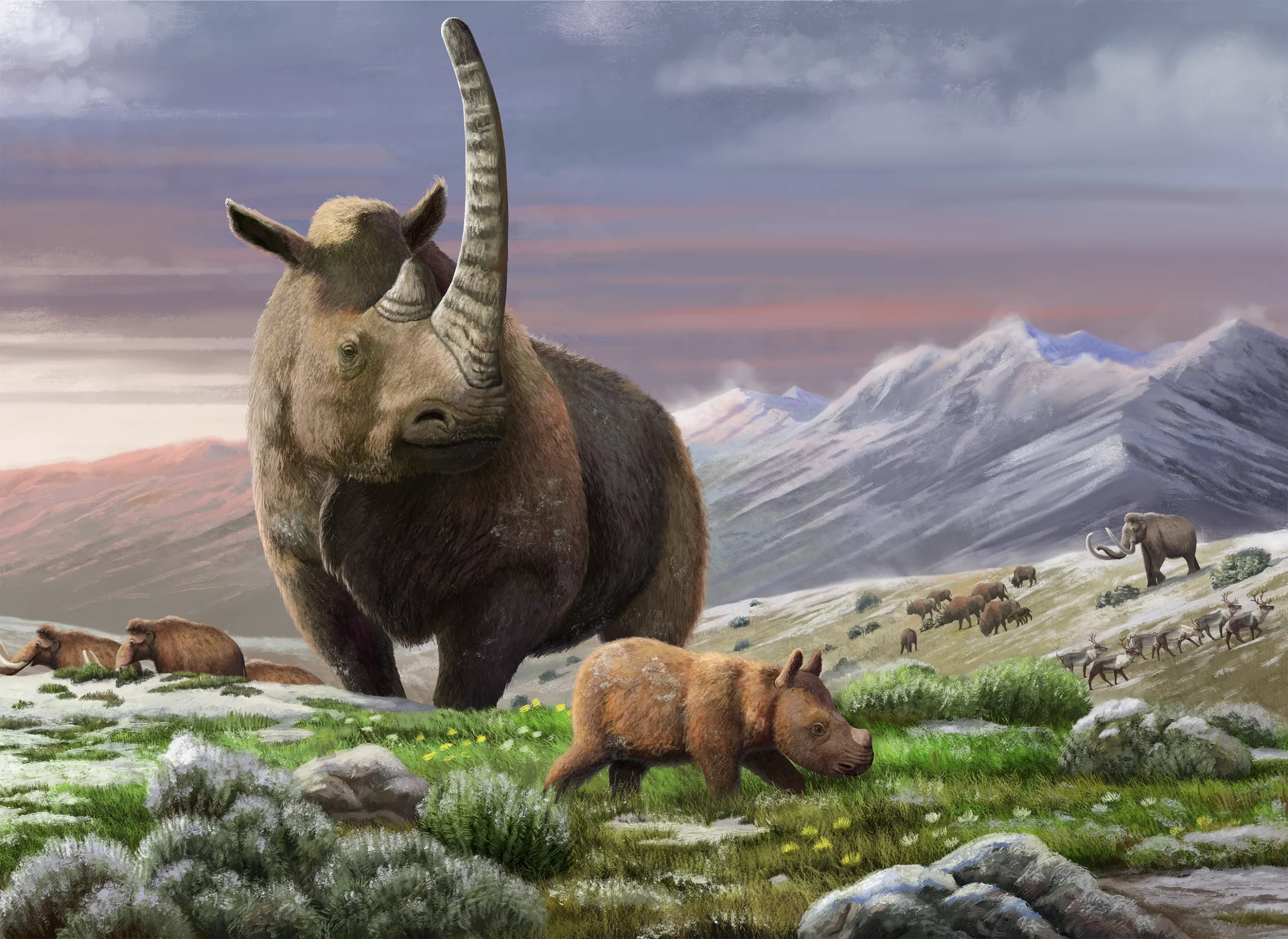
The woolly rhinoceros, Coelodonta antiquitatis, was one of the characteristic large mammals of the Ice Age. It occupied northern Eurasia during the Late Pleistocene, roughly from 130,000 to 11,000 years ago, although fossil and sediment-DNA evidence indicates that some populations may have persisted somewhat later. Its evolutionary history has been difficult to reconstruct because ancient DNA studies have been concentrated heavily in the cold, well-preserved environments of northeastern Siberia. Before this work, only three nuclear genomes were available from the species, all from Late Pleistocene northeastern Siberia, leaving much of its former range, especially mid-latitude Eurasia, genetically underrepresented.
That sampling gap mattered because woolly rhinoceroses did not necessarily follow the same evolutionary path as other cold-adapted Ice Age animals. The lineage is thought to have originated much earlier in or around the Tibetan Plateau and to have developed cold-climate adaptations through a high-altitude evolutionary pathway. The earliest known Coelodonta fossil is about 3.7 million years old and comes from the Tibetan Plateau. The earliest known fossil specifically attributed to the woolly rhinoceros, however, was found in Central Europe and dates to about 450,000 years ago. How the species subsequently spread and established populations across Eurasia remained uncertain.
The new genetic evidence comes from a much broader geographic sampling. The researchers screened 183 woolly rhinoceros fossils from across Eurasia and successfully reconstructed 29 mitochondrial genomes and 14 nuclear genomes from specimens in East Asia, the Altai region and Europe. The mitochondrial sequences had coverage ranging from 8.2× to 468.7×, while the nuclear genomes ranged from 0.5× to 14.1×. The new genomes were analyzed together with previously published woolly rhinoceros genomes and genetic data from two other rhinoceros lineages used for comparison.
The specimens covered several stages of the Pleistocene. One was dated to Marine Isotopic Stage 7, two to MIS 6, 12 to MIS 5, nine to MIS 3 and five to MIS 2. The researchers used direct radiocarbon dating, uranium-series dating, stratigraphic dating and molecular dating. After comparing the different approaches, they concluded that molecular dating provided a relatively reliable temporal reference for specimens lacking finite radiocarbon dates and stratigraphic age constraints, and they judged that the remaining dating uncertainties were unlikely to have a major effect on the subsequent genetic analyses.
The maternal lineages began diversifying about 460,000 years ago
The mitochondrial genomes revealed four major genetic groups, or clades. The common ancestor of all the woolly rhinoceros mitochondrial genomes was estimated to have lived about 464,000 years ago, with a 95% highest posterior density interval of 527,000 to 409,000 years ago. The four clades then diverged between about 464,000 and 417,000 years ago. This period overlaps a prolonged climatic transition from MIS 12 to MIS 11, when the modeled suitable habitat of woolly rhinoceroses became more fragmented and contracted across Eurasia.
The geographic distribution of those mitochondrial clades was not uniform. Two clades were found mainly in East Asia and northeastern Siberia, while the other two occurred mainly in the Altai region and Europe. Genetic differentiation between regions also indicated a close relationship between European and Altai animals. Importantly, all four mitochondrial clades were represented in the Altai region. The researchers interpret this combination of genetic diversity and persistent habitat suitability as evidence that the transition zone between Central and East Asia played an important role in the maternal evolution of the species.
The genetic diversity pattern differed from what might be expected from the species’ association with the Ice Age north. Nucleotide diversity was lowest in the northeastern Siberian population. Across the regions sampled, the researchers found greater genetic diversity in mid-latitude Eurasia than in the high-latitude areas. They argue that this pattern is consistent with the woolly rhinoceros having maintained important populations in warmer, lower-latitude regions and shifting southward during colder periods.
That pattern also contrasts with findings from woolly mammoths, for which high-latitude Siberia has been identified as a major center of genetic diversity. The researchers note that woolly rhinoceroses and woolly mammoths evolved cold adaptations differently and that woolly rhinoceroses occupied more southerly areas of East Asia than most members of the mammoth-rhinoceros complex. The genetic evidence therefore points toward a different population history for the two Ice Age animals.
The mitochondrial population structure itself was not especially strong compared with that of woolly mammoths, despite the rhinoceros generally being less mobile. The researchers discuss several possible explanations, including differences in social behavior between rhinoceroses and elephants and repeated contractions and reexpansions of the rhinoceros’ range. They emphasize that broader geographic and temporal genetic sampling will be needed to test these explanations.
A 170,000-year-old rhinoceros sits near the base of the nuclear history
The nuclear genomes provided a more pronounced picture of population structure than the mitochondrial genomes did. Autosomal phylogeny, multidimensional scaling and outgroup f3 statistics showed clear spatial and temporal clustering, with individuals from similar regions and periods tending to cluster together.
The oldest individual in the new dataset was about 170,000 years old. Known as QGRH004, it came from Qinggang in northeastern China and occupied a basal position in the autosomal phylogeny. It also showed the least genetic affinity to the other individuals analyzed. This deep position led the researchers to identify East Asia as one possible source of ancestry for the later woolly rhinoceros populations.
The seven Late Pleistocene East Asian individuals formed one genetic cluster, while eight individuals from outside East Asia formed another. Within the latter group, an approximately 102,000-year-old specimen from Denisova Cave in the Altai region occupied an ancestral position relative to younger animals from the Altai, eastern Europe and northeastern Siberia. The European and Altai individuals were also closely related genetically, matching the similarity already seen in their mitochondrial haplogroups and their relatively low pairwise FST values.
The resulting picture is not one of a single isolated population expanding steadily outward. Instead, the genetic evidence suggests that the Late Pleistocene Eurasian gene pool included a substantial contribution from East Asia. The researchers estimate that East Asian and non-East Asian populations had diverged by at least about 102,000 years ago, broadly corresponding to MIS 5, while they suggest that non-East Asian genetic diversity probably emerged in the Altai region before spreading toward northeastern Siberia and Europe.
Yet the genetic relationships were more complicated than a simple east-versus-west division. Two northeastern Siberian rhinoceroses showed greater nuclear affinity to western Eurasian individuals than to East Asian ones, while additional statistical tests detected affinity between those northeastern Siberian animals and Late Pleistocene East Asian individuals. Two East European animals dating to the Last Glacial Maximum also showed extra affinity with contemporaneous Altai animals. These patterns prompted further tests for gene flow between populations.
The resulting f4-statistics and admixture-graph analyses indicated additional genetic contributions among several lineages. The approximately 170,000-year-old East Asian lineage retained closer affinity to the local Late Pleistocene East Asian population than to populations from the Altai, eastern Europe or northeastern Siberia. The admixture graphs likewise indicated that both Altai and East European populations received gene flow from so-called ghost lineages that were ancestral to the split between the older East Asian lineage and later Late Pleistocene lineages.
The genetic exchanges appear to have intensified during the Last Glacial Maximum. Statistical tests and admixture modeling indicated increased genetic exchange across Eurasia, including gene flow from a high-latitude northeastern Siberian population into mid-latitude regions. The researchers propose that this pattern may be explained by habitat expanding in the mid-latitudes while contracting at higher latitudes, creating greater east-west connectivity as the climate cooled toward the Last Glacial Maximum.
The Altai remained habitable while other regions changed
To place those genetic patterns in an environmental context, the researchers modeled woolly rhinoceros habitat suitability over the previous 500,000 years. The model used 1,153 fossil occurrences and four climatic variables: annual mean temperature, minimum temperature, precipitation and net primary productivity. Climate and biome simulations provided those variables at 1,000-year intervals and a spatial resolution of 0.5 degrees. The approach allowed the researchers to track changes in suitable habitat, including its total area and fragmentation, through repeated glacial and interglacial cycles.
The model indicates that suitable habitat was widely distributed across mid-latitude Eurasia during the Penultimate Glacial Period, from about 191,000 to 130,000 years ago. As the Eemian interglacial began, between about 130,000 and 126,000 years ago, suitable habitat disappeared from large parts of East Asia and Europe. At the same time, substantial suitable habitat remained across central Eurasia, including the area stretching from the Ural region toward the Altai.
Genetic demographic analyses provided another indication of this environmental shift. Pairwise sequentially Markovian coalescent analyses showed substantial declines in effective population size in East Asia, northeastern Siberia and eastern Europe. The researchers interpret these declines as supporting a sizable effect of the Eemian interglacial on woolly rhinoceros populations. The mitochondrial Bayesian skyline analysis, however, showed a less pronounced decline, which could indicate a weaker effect on maternal genetic diversity or simply reflect limited resolution in that dataset.
The Altai stands out in the habitat reconstruction because it remained suitable for woolly rhinoceroses throughout at least the past 160,000 years. The researchers therefore propose that the region functioned as a climatic refugium, a place where populations could persist while conditions became less favorable elsewhere. The approximately 102,000-year-old Altai individual also appears to have contributed substantially to the major Eurasian gene pool after the Eemian interglacial. The researchers suggest that populations may subsequently have expanded from the Altai as east-west habitat connectivity increased during later cooling.
The modeling also identifies another possible refuge in the Russian Far East. Parts of the region remained suitable during the Eemian, potentially allowing a local population to persist relatively separately from populations farther west. The researchers suggest that such persistence could help explain the deep genetic divergence between East Asian and non-East Asian Late Pleistocene populations.
At the same time, increasing habitat suitability in high-latitude Siberia during this period may have created a route along the Okhotsk coast. The authors propose that this could have allowed woolly rhinoceroses to move from East Asia into northeastern Siberia and could help explain the East Asian ancestry detected in the northeastern Siberian population. This remains a proposed explanation rather than a directly observed migration route.
Europe experienced an especially severe environmental contraction. Habitat suitability there fell sharply at the Eemian onset and did not recover until about 70,000 years ago. The researchers suggest that this may account for the relatively low nuclear genetic diversity in the East European animals. Yet those animals retained relatively high mitochondrial diversity, and their nuclear genomes contained genetic contributions from an early-derived ghost lineage.
The authors therefore propose that some Middle Pleistocene European woolly rhinoceroses may also have survived in a refuge during MIS 5, perhaps near the Ural Mountains, where the habitat model indicates more favorable conditions. Such a population could have contributed to the later return of woolly rhinoceroses into eastern Europe. The idea remains difficult to test because older European genomes are scarce.
Woolly rhinoceroses also exchanged genes with another rhinoceros
The genetic history contains evidence of interaction not only among woolly rhinoceros populations but also between species. Merck’s rhinoceros was the closest surviving relative of the woolly rhinoceros during the Late Pleistocene and overlapped with it geographically and temporally. Because the two lineages are genetically close, however, distinguishing ancient gene flow between them has been difficult.
Using f4-statistics, the researchers detected the strongest shared genetic affinity with Merck’s rhinoceros in woolly rhinoceroses from northeastern Siberia. Because the Merck’s rhinoceros specimen used in the analysis also came from Late Pleistocene northeastern Siberia, the authors suggest that the genetic interaction occurred locally between the two species no later than MIS 3.
Late Pleistocene East Asian woolly rhinoceroses also showed extra affinity to Merck’s rhinoceros. Because Merck’s rhinoceros had a broad distribution that included East Asia, the authors suggest that these signals may have resulted from separate gene-flow events involving local Merck’s rhinoceroses. Individual-level analyses indicated increasing affinity to Merck’s rhinoceros from MIS 5 through MIS 3, leading the researchers to propose that introgression probably began between MIS 6 and MIS 5 and continued at least until MIS 3.
Another signal appeared in East European woolly rhinoceroses from the Last Glacial Maximum. Introgression was detected in the LGM East European individuals but not in an MIS 3 individual from the same region, suggesting a gene-flow event between MIS 3 and MIS 2. But there is a problem with interpreting this as direct interbreeding with Merck’s rhinoceros in Europe. The species is generally thought to have disappeared from Europe after the Last Interglacial, around 115,000 years ago.
The researchers therefore offer another possible explanation. The signal could have come from northeastern Siberian woolly rhinoceroses as populations moved from higher-latitude areas into lower-latitude regions during climatic cooling. The paper does not resolve these competing explanations.
The genetic evidence points south, but older genomes are still missing
Taken together, the genomic and habitat evidence supports a picture in which the woolly rhinoceros’ genetic history was strongly connected to temperate and mid-latitude Eurasia. East Asia appears to have been one source of ancestry for Late Pleistocene populations, while the Altai region may have acted first as a reservoir of genetic ancestry and later as a dispersal hub connecting western and northern Eurasia. The persistence of suitable habitat there through changing climatic conditions supports that interpretation.
The genetic diversity measurements reinforce the pattern. An East Asian individual had fewer runs of homozygosity, and East Asian and Altai individuals had significantly higher genomic heterozygosity than East European and northeastern Siberian individuals. These results provide additional evidence that East Asia and the Altai were important sources of genetic diversity in the species.
The habitat model itself was tested for robustness using repeated site-level leave-out validation and additional sensitivity analyses, and the main habitat-dynamics patterns remained robust under those tests. But the researchers also point to important gaps in the genetic record. In particular, the lack of older European genomes prevents a fuller test of whether East and West Eurasian populations had already diverged deeply during the Middle Pleistocene.
The study therefore leaves several parts of the species’ early history unresolved. More genetic data from Middle and early Late Pleistocene woolly rhinoceroses in Europe would be needed to reconstruct European population dynamics, examine the early divergence between eastern and western Eurasian populations and further resolve the species’ origin.
For now, the available evidence distinguishes the woolly rhinoceros from another iconic Ice Age giant. Rather than concentrating most of its genetic diversity in high-latitude northeastern Siberia, the species appears to have maintained substantial diversity farther south. The habitat reconstruction likewise indicates that southern central Siberia offered more favorable conditions than northeastern Siberia across glacial-interglacial cycles during at least the past 160,000 years, even though northeastern Siberia remained suitable during some of the warmest periods.
The authors conclude that the concentration of ancient-DNA discoveries in northern Eurasia can leave an incomplete picture of extinct species. Their results indicate that substantial genetic diversity can originate and persist at lower latitudes even in a species adapted to cold conditions. For the woolly rhinoceros, the genetic record recovered so far places temperate Eurasia, particularly East Asia and the Altai region, at the center of a complex history of persistence, divergence, movement and gene flow across repeated climatic changes.
The study was published in Science.