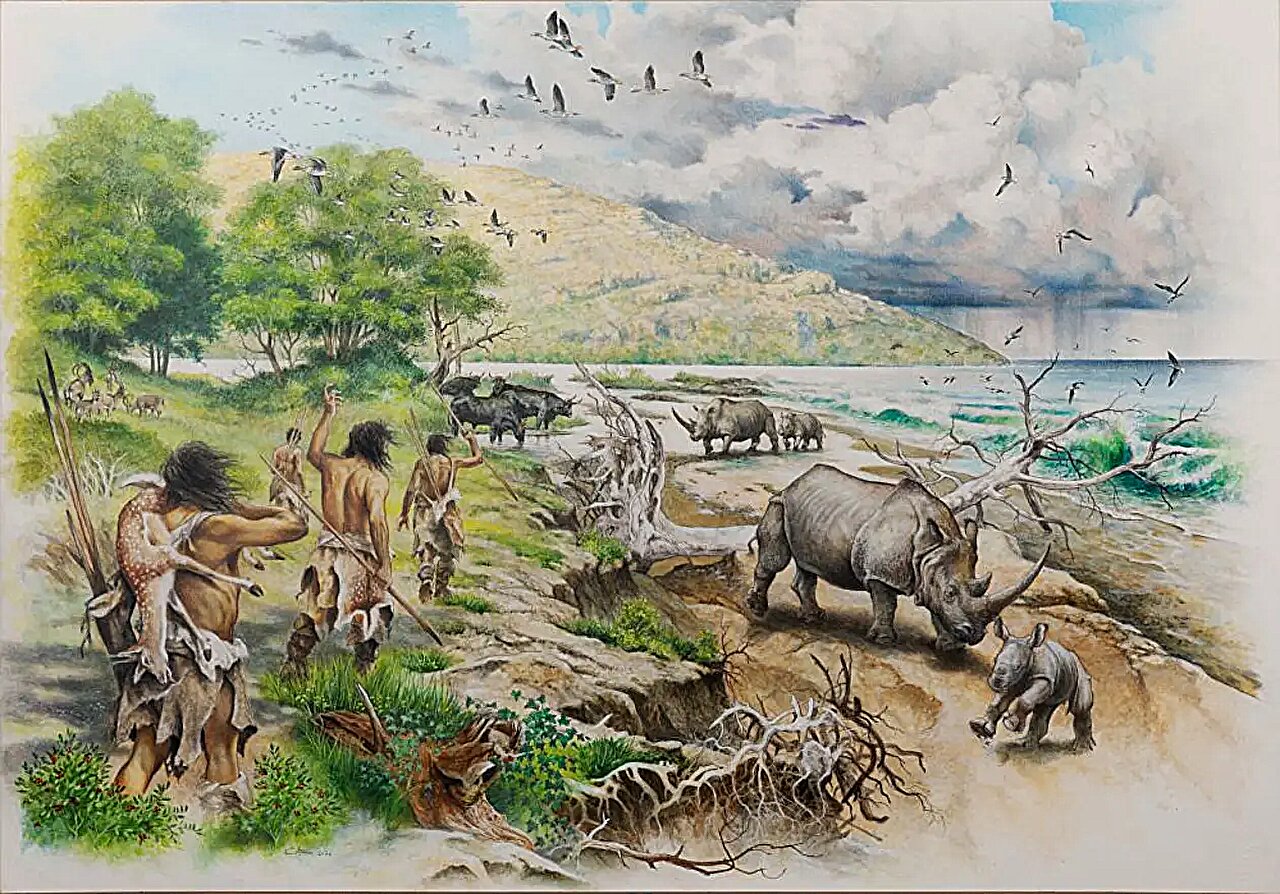
Long after the animals disappeared, their teeth and bones preserved clues to a coastal landscape where woodland vegetation supported aurochs, deer, wild goats and rhinoceroses, while prehistoric hominins repeatedly hunted different parts of that landscape. By dating old faunal collections from three Lebanese sites and combining the ages with evidence from animal bones, dental wear and landscape modeling, researchers reconstructed a central Levantine environment that remained wooded across a much longer stretch of the Pleistocene than the archaeological record had previously allowed them to see.
The evidence comes from three Paleolithic coastal sites in Lebanon: Naame, Nahr Ibrahim and Ras el-Kelb. The animal remains had been collected during earlier archaeological work and were later curated at the Museum of Lebanese Prehistory at Saint Joseph University of Beirut.
The collections were important but difficult to interpret. Nahr Ibrahim and Ras el-Kelb had been collected in the late 19th century without the detailed stratigraphic records expected in modern excavations. Naame was excavated in 1967, but much of its original context had also been altered or destroyed. The researchers therefore treated the collections as time-averaged records rather than trying to reconstruct individual hunting episodes from them.
To establish an independent chronology, the researchers selected five fossil teeth for combined uranium-series and electron spin resonance dating. Three came from Naame and one each from Nahr Ibrahim and Ras el-Kelb. The teeth retained sediment, allowing the researchers to evaluate the environmental radiation dose needed for the dating calculations.
The Ras el-Kelb tooth produced a combined age of 402 ± 46 thousand years, while the Nahr Ibrahim tooth produced an age of 245 ± 23 thousand years. Sensitivity tests placed the Nahr Ibrahim sample between about 200,000 and 300,000 years old and the Ras el-Kelb sample between about 350,000 and 500,000 years old despite uncertainties involving sediment conditions, water content and long-term depth.
The Naame material proved more complicated. One tooth from the site’s upper deposit produced a finite age of 107 ± 13 thousand years, while another from the same deposit was much younger, at 17.6 ± 2.7 thousand years. Sensitivity tests consistently placed the younger tooth within the last glacial period, suggesting that the upper deposit contains at least some material substantially younger than the Middle Paleolithic material. A third Naame tooth from the lower breccia produced results consistent with a broad Marine Isotope Stage 5 age, although its combined dating results were considered methodologically questionable at around 100,000 years.
These dates established that the three collections were not simply different samples of the same period. Ras el-Kelb represents roughly 400,000 years ago, Nahr Ibrahim roughly 245,000 years ago, and the principal Naame assemblage falls within MIS 5, broadly around the period represented by the 107 ± 13 thousand-year date. The researchers therefore gained chronological control over a Lebanese faunal record spanning roughly 400,000 to 100,000 years ago.
The bones record repeated human involvement
Across the three collections, the researchers examined 721 animal remains. Naame accounted for 559, Nahr Ibrahim for 63 and Ras el-Kelb for 99. Of the total, 203 specimens could be identified to taxon and another 16 to size class. The identified remains represented a minimum of 54 individuals, including 51 ungulates belonging to nine species, along with one rodent, one reptile and one fish.
The animals included some exceptionally large prey. Aurochs, red deer and the rhinoceros Stephanorhinus hemitoechus were prominent, alongside Persian fallow deer and wild goat. Aurochs, fallow deer and wild goat were the only taxa found at all three sites.
The researchers first had to establish whether the animals had accumulated because of human activity, natural deaths or carnivore activity. That question was particularly important because the collections had passed through complicated post-depositional histories. Some bones had been embedded in hard breccia and later extracted using mechanical and chemical treatments, processes that could increase fragmentation and favor the survival or recovery of larger, more complete pieces.
At Naame, 5.5% of the total remains carried cut marks. The researchers also identified modifications consistent with marrow extraction, including a longitudinally split fallow deer phalanx and an impact notch on another fallow deer bone. One large-herbivore fragment had a deliberately modified edge and was interpreted as an expedient bone tool. Burned remains were also present.
Nahr Ibrahim produced a butchery-related cut mark on an aurochs bone and fresh fractures on another aurochs metapodial. At Ras el-Kelb, no cut marks were identified, but two specimens had fresh fractures and 11% of the remains showed early thermal alteration. Carnivore tooth and digestion marks were absent from both Nahr Ibrahim and Ras el-Kelb.
At Naame, just three specimens, or 0.5%, carried carnivore marks. One of those had a carnivore mark overlying an anthropogenic cut mark, meaning the bone had already been accessed by humans before a carnivore acted on it. Taken together, the evidence led the researchers to conclude that large carnivores played only a minor role in accumulating the collections. Humans were the primary agents behind the Naame assemblage and were at least partly responsible for the other two.
The evidence does not mean every bone came from a human kill. The researchers explicitly note that the collections were filtered by human accumulation, natural and post-depositional processes, recovery and later curation. Rare species are probably underrepresented, while the very small Naame PIII2 assemblage, with a minimum of only three individuals, provides particularly limited information for some diversity measures.
Large adult animals dominate the hunting record
The age profiles provide another clue to how the animals were acquired. Prime-age adults made up 82% of the Naame assemblage, 70% of Nahr Ibrahim and 100% of Ras el-Kelb. Older animals and juveniles were much less common. At Naame, prime-age aurochs and fallow deer consistently dominated, while the few juveniles belonged to smaller ungulates such as wild goat and roe deer.
The researchers also estimated the amount of edible biomass represented by different species. Aurochs alone contributed an estimated 1,200 kilograms of biomass at both Naame and Nahr Ibrahim and 800 kilograms at Ras el-Kelb. At Naame, fallow deer contributed about 460 kilograms and red deer 375 kilograms. At Nahr Ibrahim, fallow deer contributed 174 kilograms and wild goat 146 kilograms. At Ras el-Kelb, horse and red deer each contributed about 150 kilograms, while wild goat contributed 43 kilograms.
The analysis of observed and expected biomass also pointed toward repeated emphasis on large-bodied animals, particularly aurochs. The researchers compared the archaeological representation of species with expectations based on the relationship between body size and population density. Aurochs generally appeared above the expected biomass relationship, while many medium-sized animals fell below it. The authors caution, however, that this analysis does not account for search time, handling time or the return rates associated with different prey.
At Naame, this pattern led the researchers to interpret aurochs and rhinoceroses as selectively acquired despite their greater danger, probably because of their greater meat returns. Fallow deer were numerous but their contribution to overall meat return was smaller. Wild goats also appear to have been actively selected, despite their lower meat yield. The authors suggest that their proximity in steep or mountainous terrain could have made them readily available, while also noting that they may have been selected for reasons other than food.
The animals’ teeth point to a wooded landscape
The strongest environmental signal came from the animals themselves.
The researchers examined mesowear, the longer-term wear pattern on teeth, and microwear, the much shorter-term pattern of scratches, pits and other microscopic features left by recent feeding. Mesowear analysis was restricted to well-preserved teeth from prime-aged adults to reduce the influence of age on the results.
Across Naame, Nahr Ibrahim and Ras el-Kelb, the ungulates generally fell into the browser or mixed-feeder categories rather than showing the stronger grazing signal expected from animals feeding predominantly on abrasive grasses. The combined average mesowear scores were 1.05 at Naame, 1.50 at Nahr Ibrahim and 1.57 at Ras el-Kelb. Differences among the Lebanese sites were not statistically significant, with pairwise adjusted values above 0.05.
The statistical test comparing mesowear patterns among the Lebanese sites produced χ² = 2.16, df = 2, p = 0.339. The study did not detect a significant difference in the overall mesowear pattern across the three collections despite their substantial chronological separation.
The pattern differed from some southern Levantine sites. At Nesher Ramla, the combined average mesowear score was 2.62, while Amud Cave had 1.97. The researchers associate these higher values with greater grazing and more open habitats. By contrast, Qesem Cave showed consistently lower values across parts of its sequence, with scores of 1.67, 1.77 and 1.76, supporting an interpretation of open woodland there. The Lebanese values were statistically indistinguishable from the broadly contemporaneous Qesem values in the comparisons reported by the authors.
The authors therefore interpret the Lebanese dental evidence as a coherent signal of Mediterranean woodland persisting along the central Levantine coast from roughly 400,000 to 100,000 years ago. The small differences between sites may indicate local or temporal differences in vegetation. At Naame, for example, red deer, aurochs and fallow deer showed relatively low abrasive wear, which the researchers suggest could reflect more abundant leafy vegetation and possibly denser tree cover.
The environmental reconstruction is also consistent with pollen evidence discussed in the study. Those records indicate a mixture of trees and shrubs, including fir, wingnut, birch, hazel, elm, lime, hop hornbeam, hornbeam and ivy, alongside grasses and other plants. The researchers describe the resulting environment as a mosaic containing woodland, understory browse and seasonally productive clearings.
Short-term tooth wear captures seasonal changes
Microwear added a different kind of information because it records what an animal was eating relatively shortly before death.
Almost all of the analyzed specimens had microwear patterns associated with browsing rather than grazing. The exceptions were the Naame rhinoceros and hippopotamus, whose scratch counts of 17 and 21, respectively, were consistent with mixed feeding. Aurochs from Naame had only five scratches, while wild goat from Nahr Ibrahim had four. Cervids showed microwear patterns typical of browsing ungulates.
Two fallow deer from Nahr Ibrahim had enamel-prism “plucking,” a feature associated with strong browsing. Other specimens showed relatively high numbers of pits, which the researchers interpret as possible evidence of ingesting dust or grit with low-growing vegetation. Large pits occurred on 59.1% of the analyzed specimens. Gouges and other features were also present in fallow deer, porcupine, hippopotamus and rhinoceros from Naame, while a rhinoceros from Ras el-Kelb showed gouges, large pits and a small number of very coarse scratches. The authors associate these patterns with occasional feeding on bark, twigs or small branches.
The combination of the two dental-wear methods is important. Mesowear suggests that aurochs, wild goats and rhinoceroses had a more abrasive, mixed-feeding diet over the longer term, while their microwear indicates that they may have shifted toward more intensive browsing shortly before death. The researchers interpret this as a possible seasonal dietary change rather than a contradiction between the two methods.
The authors link these feeding changes to the dry season. They propose that, when herbaceous vegetation became limited, some ungulates may have relied more heavily on leaves, twigs and other fibrous resources. On that interpretation, at least some of the animals represented in the collections may have died toward the end of the dry season, which the paper places broadly in September through December.
The timing of hunting varied by site
The researchers then used variation in microwear scratches to estimate whether animals accumulated over a short period or over multiple seasons. This analysis was based on coefficient of variation and standard deviation in scratch frequencies, with 500 bootstrap iterations used because the samples were small.
For the site-level analysis, Naame contained five usable specimens and fell near the boundary of the uncertainty zone associated with longer-term accumulation. Nahr Ibrahim, with six specimens, fell clearly within the zone interpreted as multi-seasonal or year-round exploitation. Ras el-Kelb, with nine specimens, fell in the zone associated with shorter-duration accumulation, although it was close to the uncertainty margin.
Looking at individual prey groups produced more specific patterns. Fallow deer at Naame, based on two specimens, and at Nahr Ibrahim, based on four, showed low variability consistent with short-duration, potentially single-season mortality events. At Ras el-Kelb, two aurochs also showed very low variability, while five rhinoceroses fell in the same general zone but close to the uncertainty threshold.
The researchers stress that these conclusions are preliminary because the samples are small. Even so, they interpret the combined evidence as suggesting that Naame and Nahr Ibrahim were visited or occupied across the year, while particular prey, including fallow deer, were hunted during more restricted periods. At Ras el-Kelb, the pattern among aurochs and rhinoceroses suggests that the nearby estuary may have functioned as a specialized hunting area at particular times of year.
This produces a more detailed picture than simply saying that people lived in a woodland. The authors propose that hominins repeatedly adjusted their hunting to seasonal changes in prey behavior and vegetation, using particular habitats at particular times. They identify the seasonal hunting evidence from Nahr Ibrahim and Ras el-Kelb as the earliest zooarchaeological evidence they know of for such behavior in Lebanon.
Coast, mountains and estuary were within reach
The physical structure of the Lebanese coast helps explain why several different prey communities could be exploited from sites only a short distance apart.
All three sites lie on a narrow coastal plain that rises rapidly toward the interior. The researchers modeled potential catchment areas using digital elevation data, travel-time surfaces and walking-speed estimates adjusted for both Neanderthals and Homo sapiens. They divided terrain at a 30% slope threshold to distinguish flatter areas from steeper, mountainous terrain.
The models produced broadly similar results for the two hominin groups. Within the modeled walking periods, Homo sapiens had access to somewhat larger areas than Neanderthals, but the proportions of flat and steep terrain were similar enough that the researchers considered either model appropriate for their sites. Depending on site and travel time, the modeled Homo sapiens catchments were approximately 6.5% to 10.1% larger than the Neanderthal catchments.
At Nahr Ibrahim, 17% of the terrain within the 1.2-hour walking radius exceeded the 30% slope threshold. Wild goats, which are associated with steeper terrain, made up 30.8% of the minimum number of individuals there. The authors suggest that the rapid transition from coastal lowlands to mountains would have allowed people to move between these ecological zones without traveling far from the site.
Ras el-Kelb provides a different example. Its estuarine setting is associated with a strong representation of rhinoceros, leading the researchers to suggest that hominins may have moved between distinct habitats to exploit prey concentrated in particular places. At Naame, meanwhile, the evidence points toward a broader mixture of woodland prey, including both large game and animals associated with steep terrain.
Importantly, the study cannot determine which hominin species accumulated the animals. The catchment modeling compares hypothetical Neanderthal and Homo sapiens mobility, but the faunal assemblages themselves do not identify their makers. The authors therefore present the models as broadly consistent with previous ideas about how terrain could structure hominin land use, rather than as evidence assigning these particular assemblages to one hominin species.
The central Levant was not environmentally uniform
The Lebanese record becomes especially notable when compared with sites farther south.
The study describes a contrast between the central Levantine coast, where woodland signals persisted through the studied Middle and Late Pleistocene sequence, and parts of the southern Levant, where dental-wear patterns point toward more open environments during the Late Pleistocene. At Nesher Ramla and Amud Cave, the more abrasive diets are interpreted as evidence of greater grazing and more open vegetation.
Gazelle distribution provides another line of comparison within the paper. Gazelles are abundant in several southern coastal Levantine Late Pleistocene assemblages but are absent from the Lebanese collections examined here and occur only sparsely in other central and northern coastal collections discussed by the authors. The researchers associate this contrast with the difference between open, dry habitats farther south and the woodland-shrubland mosaic of the central and northern coast.
The paper also places this coastal pattern alongside faunal evidence from interior Syria. Sites such as Umm el Tlel and the El Kowm/Hummal complex are described as having assemblages dominated by equids, camelids and gazelles, consistent with open, arid or semi-arid steppe environments centered on springs and wadi bottoms. Wadi Mushkuna likewise has an equid-dominated fauna interpreted as reflecting hunting around water points. These comparisons reinforce the authors’ view that the Levant contained several distinct ecological zones rather than one uniform environment.
The Lebanese findings therefore do not describe a single unchanging landscape. Instead, the study identifies a persistent woodland signal along the central coast while recognizing ecological differences between sites and between regions. The authors interpret the central Levantine coastal strip as having retained woodland conditions while some southern areas became more open during the Late Pleistocene.
The old collections still leave important uncertainties
The researchers emphasize that these conclusions depend on collections with imperfect archaeological histories.
Ras el-Kelb and Nahr Ibrahim were collected before systematic recovery methods were established, so the original collectors’ selection and curation procedures cannot be reconstructed in detail. The fact that rhinoceros and hippopotamus are represented only by teeth at those sites suggests that large, conspicuous specimens may have been preferentially collected. At the same time, the relatively high representation of rhinoceros at Ras el-Kelb has also been documented independently in earlier work, suggesting that its abundance there was not simply created by collection bias.
Naame provides a somewhat stronger recovery record. Although the material was also affected by breccia extraction, researchers recovered very small fragments, low-density bones, teeth and even fish remains. They therefore consider recovery bias toward large, dense specimens less likely to be the main explanation for its taxonomic pattern.
The dating also carries uncertainties. The researchers explicitly considered possible spatial differences in sedimentary dose rates, long-term depth and water content and performed sensitivity tests to assess their effects. Those tests supported Middle Pleistocene ages for the Nahr Ibrahim and Ras el-Kelb samples, but the Naame upper deposit contained teeth of dramatically different ages, demonstrating that at least part of that collection is chronologically mixed.
The microwear-based seasonality results are similarly limited by sample size. Only 22 of the 46 initially selected specimens were sufficiently well preserved for microwear analysis. The authors reduced the sample in this way to avoid specimens affected by taphonomic damage. They consequently describe the seasonality interpretations as preliminary until larger samples become available.
Within those limits, the combined evidence points toward a central Lebanese coastal landscape in which woodland vegetation, diverse ungulate communities and varied terrain remained available over a long portion of the Pleistocene. The hominin groups responsible for the accumulations appear to have used different parts of that landscape and, in some cases, returned to particular prey and hunting grounds during specific seasons. The study does not determine which hominin species carried out those activities, leaving that part of the story unresolved.
The study was published in Communications Earth & Environment.