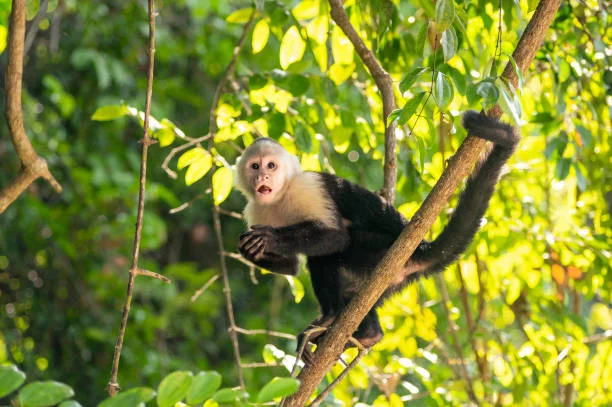
Imagine this: two adult macaques, sitting before a touch sensor, tapping their hands to the beat of music. Not just any tap, but a rhythmic, synchronized movement that mirrors the tempo of the song. At first glance, you might think of a dance floor filled with humans grooving to their favorite tunes. But in this case, it’s two primates, challenging long-held assumptions about the nature of rhythm, music, and animal behavior.
This unusual spectacle isn’t the stuff of science fiction; it’s real, and it’s happening in a lab. The macaques in question aren’t born with the ability to keep time with music. They were trained by researchers to tap in sync with a metronome first, and then, they moved on to real, complex music. What makes this so intriguing? Well, according to conventional wisdom, only species with advanced vocal learning abilities—like humans or songbirds—can spontaneously move to the beat. But this new experiment with macaques turns that idea upside down.
A Simple Question with Profound Implications
The experiment begins with a simple question: Can macaques, who are not known for their vocal learning abilities, synchronize their movements to music? This query takes us into the heart of a debate in animal cognition: the vocal-learning hypothesis. For years, scientists believed that only those species capable of complex vocal learning—those who can mimic sounds like humans or birds—could process music in such a way that they would be able to keep time with it. Humans, after all, can dance to music effortlessly, while birds can sing and mimic tunes, but macaques don’t have the same vocal flexibility.
Yet, what if we’re wrong about that? What if the ability to tap along to music has less to do with vocal mimicry and more to do with general rhythmic processing? This was the central question the researchers set out to explore.
The Tapping Begins
To test this hypothesis, the researchers started with something relatively simple: the macaques had already been trained to tap to the rhythm of a metronome. The metronome is a mechanical device that produces a steady, regular beat, allowing the monkeys to practice syncing their taps to it. But this was only the beginning.
Once they mastered this basic task, the experiment shifted. The researchers played real music, complete with melodies and intricate beats. The goal wasn’t just for the macaques to tap to the rhythm but to sync their movements with the complexity of real songs. Music, after all, isn’t as simple as a regular click. It’s layered and nuanced, with beats embedded in melodies, harmonies, and tempo changes. Could macaques keep up?
The Music Test
The monkeys began the first round of their musical challenge, tapping in response to three distinct pieces of music. But this wasn’t just about hearing the beat; the researchers made sure to test the macaques’ ability to adapt. When the tempo of the music was shifted by half a beat, the macaques adjusted their tapping accordingly, keeping in sync with the new rhythm. This was a crucial moment—one that clearly demonstrated their ability to follow the beat, even when it wasn’t a simple metronome sound. The macaques weren’t just responding to a predictable click; they were engaging with the music, listening and adapting to its structure.
The experiment’s success didn’t stop there. The music was about to get more complex.
The Rhythm Falls Apart
In the second phase of the experiment, the researchers decided to make the task more difficult. They took the music and scrambled it—cutting it into fragments and rearranging the order. This destroyed the original rhythmic structure of the songs. The idea was to test whether the macaques could still sync their taps to the rhythm, even when the music lost its predictable, steady beat.
What did the macaques do? They tapped along only when they could hear a discernible beat. If the music became too fragmented or lacked a clear rhythm, the macaques simply stopped synchronizing. They weren’t tapping randomly—they were paying attention to the presence of a beat, and if it wasn’t there, they chose not to follow.
The Final Challenge
In the third and final phase of the experiment, the researchers gave the macaques an even freer task. They played “Everybody” by the Backstreet Boys at three different speeds, and the macaques were rewarded simply for maintaining any steady rhythm. But the monkeys didn’t just pick any rhythm—they kept time with the song’s true tempo, even when they could have chosen their own rhythm.
This final phase was key: it demonstrated that the macaques weren’t just tapping out random beats. They were responding to the true musical structure of the song, showing a level of rhythmic perception and synchronization far beyond what anyone expected from a non-vocal-learning species.
A New Hypothesis for Rhythm Perception
So, how did these macaques manage to keep up with music? The study authors proposed a bold new explanation. They introduced what they called the “4Cs hypothesis,” which suggests that the ability to perceive and synchronize to musical beats doesn’t rely on vocal learning. Instead, it arises from the interplay of four general abilities: auditory detection (hearing the beat), prediction (anticipating the next beat), auditory-motor feedback (responding with movements), and coordination of these processes through reward-based reinforcement.
In other words, rhythm perception and synchronization could be a more general skill, not tied exclusively to those species with complex vocal abilities. This finding challenges long-standing assumptions about the origins of musicality and opens the door to a broader understanding of rhythm, one that could apply across a variety of species, including humans.
Why This Matters
What makes this research so important is that it forces us to reconsider what we thought we knew about the origins of music and rhythm. The idea that non-vocal learners like macaques can perceive and respond to music in this way expands our understanding of animal cognition. It suggests that the ability to sync to a beat might not be as exclusive to humans or songbirds as we once believed.
This has implications not only for how we view the cognitive abilities of non-human primates but also for how we think about the evolution of musicality. If rhythm is a more general ability, what does this mean for the evolutionary origins of music in humans? Could our innate sense of rhythm have evolved from shared traits with other species, rather than being solely tied to our complex vocal abilities?
These questions are still unfolding, but one thing is clear: the macaques have given us a glimpse into a fascinating new world of animal cognition, challenging us to rethink the relationship between music, rhythm, and intelligence.
More information: Vani G. Rajendran et al, Monkeys have rhythm, Science (2025). DOI: 10.1126/science.adp5220
Asif A. Ghazanfar et al, Groove to the music, Science (2025). DOI: 10.1126/science.aec8640