Deep in the heart of the constellation Scorpius, approximately 3,400 light years from Earth, a cosmic drama is unfolding. A dying star, once similar to our own sun, has shed its outer layers, exhaling vast shells of gas and dust into the vacuum. This skeletal remains of a star has created NGC 6302, a structure so elegantly symmetrical it is commonly known as the Butterfly Nebula. While it appears as a delicate celestial insect pinned against the velvet black of space, this nebula is actually a chaotic, high-energy laboratory. For decades, astronomers have viewed it as a place of fire and radiation, but new data from the James Webb Space Telescope (JWST) has revealed a shivering secret hidden within its wings: the first discovery of dry ice in a planetary nebula.
A Grave of Dust and Light
To understand why this discovery is so startling, one must look at the violent nature of a planetary nebula. These objects are the final gasps of stars transitioning from the main sequence phase to their ultimate fate as white dwarfs. As the star evolves into a red giant, it ejects its atmosphere, creating expanding clouds that are bombarded by intense ultraviolet irradiation. Most scientists assumed that such a harsh environment—blasted by the raw energy of a dying stellar core—would be far too hostile for fragile molecules to survive. The heat and light should, in theory, scour the neighborhood clean of anything as delicate as ice.
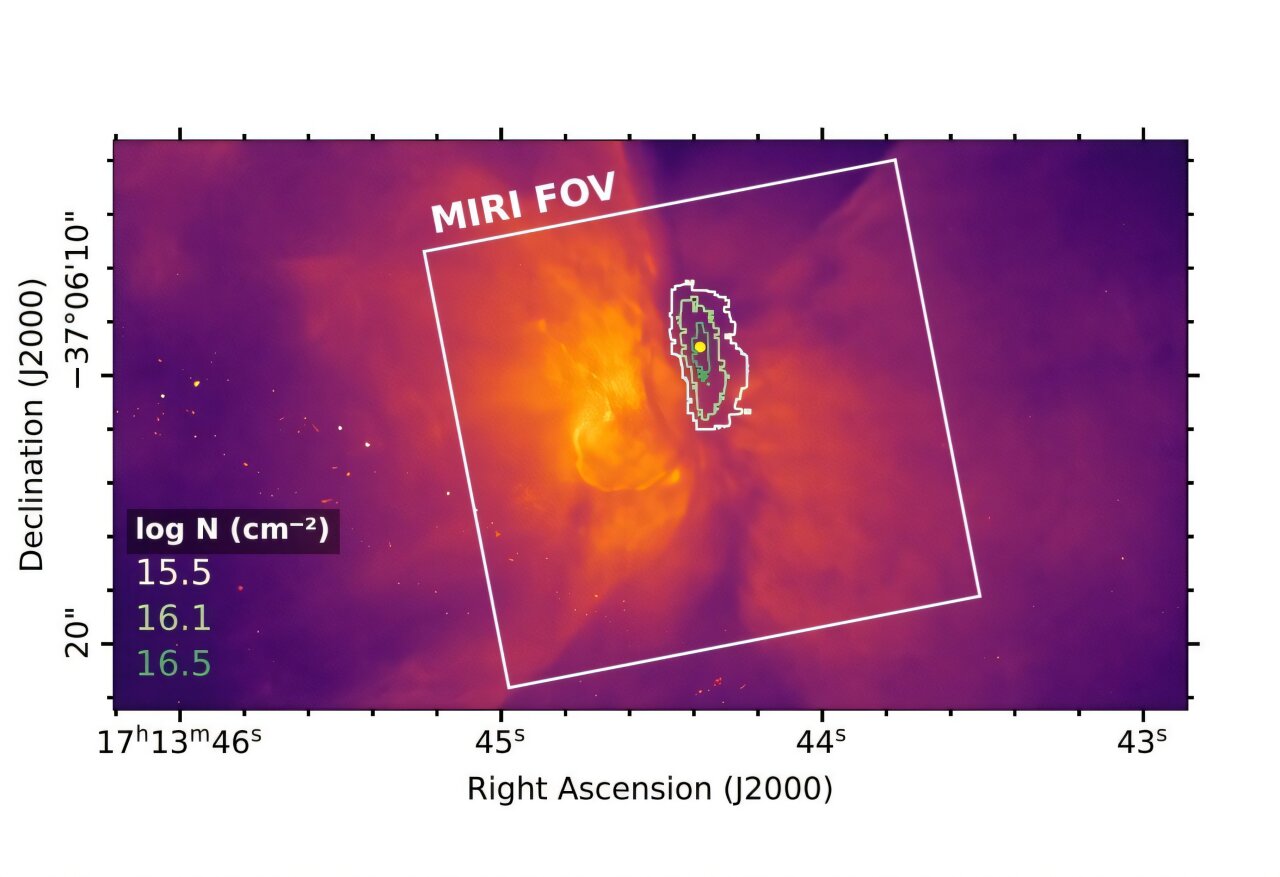
Yet, NGC 6302 is no ordinary graveyard. It is a bipolar nebula, meaning its materials have been funneled into two massive, glowing lobes that stretch out like wings for at least 1.5 light years. At the very center of this butterfly, bisecting the wings, lies a massive, shadowed dusty torus. This donut-shaped ring of debris acts as a shield, creating a pocket of mystery where the rules of deep space chemistry seem to change. It was here that a team of astronomers, led by Charmi Bhatt of the University of Western Ontario, decided to point the world’s most powerful infrared eye.
Peering Through the Infrared Veil
The team utilized the Mid-Infrared Instrument (MIRI) aboard the JWST to peer through the thick curtains of dust that usually hide the nebula’s inner workings. By using the Medium-Resolution Spectrometer (MRS), they were able to break down the light coming from the central star, the torus, and the innermost regions of the bipolar lobes. They weren’t just looking for a picture; they were looking for a chemical fingerprint.
As the data flowed back to Earth, a specific pattern emerged in the light spectrum. The researchers noticed clear absorption features in the 14.8–15.2 µm range. This was the unmistakable signature of gas-phase carbon dioxide. But as they looked closer at the dusty torus, the fingerprints became more complex. They identified a shallow, broad dip in light between 14.9–15.15 µm, followed by another distinct signature between 15.2–15.3 µm. These were not the signs of gas, but the physical evidence of carbon dioxide ice—solid, frozen “dry ice” clinging to the dust grains in the heart of a stellar explosion.
The Impossible Chemistry of the Butterfly
The presence of dry ice is a landmark find because it is significantly more volatile than water ice. While water ice is common in the universe, it takes much colder, more protected environments to allow carbon dioxide to freeze and remain stable. Until now, such molecular ices were thought to belong only to the “nurseries” of the universe—the dense molecular clouds, the envelopes surrounding young stellar objects (YSOs), and the protoplanetary disks where new worlds are born.
Finding this ice in the “retirement home” of a dying star suggests that planetary nebulae are far more chemically sophisticated than previously believed. This follows earlier hints of complexity within the Butterfly Nebula, such as the detection of methyl cation (CH3+), a vital ingredient that drives organic chemistry, and a widespread presence of polycyclic aromatic hydrocarbons (PAHs). The environment of NGC 6302 is proving to be a rich, swirling soup of ingredients that could, in theory, seed the interstellar medium (ISM) with the building blocks of future solar systems.
A Different Kind of Frost
One of the most intriguing aspects of the study, published on the arXiv pre-print server, is that the gas-to-ice ratio in the Butterfly Nebula looks nothing like what astronomers see in younger star systems. In young stellar objects, the balance between gas and frozen solids follows a predictable path. In NGC 6302, however, the ratio is markedly different. This discrepancy tells the team that the ice formation or the way the ice is processed in an evolved stellar environment follows a unique set of rules.
It appears that the dusty torus of the nebula provides a “cold, shielded environment” that mimics the conditions of deep space clouds, even while the central star nearby is screaming with energy. The ice may be forming through distinct mechanisms that only occur at the end of a star’s life cycle. This realization forces a shift in how we view the lifecycle of matter in the cosmos. Rather than just being a period of destruction, the death of a star like the one in NGC 6302 is a period of intense chemical synthesis.
Why the Frozen Butterfly Matters
This research is a pivotal chapter in our understanding of the interstellar medium. The discovery of carbon dioxide ice in a planetary nebula—the first time any ice more volatile than water has been found in such a place—proves that these expanding shells of gas are essential contributors to the chemical diversity of the galaxy. If dry ice can survive the transition from a star to a nebula, it means the materials required for complex chemistry are much hardier than we imagined.
However, the discovery also raises new questions. Astronomers now emphasize the need for even higher spatial resolution observations to determine if this ice chemistry is a common feature in all dense planetary nebula tori or if the Butterfly is a unique outlier. By constraining the chemical pathways, temperature structures, and ice processing mechanisms of these nebulae, scientists can better understand how the elements of life are recycled through the stars. We are learning that the end of a star’s life is not merely an exit, but a transformation that leaves behind a frozen, fertile legacy for the next generation of the cosmos.
Study Details
Charmi Bhatt et al, Detection of CO2 ice in the planetary nebula NGC 6302, arXiv (2026). DOI: 10.48550/arxiv.2602.22366