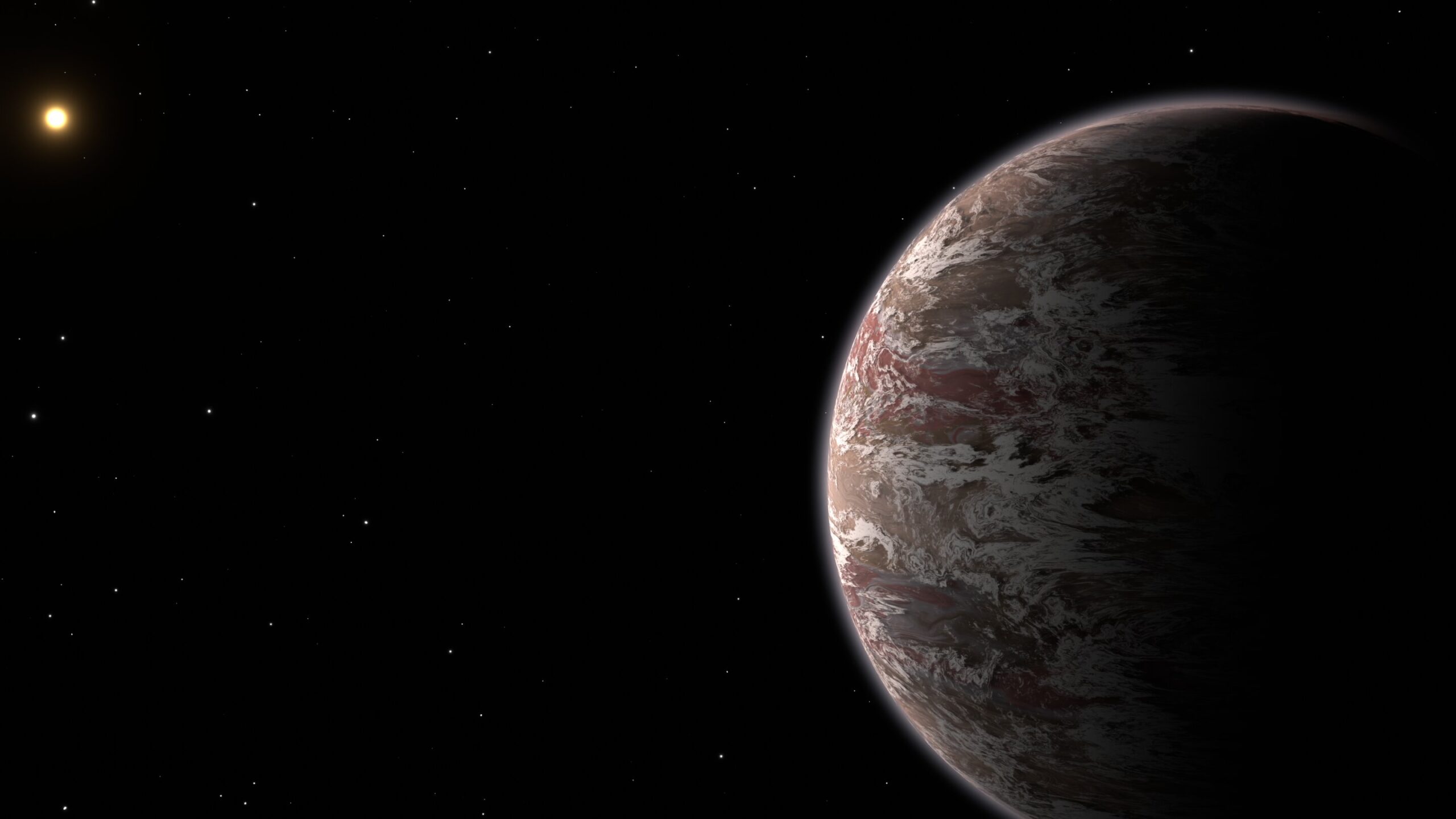
A team of astronomers using the James Webb Space Telescope has identified surprising evidence of thick water-ice clouds within the atmosphere of Epsilon Indi Ab, the closest known super-Jupiter. The study reveals that while the planet contains ammonia as predicted, the presence of these reflective clouds challenges existing atmospheric models and provides a critical stepping stone toward characterizing Earth-like worlds.
Imagine standing several light-years away and looking back at our own solar system. Until very recently, even our most powerful technology would have struggled to see Jupiter as anything more than a mathematical blip. Today, that boundary has been crossed. Astronomers have finally managed to look at a distant “solar system analog” with enough clarity to see not just the planet itself, but the complex, shifting weather patterns of a cold gas giant that sits just 12 light-years from Earth.
A New Era in the Search for Second Earths
The discovery, led by Elisabeth Matthews of the Max Planck Institute for Astronomy (MPIA), marks a pivotal shift in exoplanet science. For nearly three decades, from 1995 to 2022, the field was defined by the hunt for existence—simply proving other planets were out there using indirect methods to calculate mass and diameter. The arrival of the James Webb Space Telescope (JWST) in 2022 moved the goalposts into a second stage: the detailed reconstruction of alien atmospheres.
While the ultimate ambition remains the detection of life on an Earth-analog, researchers must first master the art of observing colder, more distant gas giants. Most gas giants studied to date are “hot Jupiters” that orbit dangerously close to their stars. Epsilon Indi Ab is different. It is a “cold” planet, orbiting its star at roughly four times the distance between Jupiter and our sun. This makes it the closest analog to our own Jupiter ever imaged, providing a laboratory for testing the techniques that will one day find a second Earth.
Measuring a Super-Jupiter
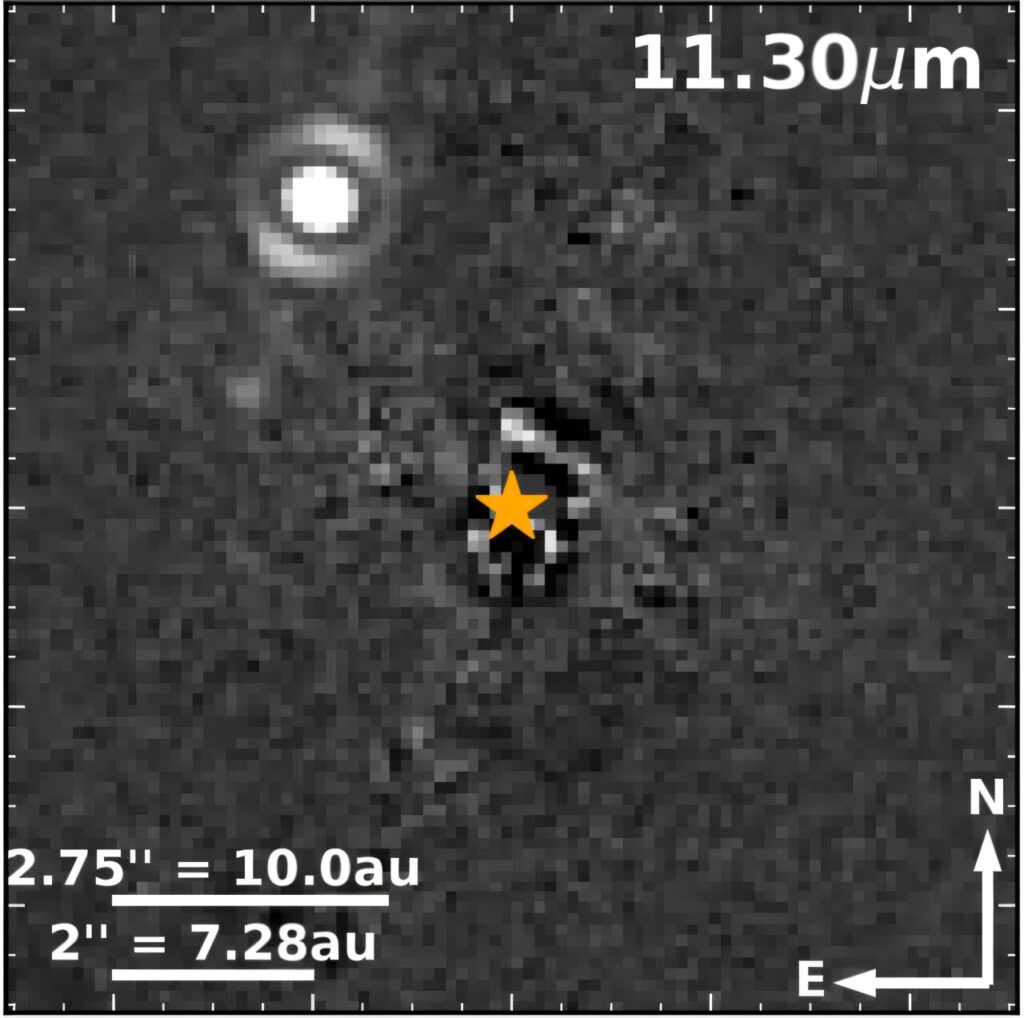
To see the planet, the team used the Mid-Infrared Instrument (MIRI) on the JWST. Because the star, Epsilon Indi A, is so bright it would normally wash out everything around it, the researchers used a coronagraph to physically block the starlight. This allowed the much dimmer glow of the planet to become visible.
Through these observations, the team was able to refine the physical profile of this distant world. Despite having a diameter roughly equal to our Jupiter, Epsilon Indi Ab is far denser, with a mass calculated at 7.6 Jupiter masses. Its temperature is another point of distinction. While our Jupiter sits at a frigid 140 Kelvin, this super-Jupiter is slightly warmer, ranging between 200 and 300 Kelvin (-70 to +20 degrees Celsius). This extra warmth is a lingering “thermal memory” from the heat generated during the planet’s formation billions of years ago.
The Mystery of the Missing Ammonia
The most significant finding came when the team analyzed the planet’s chemical makeup. Based on its temperature and mass, theoretical models suggested the atmosphere should be saturated with ammonia gas (NH3). To test this, the astronomers used a specific 11.3 μm filter to capture images just outside the wavelength where ammonia typically absorbs light.
By comparing these new images with data taken earlier in 2024 at the 10.6 μm wavelength, they could measure the ammonia’s “fingerprint.” To their surprise, they found a deficit. There was less ammonia visible than the most advanced simulations predicted. This discrepancy forced the team to look for a physical feature that could be “hiding” the gas from the telescope’s view.
The most likely culprit? Thick but patchy water-ice clouds. Much like the high-altitude cirrus clouds found in Earth’s atmosphere, these frozen water particles are thought to be suspended in the upper layers of Epsilon Indi Ab, obstructing the view of the gases beneath them.
Challenging the Status Quo of Planetary Models
The discovery of these clouds exposes a major gap in current astronomical theory. Most published models used to interpret exoplanet data omit clouds entirely because the math required to simulate them is incredibly complex. The presence of water-ice on Epsilon Indi Ab proves that “clear sky” models are no longer sufficient for understanding cold, Jupiter-like worlds.
According to co-author James Mang of the University of Texas at Austin, this “problem” is actually a sign of success. The fact that the JWST can detect such nuances means humanity is finally probing the true structural complexity of distant atmospheres. These findings are already being used to improve the simulations that theorists use to predict what alien weather looks like.
Why This Matters
The identification of water-ice clouds on a super-Jupiter is more than just a weather report from a distant world; it is a vital stress test for the future of space exploration. By learning to account for the “interference” caused by clouds on large gas giants, astronomers are refining the high-contrast imaging techniques necessary to eventually see through the atmospheres of much smaller, rocky planets.
Furthermore, the timing of this discovery aligns with the next generation of hardware. NASA’s Nancy Grace Roman Space Telescope, scheduled for launch in 2026–2027, will be uniquely equipped to observe the light reflected directly off these water-ice clouds. As researchers like Matthews continue to target more cold Jupiter-analogs, they are effectively building the instruction manual for the telescopes of the 2030s and 2040s, which will carry the specific task of searching for the chemical signatures of life.
Study Details
Elisabeth C. Matthews et al, A Second Visit to Eps Ind Ab with JWST: New Photometry Confirms Ammonia and Suggests Thick Clouds in the Exoplanet Atmosphere of the Closest Super-Jupiter, The Astrophysical Journal Letters (2026). DOI: 10.3847/2041-8213/ae5823