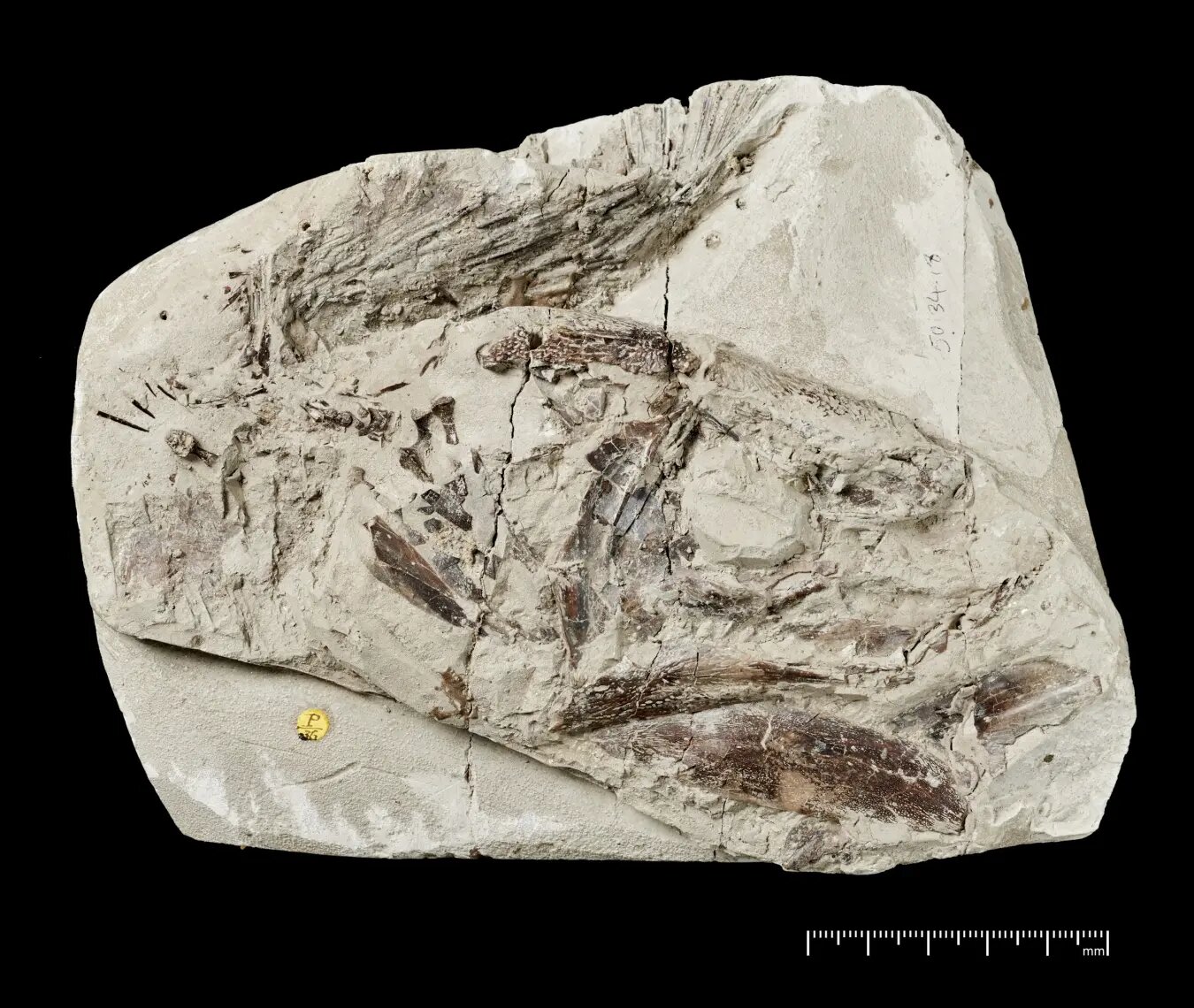
Researchers have identified a new species of coelacanth, Macropoma gombessae, from a 150-year-old fossil that had been stored at London’s Natural History Museum since the 19th century. This discovery fills a critical 50-million-year void in the fossil record of the Latimeriidae family, providing a long-sought evolutionary link between ancient ancestors and the modern “living fossils” that still inhabit our oceans today.
For more than a century, a stony relic sat quietly in the archives of the Natural History Museum in London, its true identity masked by the limitations of 19th-century science. While the specimen was collected generations ago, it took a curious paleontology student and the power of 21st-century imaging to realize that this dusty artifact was actually a “missing chapter” in the history of one of Earth’s most mysterious creatures. The coelacanth is often called a living fossil because it has remained remarkably unchanged for hundreds of millions of years, surviving even the cataclysmic extinction event that wiped out the dinosaurs. Yet, despite their fame, the path they took to reach their modern form has been riddled with massive chronological gaps that have frustrated scientists for decades.
A Discovery in the Museum Vaults
The breakthrough began when Jack L. Norton, then a student at the University of Portsmouth, decided to re-examine the ancient specimen housed in the London collection. The fossil originated from the Lower Cretaceous Gault Formation of southern England, a geological layer known for its marine deposits. By applying modern scrutiny to this old find, Norton and his supervisor, Dr. Samuel Cooper, realized they were looking at a previously unknown species belonging to the Latimeriidae family. This specific family is of immense interest to biologists because it contains the direct ancestors of the coelacanths found in deep-sea environments today.
Identifying this specimen as a distinct species has immediate and profound implications for the timeline of vertebrate evolution. Specifically, it bridges a 50-million-year gap in the fossil record. Before this discovery, there was a significant “black hole” in our understanding of how these fish transitioned through the Cretaceous period. By pinpointing this new species, researchers can now trace the morphological continuity of the lineage with much greater precision, seeing exactly how the family maintained its form over deep time while other species around them were undergoing radical transformations or disappearing entirely.
Leveraging Advanced Imaging Technology
The reason this fossil remained unrecognized for 150 years is largely due to the physical constraints of traditional paleontology. For over a century, scientists could only observe what was visible on the surface of the rock. However, the team utilized X-ray computed tomography (XCT), a high-resolution scanning technique that allowed them to peer inside the stone without damaging the fragile bones. This technology provided the researchers with the ability to manipulate the specimen in 3D, revealing internal structures that were previously invisible to the naked eye.
This non-invasive digital dissection transformed the way the team interacted with the antiquity. Being able to rotate, slice, and zoom into the skeletal framework of a fish that lived millions of years ago allowed for a level of anatomical detail that was simply impossible for the Victorian-era collectors who first found it. The study, which has now been published in the journal Papers in Palaeontology, serves as a testament to how digital tools are breathing new life into old collections. As technology improves, the “scientific potential” of museum archives continues to expand, proving that a discovery doesn’t always require a new trek into the field; sometimes, it just requires a new way of looking at what we already have.
Honoring Tradition and Local Knowledge
The naming of the new species, Macropoma gombessae, carries a unique cultural significance that connects modern science with traditional history. The specific epithet honors “Gombessa,” a name used for the living coelacanth by Malagasy communities and fishers in the Comoros. Historically, the term roughly translates to “inedible fish” or “worthless fish.” This name reflected the local perspective of the animal as a creature of little utility before the global scientific community recognized its status as an evolutionary icon.
By choosing this name, the researchers have acknowledged the long-standing relationship between local people and the fish that science only “discovered” relatively recently. It highlights a shift in perspective, where an animal once deemed of no value is now seen as one of the most important biological treasures on the planet. This blend of traditional nomenclature and formal taxonomy serves to ground the high-tech discovery in the real-world history of the regions where these “living fossils” are still found.
Why This Matters
This discovery is a powerful reminder that the story of life on Earth is far from fully written. The identification of Macropoma gombessae proves that museum collections are not static graveyards of the past, but active frontiers for future research. By filling a 50-million-year evolutionary void, this find provides scientists with the data needed to understand how certain lineages achieve such incredible stability over millions of years. It offers a rare look at a survivor, a species that managed to navigate the turbulent waters of the Lower Cretaceous and maintain a blueprint that still works in the modern era.
Furthermore, the success of an early-career researcher like Jack L. Norton underscores the importance of the next generation of scientists. It shows that fresh eyes combined with new technology can overturn century-old assumptions. As museums continue to hold these specimens in trust for society, they remain vital laboratories where the mysteries of extinction and survival are waiting to be decoded. The fact that an “important specimen” could hide in plain sight for 150 years suggests that many more missing pieces of the evolutionary puzzle are likely sitting on shelves right now, just waiting for the right technology to reveal their secrets.
Study Details
Jack L. Norton et al, Oldest Cretaceous latimeriid elucidates cranial evolution in derived and extant coelacanths (Actinistia, Latimeriidae), Papers in Palaeontology (2026). DOI: 10.1002/spp2.70076